
How AI-Powered Traffic Enforcement Is Changing the Engineering of Vehicle Registration Plates

Traffic cameras have stopped being passive observers. Today, they read, analyse, process, and act on vehicle data in real time, all within milliseconds. And here is the uncomfortable truth most vehicle owners do not realise: the quality of your vehicle registration plate directly determines whether the AI system can do its job properly.


India’s roads carry over 413 million registered vehicles as of 2025-26, according to the Ministry of Road Transport and Highways. Every single one of those vehicles interacts with an expanding network of AI-powered traffic enforcement cameras daily. The margin for error? Practically zero.


A poorly manufactured plate does not just look bad. It actively breaks automated enforcement systems, creates false negatives in toll networks, and weakens law enforcement databases. The stakes have never been higher for plate engineering.


This article explores exactly how artificial intelligence is reshaping the science behind vehicle registration plates, why manufacturing precision has become a national infrastructure concern, and what the best HSRP manufacturer standards look like in 2026. Read on, because the details will genuinely surprise you.


Why AI Traffic Enforcement Has Raised the Bar for Plate Engineering

The relationship between artificial intelligence and vehicle registration plates has fundamentally changed how plates are engineered, manufactured, and evaluated. AI enforcement systems no longer treat a registration plate as a simple visual label. They treat it as a structured data source that must perform with machine-grade consistency across thousands of enforcement interactions every single day. Understanding how this shift occurred helps explain why manufacturing standards have become so critical in 2026.


How AI Traffic Enforcement Systems Process Registration Plate Data

AI traffic enforcement systems use automatic number plate recognition (ANPR) technology, which combines high-resolution imaging, computer vision algorithms, and deep learning optical character recognition (OCR) to extract vehicle identity data in real time. The camera captures the frame. An AI algorithm isolates the plate region. The OCR engine reads each character. The system then cross-references that data against national vehicle databases within fractions of a second.


Traffic management has emerged as the leading application segment, capturing approximately 43% of the global ANPR market share in 2026, driven by intensifying urban congestion and government mandates for intelligent transportation systems. That figure tells a clear story: AI enforcement is now mainstream infrastructure, not experimental technology.


The ANPR System market was valued at USD 3.17 billion in 2023 and is expected to reach USD 6.96 billion by 2032, growing at a CAGR of 9.15% over the forecast period. This explosive growth means more cameras, more enforcement touchpoints, and significantly higher demands on every plate that enters the system. So, the question worth asking is this: does your vehicle’s registration plate actually meet the technical demands of the AI systems now operating across India’s roads? The answer depends entirely on how that plate was manufactured.


The critical insight here is this: AI systems do not tolerate plate imperfections. They demand consistency, precision, and standardisation at every level of plate engineering. And that is precisely where the best HSRP manufacturers become central players in national mobility infrastructure.


The Plate Engineering Variables That AI Systems Depend On

Registration plate engineering has always involved material science, dimensional standards, and visual legibility requirements. However, the rise of AI enforcement systems has introduced an entirely new dimension: machine readability under real-world operational conditions. Several specific engineering variables now determine whether a plate functions as a reliable AI data source or becomes a liability within automated enforcement networks. Each of these variables demands precision that only advanced manufacturing systems can consistently deliver.


Reflectivity and Light Return Performance

Retroreflective sheeting technology is the single most important physical characteristic that determines whether an AI camera reads a plate successfully. Retroreflective sheeting reflects light directly back toward its source, which in enforcement scenarios means the camera captures a bright, high-contrast plate image even under poor lighting conditions. This is not a cosmetic feature. It is an engineering specification that directly controls AI recognition performance.


Studies from large-scale intelligent transportation system deployments show retroreflective plates can improve capture rates by over 30% in low-light conditions. That is not a marginal improvement. A 30% gain in nighttime capture rates means thousands of additional enforcement events processed accurately every single night across a city-wide camera network.


Standardised reflective sheeting with luminance values greater than 300 cd/lx/m² has been required by governments in 48 countries, increasing nighttime visibility by 36%. India’s HSRP specification aligns with these global standards, requiring Grade A retro-reflective sheeting that ensures visibility from a minimum of 200 meters. Plates that deviate from this specification fail AI camera reads at exactly the moments when enforcement matters most: at night, in rain, and at high vehicle speeds. This is why reflective license plate technology is a non-negotiable manufacturing benchmark, not an optional quality upgrade.


Character Geometry, Font Consistency, and OCR Accuracy

The geometric precision of characters embossed or laser-coded onto a vehicle registration plate directly determines how accurately an AI recognition engine reads the plate. This is one of the most technically demanding aspects of modern HSRP manufacturing, and one of the most commonly underestimated by non-specialists.


OCR-based recognition engines are trained on standardised character shapes, stroke widths, and spacing ratios. Plates that deviate from these parameters, even slightly, introduce recognition errors that compound rapidly at scale. Industry benchmarks show well-standardised plates push ANPR accuracy above 95% in controlled environments. Poor-quality plates can drop accuracy below 70%, triggering false negatives and missed enforcement events.


Consider what a 25% accuracy drop means across a city with 7,500 ANPR cameras. Thousands of enforcement events get missed daily. Stolen vehicles pass undetected. Toll evasion goes unrecorded. Traffic violation databases become unreliable. The public safety consequences of poor plate character geometry are significant and direct. It raises a serious question about the national standard of plate manufacturing: if non-compliant plates are entering AI enforcement networks, how much enforcement data are authorities actually missing?


Embossing consistency matters here too. Laser-etched alphanumeric codes now cover 94% of newly issued HSRPs, reducing duplication risks by 57% versus embossed formats. Precision laser coding ensures that character dimensions remain stable over the plate’s operational lifetime, unlike hand-embossed characters that wear unevenly and lose OCR clarity over time.


Plate Positioning, Dimensional Accuracy, and Camera Framing

AI camera systems operate with fixed framing parameters calibrated for standard plate dimensions. Plates that fall outside standard dimensional tolerances create framing mismatches that force recognition algorithms to compensate, reducing accuracy and processing speed simultaneously. This is a systemic problem when non-standardised plates enter large-scale enforcement networks.


Dimensional accuracy in HSRP manufacturing is therefore not just a compliance formality. It is a functional prerequisite for AI enforcement compatibility. Embossing accuracy exceeds 99.4% per batch of 100,000 units in top-tier HSRP manufacturing operations, a benchmark that ensures dimensional consistency at industrial scale. Achieving this level of accuracy consistently requires automated production infrastructure and AI-assisted inspection systems operating in real time throughout the manufacturing process.


Celex Technologies Pvt. Ltd. manufactures plates with uniform reflectivity and laser precision, maintaining dimensional accuracy across a production capacity of 4 million plates per month. Every plate leaving their facility meets the engineering specifications that modern AI-enabled traffic infrastructure requires, making them one of the most technically credible HSRP manufacturing operations in the country.


India’s ANPR Expansion and the Growing Infrastructure Demand

India’s investment in intelligent traffic enforcement infrastructure has accelerated dramatically through 2025 and into 2026. States are deploying ANPR networks at scale, smart cities are integrating AI surveillance into core transportation management systems, and the national government is rolling out multi-lane free-flow tolling infrastructure that will transform highway travel. All of this expansion creates a growing and urgent dependency on registration plates that perform reliably within AI recognition frameworks at every point in the network.


ANPR Deployment Across Indian Cities in 2026

The scale of India’s ANPR deployment in 2026 is genuinely impressive. Delhi has over 7,500 ANPR cameras installed across the city for traffic enforcement, stolen vehicle detection, and pollution monitoring. Bengaluru’s Intelligent Traffic Management System uses ANPR for automated challan generation. Hyderabad’s integrated ANPR network covers major intersections and highway corridors. Ahmedabad’s Smart City project includes ANPR at 200+ intersections.


India’s Smart Cities Mission aims to deploy over 10,000 ANPR units by 2026, with significant backing from state and municipal budgets. This expansion creates an enormous infrastructure dependency on plates that perform reliably within AI recognition frameworks. Every camera added to the network increases the volume of plate reads happening daily, and every plate read is only as accurate as the plate being read.


Now consider the quality question from the other direction. If a poorly manufactured plate enters a city with 7,500 ANPR cameras, it does not create one recognition failure. It creates a recognition failure every single time that vehicle passes a camera, across the entire lifetime of that plate. The cumulative impact on enforcement data quality is significant and completely preventable through proper manufacturing standards.


Multi-Lane Free-Flow Tolling and the Speed Requirement

The Ministry of Road Transport and Highways has announced a nationwide rollout of a multi-lane free-flow tolling system powered by AI, satellite integration, and ANPR cameras, allowing vehicles to pass through toll points without stopping. For vehicles travelling at up to 80 km/h, the AI tolling system automatically computes and deducts toll charges using FASTag data, satellite monitoring, and ANPR camera recognition.


This is a transformational development for HSRP manufacturing standards. Multi-lane free-flow tolling at 80 km/h requires plates that maintain full retroreflective performance, dimensional accuracy, and OCR-compatible character geometry at highway speeds. Plates that fail this test do not just create inconvenience. They break automated toll collection entirely, forcing manual intervention that defeats the purpose of the system completely.


As of 2026, over 40 smart cities have either deployed or tendered for ANPR-based traffic systems, with 99%+ accuracy demanded in real-world conditions across day/night, rain, and high-speed scenarios. A 99% accuracy standard is only achievable when the plates feeding the system meet equally rigorous manufacturing precision standards. This is the direct link between best HSRP manufacturer credentials and national enforcement infrastructure performance.


Anti-Counterfeit Engineering and Its Role in AI Enforcement Integrity

Physical plate security and digital enforcement integrity are not separate concerns. They are directly connected through a chain of identity that begins at the manufacturing facility and ends at the enforcement database. Counterfeit or cloned plates break this chain in ways that corrupt AI enforcement systems far beyond the immediate incident, creating cascading data integrity problems across tolling, law enforcement, and insurance networks. This is why anti-counterfeit engineering has become a core component of AI-compatible plate manufacturing, not merely a security add-on.


How Cloned Plates Corrupt AI Enforcement Systems

Cloned or duplicate registration plates create data corruption within AI enforcement databases. An ANPR camera reads a cloned plate and records an enforcement event against the legitimate vehicle owner, not the criminal. The legitimate owner receives challan notices for violations they did not commit. Enforcement databases fill with false associations. Insurance and legal systems downstream inherit corrupted identity data. The entire value of AI-powered enforcement depends on the integrity of the physical plate feeding data into it.


Tamper-proof locking mechanisms achieved 98% compliance in regulated tenders, compared to 81% in 2018. This improvement reflects the growing recognition that physical anti-counterfeit engineering is inseparable from digital enforcement integrity. The two must be engineered together, not treated as separate disciplines.


Chromium holograms embedded in HSRPs provide an immediate visual authentication layer. Laser-etched permanent identification numbers create a cryptographically unique physical fingerprint that cannot be replicated without industrial-grade equipment. Tamper-proof snap lock systems prevent silent plate substitution between vehicles, maintaining the physical integrity of the identity chain from manufacturing to road deployment. These features do not just protect individual vehicle owners. They protect the accuracy of every AI enforcement system that reads those plates.


Celex Technologies Pvt. Ltd. and Multi-Layered Security Manufacturing 

Celex Technologies Pvt. Ltd. has manufactured over 6.10+ crore HSRPs incorporating these multi-layered security features. Their plates integrate chromium holograms, Grade A retroreflective sheeting, laser-coded unique identifiers, and snap-lock mechanisms into a single engineered assembly that supports both physical security and AI recognition system performance simultaneously.


The manufacturing discipline required to deliver these security features consistently at scale is substantial. Every chromium hologram must bond correctly. Every laser code must be precisely inscribed. Every snap lock must function as designed. At 40 lakh plates per month, maintaining this consistency requires AI-assisted production monitoring and automated quality inspection systems operating at every stage of the manufacturing process. This is exactly the kind of manufacturing excellence that the best HSRP manufacturers build their operational infrastructure around.


How the Best HSRP Manufacturers Support AI-Ready Plate Engineering 

Not every HSRP manufacturer is equally equipped to support India’s expanding AI enforcement ecosystem. The gap between compliant manufacturers and truly AI-ready manufacturers is significant, spanning manufacturing precision, certification infrastructure, digital integration capability, and industrial-scale production consistency. Understanding what separates the best from the rest matters enormously for transport authorities, automotive OEMs, and anyone responsible for selecting a manufacturing partner within India’s evolving intelligent mobility infrastructure.


Manufacturing Precision at Industrial Scale

AI-compatible plate engineering demands production consistency that ordinary manufacturing environments cannot achieve. Reflectivity must remain uniform across every unit in a production batch. Character embossing must maintain dimensional accuracy across millions of plates manufactured monthly. Laser coding must produce identifiers with zero character deviation across the entire production run. These are not aspirational standards. They are operational requirements for plates entering AI enforcement networks.


Automated plate manufacturing lines have increased output efficiency by 41%, lowering defect rates to below 1.8% per 10,000 units. This level of defect control requires AI-assisted quality inspection systems operating continuously alongside production lines, scanning every plate for reflectivity deviation, dimensional inconsistency, and laser code accuracy before dispatch.


Celex Technologies Pvt. Ltd. operates with a manufacturing capacity of 4 million plates per month and embossing 50,000 plates per day across 267 cities. This industrial scale is matched by precision quality systems that maintain AI enforcement compatibility across every plate leaving their facility. Their 23+ years of manufacturing experience and a turnover exceeding ₹110 crore reflect the operational maturity and scale that AI-ready plate manufacturing genuinely demands.


Certification Infrastructure and Compliance Standards 

Government-approved manufacturers hold certifications that validate not just their product quality but also their manufacturing processes, information security systems, and production consistency protocols. Type Approval Certificates (TAC) from accredited testing agencies confirm that a manufacturer’s entire production system meets national HSRP technical specifications. ISO 9001:2015 quality management certification validates production process consistency. ISO/IEC 27001, ISO/IEC 20000-1, and TISAX information security certification protect the digital identity data linked to every plate manufactured. These certifications are not decorative credentials. They are audited, maintained, and renewed through continuous compliance processes that shape every aspect of how a manufacturer operates.


As the best HSRP manufacturer, Celex Technologies Pvt. Ltd. holds a comprehensive certification portfolio, including at least 25 “Conformity of Production” (CoPs), Type Approval Certificates (TACs), ISO 9001:2015, ISO 14001:2015, ISO/IEC 27001, ISO/IEC 20000-1:2018, TISAX AL2, ISO/IEC 20000-1, and TISAX certification covering high availability and confidentiality standards. This multi-certification infrastructure positions them as one of India’s genuinely future-ready HSRP manufacturers, capable of supporting the national AI enforcement ecosystem with both technical precision and regulatory credibility at the same time.


The Future of Registration Plate Engineering in an AI-Dominated Mobility World

The engineering trajectory of vehicle registration plates points clearly toward greater intelligence, greater connectivity, and greater integration with AI-powered transportation networks. The plates of 2026 already represent a significant leap from the simple metal identifiers of a decade ago. The plates of the next decade will represent an even more dramatic transformation, evolving from passive physical identifiers into active digital components within connected transportation ecosystems. Manufacturers who invest in future-ready engineering capabilities today will define the standards that govern this next chapter.


RFID, Blockchain, and Edge AI Recognition

RFID integration within registration plates will enable passive vehicle identification without line-of-sight camera dependency, supporting underground parking management, border crossing automation, and fleet tracking within logistics corridors. RFID-enabled plate penetration reached 33% in 2024, compared to 19% in 2021, enhancing enforcement efficiency by 42%. This adoption rate signals that RFID-capable plate manufacturing is rapidly moving from emerging technology to operational expectation.


For more than ten years, deep learning for ANPR has been a tool in the enforcement sector’s toolbox, with neural networks continuously increasing read rates. New developments now embed vehicle analytics software directly into cameras, extracting plate, make, model, colour, classification, and speed at the edge with no back-office server required. This edge computing evolution means plates must perform even more consistently, as recognition now happens locally without the correction capabilities of centralised server processing. Every manufacturing imperfection becomes immediately visible within edge AI frameworks.


Blockchain-based verification systems may replace centralised database models with distributed ledger architectures, providing tamper-proof identity records accessible across state and national jurisdictions simultaneously. Smart vehicle identification systems incorporating AI-powered predictive analytics will depend on historically consistent plate data to build accurate vehicle movement models for urban planning and enforcement prioritisation. The plates being manufactured today are already feeding the datasets that these future systems will train on.


Celex Technologies Pvt. Ltd. and India’s Future-Ready HSRP Ecosystem

India’s roads are getting smarter by the day, and your vehicle’s registration plate needs to keep pace. Celex Technologies Pvt. Ltd. brings 23+ years of HSRP manufacturing excellence, a production capacity of 40 lakhs per month, over 6.10+ crore HSRPs supplied, and a network spanning 267 cities across India to every partnership they build.


Whether you are an automotive OEM, a transport authority, or a fleet operator, Celex’s government-approved, multi-certified HSRP manufacturing ecosystem delivers plates engineered for the age of AI enforcement. From retroreflective precision to laser-coded security and VAHAN-integrated traceability, every Celex plate is built to perform where it matters most: on India’s roads, in front of AI cameras, and within the digital governance systems shaping the future of Indian mobility.


Ready to experience AI-ready HSRP manufacturing? Partner with Celex Technologies Pvt. Ltd. today. Visit celex.co.in today and connect with India’s most trusted HSRP manufacturing partner.


Conclusion

The humble vehicle registration plate has quietly become one of the most technically demanding components in India’s national transportation infrastructure. AI-powered traffic enforcement systems have fundamentally changed what a plate needs to do, how it needs to perform, and what engineering standards it must meet to function within automated enforcement networks operating at a national scale.


Retroreflective sheeting, laser-etched identification codes, embossing precision, chromium holographic security layers, and dimensional accuracy are no longer optional quality features. They are functional prerequisites for every plate entering India’s expanding AI enforcement ecosystem. Poor plates do not just fail inspections. They break automated systems, corrupt enforcement databases, and weaken the public safety infrastructure that millions of people depend on daily.


The best HSRP manufacturers understand this responsibility completely. Celex Technologies Pvt. Ltd. has built its 23+ year manufacturing legacy on exactly this foundation: engineering precision, certification excellence, and a commitment to plates that perform reliably within whatever intelligent enforcement infrastructure India builds next. Choosing the right manufacturer is no longer just a procurement decision. It is a decision that directly affects the quality and reliability of India’s national transportation governance systems.


Frequently Asked Questions (FAQs)

1. How does plate reflectivity affect AI traffic enforcement camera accuracy?

Higher retroreflective performance improves camera capture clarity in low-light and high-speed conditions. Studies show retroreflective plates improve ANPR capture rates by over 30% compared to non-reflective alternatives.


2. Why do AI enforcement systems fail to read poor-quality vehicle registration plates?

Poor plates deviate from standardised character geometry, reflectivity, and dimensional specifications that AI OCR engines depend on. Recognition accuracy can drop from 95% to below 70% with non-compliant plates.


3. What makes Celex Technologies Pvt. Ltd. a trusted HSRP manufacturer for AI-compatible plates?

Celex holds multiple certifications, including Conformity of Production (CoPs), Type Approval Certificates (TACs), ISO 9001:2015, TISAX AL2, ISO/IEC 20000-1, and TISAX backed by 23+ years of experience, 6.10+ crore HSRPs supplied, and 40 lakh plates monthly production capacity.


4. How does India’s ANPR expansion in 2026 impact HSRP manufacturing standards?

India’s Smart Cities Mission targets over 10,000 ANPR units by 2026, requiring plates with consistent reflectivity, standardised fonts, and laser-coded identifiers to maintain system-wide enforcement accuracy.


5. What future technologies will further evolve vehicle registration plate engineering?

RFID integration, blockchain-based verification, edge AI recognition, and IoT connectivity will transform plates into active digital identity nodes within connected transportation ecosystems over the next decade.
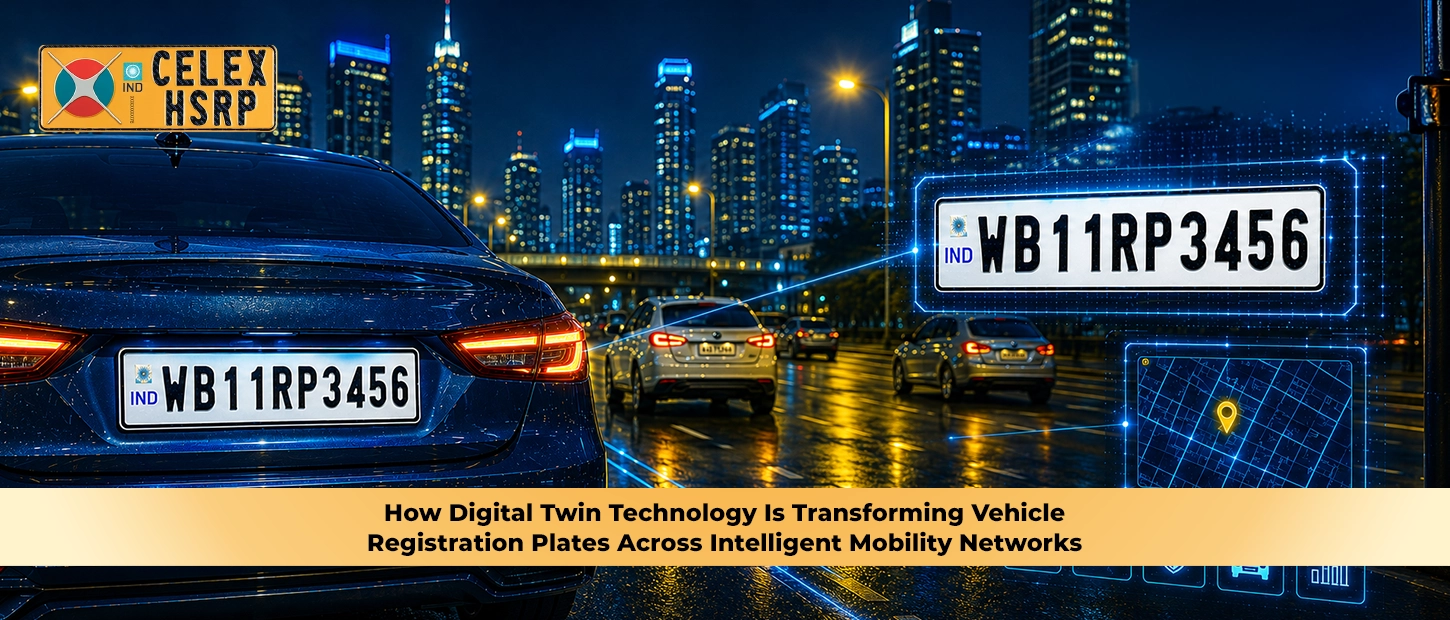
How Digital Twin Technology Is Transforming Vehicle Registration Plates Across Intelligent Mobility Networks

Transport is changing quickly, and most people are unaware of how. Roads are no longer just physical spaces where vehicles move from point A to point B. They are becoming intelligent networks where every vehicle continuously communicates with infrastructure, databases, enforcement systems, and mobility platforms.


This shift is exciting, but it also creates a critical challenge. How do you reliably identify millions of vehicles inside a system that never stops generating data? That is the exact problem digital twin technology is beginning to solve. If your vehicle operates inside a connected mobility ecosystem without a secure and traceable identity, the entire system loses accuracy and trustworthiness.


That is a real operational risk. The good news is that modern vehicle registration plates are stepping up in a big way. Advanced HSRP systems are becoming trusted digital identity gateways that connect physical vehicles with their virtual counterparts. Keep reading to discover exactly how this transformation works and why it matters for the future of transportation.


Introduction to Digital Twin Technology and the Evolution of Vehicle Registration Plates


Let us start with the basics. A digital twin is a virtual replica of a real physical asset. It receives continuous updates from its physical counterpart through sensors, databases, and connected systems.


Engineers originally used digital twins in manufacturing and aerospace. Today, transportation networks are adopting them aggressively to improve safety, efficiency, and visibility across entire mobility ecosystems.


At the same time, vehicle registration plates have gone through a quiet but significant transformation. Traditional plates displayed numbers. That was their entire job. Modern High Security Registration Plates do far more. They carry laser-engraved identification codes, chromium-based holograms, retroreflective sheeting, and tamper-resistant snap lock fasteners. These features make plates harder to duplicate and far easier to authenticate automatically.


Why does this matter for digital twin technology?


Every digital twin needs a reliable identity source. The physical vehicle needs a trusted reference point that connects it to its digital records. That reference point is the registration plate.


As intelligent transportation ecosystems become more sophisticated, the plate is no longer a passive number display. It is an active identity carrier that helps digital systems recognise, authenticate, and track vehicles in real time. This fundamental shift positions registration plates as critical infrastructure within the broader connected vehicle ecosystem.


Understanding the Digital Twin Framework in Intelligent Mobility Networks


Picture a vehicle travelling through a smart city corridor. Traffic cameras capture their movement. Electronic toll systems log their passage. Insurance platforms verify their coverage. Maintenance databases monitor their service history. Regulatory systems check their compliance status. Every single one of these interactions generates data, and all that data feeds into a central digital twin platform that reflects the vehicle’s real-world status continuously.


This framework operates through four interconnected layers. First, you have the physical vehicle itself. Second, data acquisition systems collect information from cameras, sensors, GPS units, and enforcement platforms. Third, a digital twin platform processes and stores that information. Fourth, an identity management infrastructure ensures every data point links to the correct vehicle.


How do vehicle registration plates fit into this framework?


They sit at the heart of the identity management layer. Every database query, every enforcement interaction, every compliance check begins with identifying the vehicle. The registration plate provides that identification. Without a secure and consistent plate identity, the entire data framework loses its reliability. Research into intelligent transportation systems consistently highlights accurate identity management as a non-negotiable requirement for maintaining synchronisation between physical vehicles and their digital replicas. Manufacturers contributing to secure vehicle identification infrastructure are therefore directly supporting the integrity of these connected systems.


Why Vehicle Registration Plates Are Becoming Digital Identity Gateways


This is a pivotal moment in understanding the evolution of vehicle registration plates. Traditionally, a vehicle registration plate was merely a bureaucratic necessity, required for the legal operation of a vehicle. However, this simplistic view has transformed significantly. Today, registration plates have evolved into essential components of a broader digital identity framework, serving functions far beyond mere compliance.


Each registration plate serves as a gateway for digital identities. The moment a vehicle enters a connected transportation network, its plate becomes the key that unlocks an entire ecosystem of digital records. Traffic monitoring platforms retrieve vehicle history. Toll systems process payments automatically. Compliance databases verify insurance and registration validity. Law enforcement platforms confirm ownership and flag anomalies. All of this happens within seconds.


Modern HSRPs support this capability through multiple-layered security features. The laser-branded alphanumeric code provides a unique identifier that automated systems can read reliably. The chromium-based hologram serves as a visual authentication marker. The reflective surface improves recognition accuracy under varying light conditions. The snap lock fastening mechanism makes unauthorised removal immediately visible.


Can a vehicle registration plate genuinely function as a digital identity anchor?


Absolutely. And the evidence is clear across multiple transportation ecosystems globally. Advanced plate systems built to consistent manufacturing standards reduce identity fraud, improve automated recognition rates, and create reliable bridges between physical assets and digital records. This is exactly the kind of infrastructure that future intelligent mobility networks depend on.


Connecting Physical Vehicles with Their Digital Counterparts Through HSRP Systems


Digital twins are only as good as the data that feeds them. Garbage in, garbage out. That principle applies with full force to vehicle identity management.


HSRP systems create reliable connections between physical vehicles and their digital counterparts by establishing persistent unique identifiers at the registration stage. The laser-engraved code on each plate links directly to centralised government databases containing ownership details, chassis numbers, engine specifications, insurance records, and compliance history. Every subsequent interaction throughout the vehicle’s life refers back to that same identifier.


This creates a consistent digital thread running through the entire vehicle lifecycle. Ownership transfers update the digital record. Insurance renewals synchronise automatically. Maintenance activities log against the same profile. Traffic violations are associated with the correct vehicle history. The physical plate and the digital twin remain connected because the identity anchor never changes.


How does this help with fraud prevention?


Significantly. Duplicate plates, cloned identities, and tampered records become far easier to detect because inconsistencies across the synchronised digital ecosystem trigger alerts. The physical security features of the plate add another protective layer by making duplication attempts visible and difficult. Manufacturers investing in precision manufacturing processes and rigorous quality standards are therefore directly contributing to the reliability of vehicle lifecycle management across connected transportation networks.


The Role of Machine-Readable Registration Plates in Intelligent Transportation Ecosystems


Modern transportation networks process enormous volumes of data every single second. Manual identification simply cannot keep pace with this scale. That is where machine readability becomes essential.


Automatic Number Plate Recognition technology now powers a wide range of transportation applications. Smart toll collection processes millions of transactions daily without human intervention. Traffic management centres monitor vehicle flows across entire city networks in real time. Parking systems automate entry and exit based on plate recognition. Vehicles that are flagged or unregistered are immediately flagged by law enforcement platforms.


All of these applications depend on consistent, high-quality registration plates. Poor reflectivity reduces recognition accuracy in low-light conditions. Inconsistent character spacing confuses optical recognition algorithms. Faded or damaged plates generate errors that cascade through dependent systems.


Why does manufacturing quality directly affect transportation system performance?


Because every automated interaction begins with a successful plate read. A failed or inaccurate read corrupts downstream data. When that data feeds into a digital twin platform, the corruption spreads through the vehicle’s entire digital record.


Standardised HSRPs manufactured to precise specifications address this problem directly. Consistent reflective sheeting, standardised fonts, accurate laser engraving, and durable materials maintain recognition performance across years of operational use. India’s HSRP mandate, which requires high security plates across all registered vehicles, was introduced specifically to establish a uniform identification standard that supports modern transportation systems. With over 413 million registered vehicles in India as of 2025, according to the Ministry of Road Transport and Highways, the scale of reliable machine-readable identification required is staggering.


How Digital Twin Technology Enhances Vehicle Traceability and Lifecycle Management


In modern-day transport ecosystems, traceability has emerged as a primary concern. Authorities need to know where vehicles have been, who owns them, and whether they comply with applicable regulations. Insurers need accurate risk profiles. Fleet operators need maintenance visibility. Individual owners need reliable ownership records.


Digital twins address all of these needs simultaneously.


A continuously updated digital replica maintains a complete history of every significant event in a vehicle’s life. Ownership changes, registration renewals, insurance updates, service appointments, traffic incidents, and compliance inspections all feed into the same synchronised profile. The result is an auditable, trustworthy record that serves multiple stakeholders at once.


How do registration plates support vehicle lifecycle traceability?


They act as persistent physical identifiers that anchor every interaction to the correct digital record. The plate does not change when ownership transfers. The core identifier remains stable even as surrounding records evolve. This stability is what makes long-term traceability possible.


Research into Internet of Vehicles ecosystems demonstrates that digital twins combined with intelligent analytics can support predictive maintenance by identifying performance patterns that signal potential failures before they occur. A vehicle with a reliable digital identity benefits from this capability fully. Every data point is associated correctly with its history, making the predictive models more accurate and actionable. Secure manufacturing standards that ensure plate durability and consistent readability across the vehicle’s operational life directly support this long-term traceability objective.


Strengthening Smart Enforcement Through Digital Twin-Enabled Registration Systems


Traditional enforcement relied heavily on manual checks, fragmented databases, and delayed information exchange. Officers pulled over vehicles individually. Database queries took time. Records were sometimes incomplete or outdated. Intelligent mobility networks demand something far more capable.


Digital twin-enabled enforcement changes this entirely. A continuously synchronised digital replica provides authorities with real-time visibility into a vehicle’s status, history, and compliance record. The moment an enforcement system reads a plate, it can retrieve a complete and current profile almost instantly.


How does this improve enforcement outcomes?


Faster identification reduces response times. Accurate records reduce wrongful stops. Predictive analytics help authorities allocate enforcement resources more effectively by identifying high-risk patterns before incidents occur. Automated surveillance systems flag non-compliant vehicles without requiring manual monitoring.


Trusted HSRP systems are essential to this framework. Machine-readable plates with consistent security features allow enforcement platforms to operate at scale across entire transportation networks. Research on transportation digital twins confirms their ability to support real-time monitoring and system-level decision-making across large operational environments. Reliable plate infrastructure is what makes that capability accessible at the ground level.


Data Integrity and Cyber-Physical Security in Digital Vehicle Identity Networks


Connected systems attract attacks. This is not a hypothetical risk. As vehicle identity data becomes increasingly valuable within intelligent mobility ecosystems, it becomes an attractive target for fraud, manipulation, and unauthorised access.


Identity cloning, registration fraud, database manipulation, and vehicle spoofing are real threats that can undermine the reliability of entire transportation networks. A compromised vehicle identity corrupts the digital twin, generates false compliance records, and potentially enables criminal activity.


What security mechanisms protect digital vehicle identity systems?


Several layers work together. Physical tamper resistance in the registration plate prevents unauthorised removal or duplication. Centralised database synchronisation detects inconsistencies across records. Authentication protocols verify identity claims before granting access to sensitive vehicle data.


Research increasingly explores the role of digital twins in automotive cybersecurity, noting that virtual replicas allow organisations to simulate attacks, identify vulnerabilities, and validate defences before real-world incidents occur. Manufacturers who maintain rigorous quality control, comply with regulatory standards, and implement consistent security features in their plates are contributing meaningfully to the cyber-physical trust frameworks that connected transportation ecosystems depend on.


How Celex Technologies Pvt Ltd Is Supporting the Future of Digital Vehicle Identity Infrastructure


Among the manufacturers building this foundation, Celex Technologies Pvt Ltd stands out for its focus on precision, compliance, and scalability. The company operates as a dedicated HSRP manufacturer with capabilities spanning design, production, and deployment of high-security registration systems at a national scale.


Celex Technologies Pvt Ltd brings several critical strengths to this space. Its manufacturing processes meet stringent regulatory specifications, ensuring that every plate delivers consistent reflectivity, accurate laser engraving, and reliable security features. This consistency directly supports automated recognition systems and digital twin data integrity across large transportation networks.


The company’s nationwide operational reach means it can serve diverse geographic markets while maintaining uniform quality standards. As India continues expanding its connected transportation infrastructure across metropolitan corridors and regional networks alike, this scalability becomes increasingly important.


Why does manufacturing expertise matter so much in digital vehicle identity infrastructure?


Because the physical plate is the foundation of every digital interaction. No software platform, no enforcement system, no digital twin can function reliably if the identity anchor at the physical layer is inconsistent or insecure. Celex Technologies Pvt Ltd’s commitment to manufacturing excellence positions it as a key contributor to India’s evolving intelligent mobility infrastructure and the broader vision of synchronised physical and digital transportation ecosystems.


The Future of Vehicle Registration Plates in Fully Connected Mobility Ecosystems


Transportation is heading somewhere genuinely transformative. Autonomous vehicles, AI-powered traffic management, smart city ecosystems, predictive governance frameworks, and seamlessly connected mobility networks are no longer distant concepts. They are active development priorities across governments and technology organisations worldwide.


Inside these future ecosystems, vehicle registration plates will play a more strategic role than ever before. They will serve as primary identity anchors connecting physical vehicles with AI systems, infrastructure networks, insurance platforms, regulatory frameworks, and digital twin environments simultaneously.


Future applications may include real-time identity verification for autonomous vehicle authorisation, seamless cross-border mobility management, dynamic insurance models based on verified operational data, and predictive governance systems that identify compliance risks before they materialise.


Will registration plates remain relevant as transportation becomes increasingly automated?


Without a question. Every intelligent system requires a trusted identity layer. The more automated and interconnected transportation becomes, the more important reliable vehicle identification becomes. The best HSRP manufacturers, like Celex Technologies Pvt Ltd, building secure, machine-compatible, and durable registration systems today, are laying the foundation for tomorrow’s mobility infrastructure.


The future of intelligent transportation depends on seamless synchronisation between physical assets and digital environments, and advanced HSRP systems will remain central to achieving that synchronisation.


Conclusion


Digital twin technology is fundamentally reshaping how transportation systems understand and manage vehicles. A vehicle is no longer just a physical object on a road. It exists simultaneously as a physical asset and a continuously updated digital profile that reflects its condition, compliance status, ownership history, and operational behaviour.


Vehicle registration plates sit at the heart of this transformation. Modern HSRPs have evolved from simple numbering mechanisms into trusted digital identity gateways. They connect physical vehicles with real-time digital records across compliance systems, enforcement platforms, maintenance databases, insurance networks, and intelligent transportation infrastructure. Their role grows more strategic with every advance in connected mobility technology.


Manufacturers who deliver consistent, secure, and machine-compatible registration systems are not simply fulfilling a regulatory requirement. They are actively building the physical identity infrastructure that makes intelligent mobility possible. The synchronisation of physical and digital transportation worlds begins with a reliable identity anchor. That anchor is the vehicle registration plate.


Frequently Asked Questions

1. What is a digital twin in the context of vehicle management?

A digital twin is a virtual replica of a physical vehicle that updates continuously using real-world data. It supports real-time monitoring, maintenance planning, compliance tracking, and ownership verification throughout the vehicle’s operational lifecycle.


2. Why are vehicle registration plates important in digital twin ecosystems?

Registration plates provide a unique physical identity anchor that connects vehicles to their digital records. Without a reliable plate identifier, data synchronisation across connected mobility platforms becomes inaccurate and untrustworthy.


3. How do HSRPs improve vehicle security and fraud prevention?

HSRPs incorporate tamper-resistant fasteners, laser-engraved identifiers, chromium holograms, and reflective sheeting. These features make duplication difficult, support automated authentication, and help detect fraudulent identity claims across transportation systems.


4. Can predictive car maintenance be supported by digital twins?

Yes. Digital twins analyse operational data patterns to identify potential mechanical issues before failures occur. This improves safety, reduces unexpected downtime, and helps vehicle owners and fleet operators plan maintenance more efficiently.


5. How will vehicle registration plates evolve in future autonomous transportation systems?

Future plates will support real-time digital authentication, AI-driven identity verification, cross-network interoperability, and smart city infrastructure integration, making them strategic identity assets within fully connected and autonomous mobility ecosystems.

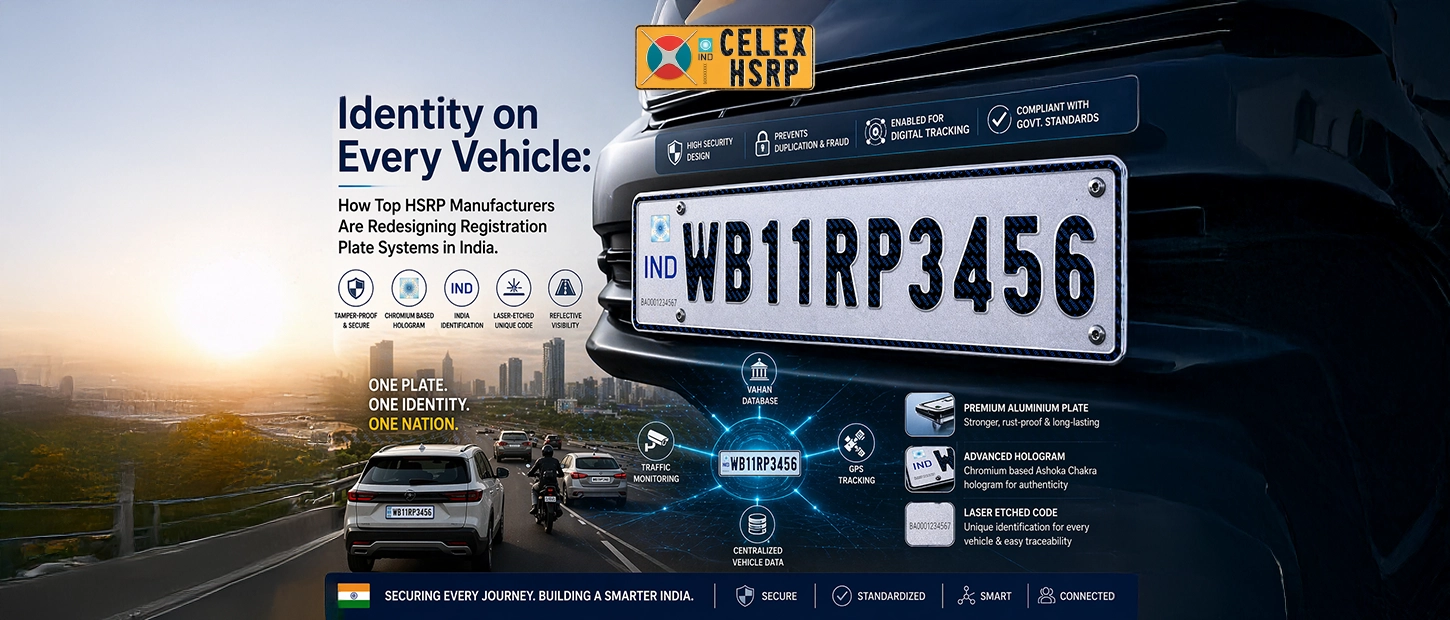
Identity on Every Vehicle: How Top HSRP Manufacturers Are Redesigning Registration Plate Systems in India

Introduction

Picture this. A stolen vehicle cruises through a toll booth. The number plate is fake. The cameras capture it. But the data leads nowhere because the plate was never linked to any real record. Sound familiar? This is exactly the kind of loophole that cost India’s road safety and law enforcement system dearly for years.


Vehicle registration plates were once nothing more than painted boards with letters and numbers. No security. No traceability. No digital backbone. Anyone with basic tools could duplicate them, and many did. The consequences ranged from toll evasion to serious crime, and authorities had very little to fight back with.


Today, that story is changing fast. The rise of the high security registration plate system has turned a simple plate into a powerful identity instrument. This article walks you through the entire transformation, the technology, the regulations, the manufacturers driving it, and why it matters for every vehicle on Indian roads. Stay with us. This is genuinely important.


The Evolution of Vehicle Registration Plates in India: From Basic Identification to Secure Identity Systems

For decades, vehicle registration plates in India were produced without any national standard. Local workshops painted plates by hand. Fonts varied wildly. Materials ranged from cheap acrylic to thin sheet metal. Some plates faded within months. Others were duplicated within hours. The system was broken before it even had a chance to work properly.


The data speaks for itself. India had over 413 million registered vehicles as of 2025-26, according to the Ministry of Road Transport and Highways. Managing the identity of that many vehicles with unverified, non-standardised plates was practically impossible. Enforcement agencies across states struggled to cross-check vehicle records quickly, and criminals exploited every gap in the system.


The shift toward the high-security registration plate system was not a cosmetic upgrade. It was a structural correction. The government mandated standardised plates with embedded security features, centralised database linkage, and strict manufacturing compliance. This moved vehicle registration plates in India from a fragmented, locally managed affair to a centralised, nationally enforceable identity framework. Manufacturers capable of operating at this standard and scale became critical to making this shift real across millions of vehicles.


Regulatory Backbone: CMVR Rule 50 and the Mandate for Standardised Registration Plates

Rules without teeth rarely work. Fortunately, CMVR Rule 50 compliance plates come with very sharp teeth indeed.


CMVR Rule 50, under the Central Motor Vehicles Rules, 1989, lays down precise specifications for every aspect of a vehicle registration plate. It defines the material, the dimensions, the font style, the colour scheme, the reflective properties, and the mandatory security features that every plate must carry. This is not a guideline. It is a legal requirement, and non-compliance attracts penalties under the Motor Vehicles Act.


The Supreme Court of India reinforced this mandate, directing state governments to ensure HSRP implementation across both new and old vehicles. Several states have already made HSRP retrofitting compulsory for older vehicles, with fines ranging from ₹5,000 upward for non- compliance.


Top HSRP number plate manufacturers must calibrate every stage of their production process to these specifications. From the grade of aluminium used to the exact height of embossed characters, nothing is left to interpretation. Manufacturers like Celex Technologies Pvt. Ltd. build their entire production workflow around CMVR Rule 50 requirements, ensuring that every single plate leaving their facility qualifies as a legally valid, nationally standardised identity document. This level of regulatory alignment makes the difference between a plate that looks right and one that actually is right.


Engineering Security: The Technology Embedded in Modern HSRP Plates

Here is where the real engineering marvel begins. Modern high-security registration plates pack an impressive amount of technology into what looks like a simple piece of metal.


The production journey starts the moment an aluminium roll arrives at the manufacturing facility. Instead of using pre-cut sheets, the continuous roll format allows for a steady and high-volume production process that avoids the inconsistencies often found in batch manufacturing. Retroreflective license plate material is then bonded onto the aluminium surface through a fully automated machine-driven process. This ensures uniform adhesion across the entire plate surface with zero gaps and zero misalignment. The reflective properties this material provides are critical for nighttime visibility and for machine-based reading systems.


Hologram hot stamping follows next. Precisely calibrated equipment bonds a chromium-based hologram onto the reflective surface at a molecular level. This process makes tampering visually obvious because any attempt to remove or alter the hologram leaves permanent visible damage. This is an anti-counterfeit registration plate design working exactly as intended.


After that, laser-etched vehicle identification numbers are permanently marked onto each plate using high-precision laser engraving systems. These codes are unique to every plate and link directly to the corresponding vehicle record in the national database. The material is then cut to standardised dimensions as specified under CMVR Rule 50 and sorted according to state-wise destination and demand.


Plates then move to decentralised embossing stations across different states, where alphanumeric characters are raised to precise regulatory heights and hot-stamped with accuracy. At these stations, AI-powered inspection systems verify that every character on the embossed plate precisely matches the vehicle data in the system before the plate is cleared. This is HSRP manufacturing technology in India, delivering tamper-proof precision at an industrial scale. Tamper-proof number plate technology like this does not leave any room for error, and that is exactly the point.


Standardisation Across States: Creating a Unified National Vehicle Identity System

India’s vehicle registration landscape was once a chaotic mix. Every state did things differently. Inter-state vehicle tracking was a challenging task, often leading enforcement agencies to encounter obstacles when attempting to verify plates from other regions.


Embossed aluminium number plates under the HSRP framework address these issues directly. Standardised fonts, fixed dimensions, approved retroreflective license plate materials, and unique identification codes now ensure that a plate issued in Rajasthan is just as readable and verifiable in West Bengal. This uniformity is the backbone of any functional vehicle identity management system at a national level.


For large-scale manufacturers, producing millions of plates with absolute consistency across every unit is a significant operational challenge. It requires automated production lines, quality- controlled material sourcing, and a distribution network capable of reaching embossing stations in every corner of the country.


The decentralised embossing model, where plates are sorted centrally and embossed regionally, ensures that region-specific registration details are applied accurately and as close to the point of vehicle delivery as possible. The result is a secure vehicle registration ecosystem that functions consistently from Kashmir to Kanyakumari.


Digital Integration: Linking Physical Plates with VAHAN and Central Databases

A plate that cannot be verified digitally is only half a solution. The real power of modern vehicle registration plates lies in their connection to live data systems.


VAHAN database integration is what transforms a physical plate into a dynamic identity instrument. The VAHAN platform, maintained by the Ministry of Road Transport and Highways, holds records for hundreds of millions of vehicles across India. Every HSRP carries a unique laser identification code that is synchronised with the corresponding vehicle record in this database during the production process. Authorities can scan this code at any checkpoint and instantly retrieve ownership information, registration validity, insurance status, and compliance records.


This real-time verification capability is a game-changer for traffic enforcement, crime investigation, and fleet management. It eliminates the manual, time-consuming process of cross-referencing physical documents during checks. Manufacturers must ensure that every plate’s laser code is accurately synchronised with the VAHAN system before dispatching, because any mismatch breaks the entire chain of traceability. Precision in production directly enables precision in governance, and that responsibility sits squarely with the manufacturer.


OEM Integration: Redesigning Registration Plate Deployment at the Source

New vehicle delivery is a high-stakes moment in the registration process. A customer expects to drive their new vehicle home with everything in order. Any delay or gap in plate issuance creates frustration and compliance risk simultaneously.


OEM license plate suppliers in India solve this issue by integrating plate production and issuance directly into the vehicle delivery workflow. Plates are pre-assigned based on vehicle data, embossed with accurate registration details, and affixed to vehicles before the customer takes delivery. This approach eliminates the interim period where vehicles used to run on temporary or non-compliant plates.


Achieving this goal requires manufacturers to align production schedules with vehicle manufacturing timelines, manage state-specific regulatory formats simultaneously, and maintain a reliable distribution network across thousands of dealerships nationwide. Celex Technologies Pvt. Ltd. operates this kind of integrated supply chain, working directly with automobile OEMs and dealerships to ensure every new vehicle carries a CMVR Rule 50 compliance plate from day one of ownership. This is operational precision meeting regulatory compliance in real time.


Anti-Counterfeiting Ecosystem: Eliminating Fraud Through Secure Plate Design

Vehicle cloning is not a minor inconvenience. It is a serious crime that enables toll evasion, traffic violation evasion, and, in worst cases, links innocent vehicle owners to criminal activity. Traditional plates made cloning embarrassingly simple. A local workshop, some paint, and a stencil were all it took.


The anti-counterfeit registration plate design of HSRPs makes the process significantly harder. Multiple layers of security, including chromium holograms, laser-etched vehicle identification numbers, and tamper-evident snap locks, make replication with basic tools impossible. Even if someone manages to copy the visual appearance of a plate, the laser code will not match the VAHAN database integration records. Any digital verification will immediately flag the discrepancy.


Maintaining the integrity of this system requires manufacturers to uphold strict production standards. Every plate entering the market must be genuinely produced, accurately coded, properly linked to its vehicle record, and distributed through verified channels. A single counterfeit plate that slips through compromises the credibility of the entire system. This is why it is strict.


Manufacturing controls and auditable production processes are non-negotiable for any top HSRP number plate manufacturer operating responsibly within this ecosystem.


Scaling Manufacturing Excellence: Meeting India’s Massive Vehicle Demand

India registered approximately 413 million new vehicles by the year 2025, as per the data from the government’s PARIVAHAN website. Each of those vehicles needed a compliant, correctly issued high-security registration plate. Add to that the massive retrofitting demand from the existing vehicle population, and the production challenge becomes enormous.


Meeting this demand without compromising quality requires high-capacity automated production lines, reliable raw material supply chains, and a multi-location distribution infrastructure that can operate at a national scale. In India, HSRP manufacturing technology needs to be fast and accurate. Making millions of plates that are slightly wrong is worse than making fewer completely right plates.


The decentralised embossing model addresses part of this challenge by moving the final, region- specific step closer to the delivery point. Central production takes care of the standardised, high- security parts, such as reflective sheeting, holograms, and laser etching. Regional embossing stations then apply the specific registration details. This division of tasks lets manufacturers increase production without losing the accuracy that CMVR Rule 50 requires.


Enabling Smart Mobility: The Role of HSRPs in Intelligent Transport Systems

Automated number plate recognition (ANPR) technology is rapidly becoming a cornerstone of smart transport infrastructure India is building across its highway network, toll plazas, and urban traffic systems. These systems use cameras and image processing software to read vehicle plates automatically, enabling real-time traffic monitoring, automated toll collection, and instant flagging of vehicles with outstanding violations.


For ANPR to work well, license plates need to be made in a specific way, be easy to read, and be made from retroreflective license plate material that works well in different lighting situations, like bright headlights, rain, and at night. High security registration plates are engineered to meet exactly these requirements. Their standardised fonts, precise embossing depth, and reflective material specifications make them highly compatible with optical recognition systems.


Every improvement in plate manufacturing accuracy directly improves the performance of these smart systems. Manufacturers producing plates that feed into ANPR infrastructure are not just supplying a vehicle component. They are contributing to a smart transport infrastructure that India depends on for future-ready traffic governance. This positions leading manufacturers as genuine enablers of the country’s digital mobility agenda.


Redesigning Identity Beyond Plates: A System Built by Top HSRP Manufacturers

Vehicle registration plates in India have crossed a significant threshold. They are no longer passive labels attached to a vehicle’s surface. They are active, data-linked identity instruments embedded within a national governance framework.


The integration of precision manufacturing, regulatory compliance, digital database synchronisation, OEM supply chain collaboration, and smart infrastructure compatibility has fundamentally redefined what a number plate does and what it means. This level of system thinking goes far beyond stamping metal. It requires manufacturers who understand the full lifecycle of a plate, from raw aluminium roll to real-time ANPR data capture.


Celex Technologies Pvt. Ltd. represents this new generation of top HSRP number plate manufacturers. By combining high-volume production with precise engineering, AI-driven quality checks, and strong connections to both original equipment manufacturer supply chains and national digital databases, Celex helps create a secure vehicle registration ecosystem that can handle India’s size and complexity. Every plate they produce carries the credibility of that system, and every vehicle that carries their plate carries a verifiable identity that the entire national framework can rely on.


Conclusion

The transformation of vehicle registration plates in India is one of the most practically significant upgrades in the country’s road governance history. What began as a simple identification exercise has evolved into a sophisticated, multi-layered vehicle identity management system that connects physical plates with live digital databases, intelligent traffic infrastructure, and nationwide enforcement tools.


CMVR Rule 50 compliance plates set the legal standard. Tamper-proof number plate technology, laser-etched vehicle identification numbers, retroreflective license plate material, and VAHAN database integration deliver the technical substance. And manufacturers like Celex Technologies Pvt. Ltd. provide the production scale, engineering precision, and supply chain reach needed to make this system function across hundreds of millions of vehicles.


Reliable, standardised, and verifiable vehicle registration plates lay the groundwork for India’s smart transport infrastructure. Every plate that leaves a compliant manufacturing facility strengthens that foundation. Every top manufacturer that maintains rigorous standards makes Indian roads safer, smarter, and better governed for everyone who uses them.


Partner with India’s Leading HSRP Manufacturer for a Compliant, Secure Vehicle Identity System

If your business depends on reliable, regulation-grade vehicle registration plates, you cannot afford to compromise on your manufacturing partner. Celex Technologies Pvt. Ltd. is a top HSRP number plate manufacturer with a huge production capacity, precision engineering, and a nationwide distribution network to meet your needs at any scale.


Whether you are an automobile OEM, a state registration authority, or a dealership network seeking seamless compliance, Celex delivers plates that meet every CMVR Rule 50 specification and integrate fully with the VAHAN database. Visit celex.co.in today and take the first step toward building a smarter, safer vehicle identity system.


Frequently Asked Questions (FAQs)

1 . What is a High Security Registration Plate, and why is it mandatory in India?

A High Security Registration Plate is a standardised vehicle number plate that incorporates multiple embedded security features, including a chromium-based hologram, a laser-etched vehicle identification number, a tamper-proof snap lock, and retroreflective license plate material. The Government of India has made HSRPs mandatory for all vehicles under CMVR Rule 50 of the Central Motor Vehicles Rules. The mandate exists to eliminate plate duplication, strengthen vehicle traceability, and support national-level enforcement. Non-compliance attracts financial penalties and can result in legal complications for vehicle owners.


2. How does the laser-etched identification number on an HSRP work?

The laser-etched vehicle identification number is a unique alphanumeric code permanently engraved onto each plate using high-precision laser engraving systems during the manufacturing process. This code is directly synchronised with the vehicle’s record in the VAHAN database during production. Authorities at checkpoints, toll plazas, or enforcement stations can scan or verify this code to instantly access the vehicle’s ownership details, registration status, and insurance information. The laser etching is permanent and cannot be altered without causing visible damage to the plate’s surface.


3. How do top HSRP manufacturers ensure quality across millions of plates?

Top HSRP number plate manufacturers use fully automated production lines that handle reflective sheeting application, hologram hot stamping, laser etching, cutting, and sorting with consistency.


precision. AI-powered inspection systems at embossing stations verify that every character on a finished plate matches the vehicle data in the system before the plate is cleared for dispatch. This combination of automation and intelligent quality control ensures that large-scale production does not come at the cost of accuracy or CMVR Rule 50 compliance.

4. What role does VAHAN database integration play in the HSRP system?

VAHAN database integration is what transforms a physical high-security registration plate from a standalone identifier into a live data instrument. During production, each plate’s unique laser identification code is linked to the vehicle record in the VAHAN platform. This linkage allows real-time verification of a vehicle’s ownership, registration validity, and compliance status at any point. It also makes it significantly easier for authorities to detect cloned or fraudulent plates because any plate whose code does not match a valid VAHAN record is immediately flagged as suspicious.


5. How do HSRPs support automated number plate recognition systems?

Automated number plate recognition (ANPR) systems rely on plates being machine-readable under a wide range of conditions. High security registration plates are engineered to support this. Their standardised fonts, precisely embossed characters, and retroreflective license plate material ensure that cameras capture clear, consistent plate images even in low light or adverse weather. The data captured by ANPR cameras can be cross-referenced with VAHAN database records in real time, enabling automated toll collection, traffic monitoring, and instant flagging of vehicles with outstanding violations. HSRPs are therefore a foundational component of smart transport infrastructure, which India is actively deploying nationwide.

Copyright 2026 © Celex Technologies Pvt. Ltd.