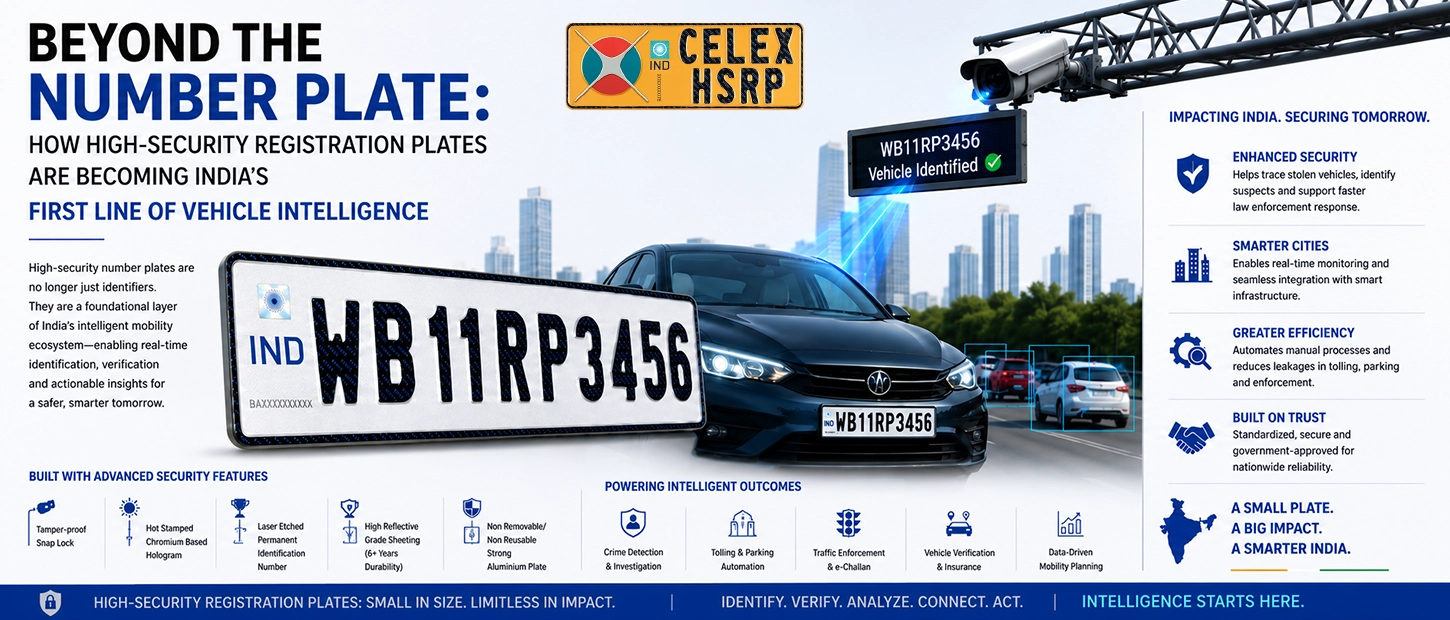
Beyond the Number Plate: How High-Security Registration Plates Are Becoming India’s First Line of Vehicle Intelligence

Introduction


Picture this: you’re stuck in traffic, and a vehicle with a dubious number plate zips past, leaving you wondering whether it even exists in official records. This scenario isn’t just hypothetical. India’s roads have long struggled with vehicle identity fraud, cloned plates, and enforcement loopholes that make tracking errant vehicles feel like chasing shadows. For years, traditional metal plates were easy to duplicate, tamper with, or outright fake. The result? Stolen vehicles roam freely, traffic violators evade fines, and law enforcement agencies play an endless game of catch-up.


But here’s the good news: high-security registration plates are completely changing that narrative. These aren’t your grandfather’s number plates. They’re intelligent, tamper-proof, and digitally integrated systems that act as the first line of defence in India’s evolving vehicle intelligence infrastructure. Think of them as your vehicle’s digital passport, embedded with security features that make fraud nearly impossible. As India races toward smart cities, automated enforcement, and connected mobility, understanding how high-security registration plates in India function isn’t just interesting; it’s essential. Stay with us, and you’ll discover how a simple piece of aluminium is revolutionising road safety, governance, and transportation management across the nation.


The Evolution of Vehicle Registration in India

India’s journey with vehicle registration has been nothing short of transformative. Back in the day, registration plates were simple stamped metal sheets, often hand-painted, with zero standardisation across states. You could drive from Maharashtra to Kerala and notice completely different plate designs, fonts, and quality standards. This inconsistency wasn’t just aesthetic; it created massive enforcement challenges.


The shift toward high-security registration plates began gaining serious momentum around 2012-2019, but the real technological leap happened after the implementation of mandatory HSRP fitment rules. The Ministry of Road Transport and Highways recognised that India’s rapidly expanding vehicle population (An estimation of over 413 million registered vehicles as of 2025-26, according to the Ministry of Road Transport and Highways) demanded a unified, secure, and intelligent identification system. Today’s HSRP manufacturers across India are producing plates that go far beyond basic identification. These are sophisticated security devices featuring laser-etched vehicle plates, chromium-based holograms, and unique identification numbers linked directly to centralised databases.


Companies like Celex Technologies Pvt. Ltd. have emerged as pivotal players in this transformation. They’re not just stamping metal; they’re engineering intelligent security solutions that support governance frameworks, surveillance networks, and transportation management systems. The modern vehicle registration plate manufacturers operate in highly controlled environments where every plate produced carries a unique identity mapped to specific vehicles, owners, and regional transport offices. This traceability is fundamental to building a robust vehicle intelligence infrastructure that can support everything from automated toll collection to AI-driven traffic enforcement.


Why Traditional Number Plates Could No Longer Support Modern Mobility

Traditional number plates had a good run, but they simply couldn’t keep pace with modern transportation demands. Anyone with basic metalworking skills could duplicate a registration plate in their garage. The paint faded within months. Numbers became illegible. Tamper detection? Non-existent. The result was a wild west of vehicle identification where fraudsters thrived, and genuine vehicle owners occasionally suffered mistaken identity.


India’s urbanisation brought new challenges that old-style plates couldn’t handle. Cities began deploying automated traffic enforcement cameras, electronic toll plazas, and digital parking systems. These technologies needed one thing: clear, standardised, machine-readable registration plates. Try scanning a faded, hand-painted plate at 80 kilometres per hour, and you’ll understand the problem. According to transport ministry data, roughly 30 per cent of traffic violation challans issued through automated systems in 2020 faced disputes due to plate readability issues.


The rise of vehicle-related crimes added urgency. Statistics from the National Crime Records Bureau show that vehicle theft remains a persistent problem, with thousands of cases reported annually. Criminals exploited weak registration systems, cloning legitimate plates to disguise stolen vehicles. Traditional plates offered zero protection against such fraud. Law enforcement agencies needed something better: a registration system with built-in security layers that made duplication economically and technically unfeasible. Enter tamper-proof number plates with their multi-layered defence mechanisms.


Understanding the Technology Behind High-Security Registration Plates

So, what makes these plates “high-security”? It’s all about layered protection. The base material itself sets the foundation. Modern aluminium number plate manufacturing uses specially treated aluminium substrates that resist corrosion, maintain structural integrity across temperature extremes, and provide an ideal surface for advanced security features.


The visible numbers and letters use retro-reflective number plate technology, which sounds complex but works brilliantly. The sheeting contains microscopic glass beads that reflect light directly back to its source. Shine your headlights on an HSRP at night, and the plate glows brightly, ensuring visibility even in poor weather or low-light conditions. This reflective property isn’t paint; it’s embedded in the material itself, making it virtually impossible to wear off through normal use.


Security features get more sophisticated. Every genuine HSRP carries a chromium-based hologram, typically positioned in the top-left corner. These hologram-based number plates display a unique optical pattern that’s extraordinarily difficult to replicate. Tilt the plate, and you’ll notice the hologram shifting colours and patterns; a simple but effective anti-counterfeiting measure visible to any enforcement officer.


The real intelligence lies in laser-etched vehicle plates. A high-precision laser permanently engraves a unique identification number on every plate during manufacturing. This isn’t surface-level marking; it’s etched deep enough to survive years of environmental exposure but shallow enough not to compromise structural integrity. This laser code links directly to vehicle registration databases, creating an unbreakable connection between the physical plate and digital records.


Tamper-proof number plates achieve their security through snap-lock technology. Traditional plates used simple bolts that anyone could remove. Modern HSRPs feature non-removable, one-time-use snap locks. Once fitted, removing the plate without destroying the lock is virtually impossible. Any attempt to tamper triggers visible evidence that immediately alerts authorities during routine checks.


How HSRPs Are Strengthening India’s Vehicle Intelligence Network

Here’s where things get really interesting. High-security registration plates aren’t just security devices; they’re becoming active nodes in India’s emerging vehicle intelligence network. The integration starts at registration. Every HSRP issued carries information linked to centralised databases maintained by transport authorities. This digital linkage transforms plates from passive identifiers into active data points that enforcement systems can query instantly.


Automated number plate recognition (ANPR) systems deployed across highways, toll plazas, and urban intersections depend entirely on standardised, machine-readable plates. These cameras capture plate images at high speeds, extract alphanumeric data through optical character recognition, and cross-reference against databases in milliseconds. This technology powers automated toll collection, stolen vehicle alerts, and traffic violation enforcement. None of this works reliably without standardised secure vehicle registration solutions that ensure consistent readability.


The data generated creates powerful intelligence capabilities. Transport authorities can track vehicle movement patterns, identify unauthorised entry into restricted zones, and flag suspicious behaviour. For example, a vehicle reported stolen in Mumbai can trigger automatic alerts if its HSRP is scanned in Pune or Delhi. This real-time intelligence network, powered by smart vehicle identification systems, dramatically improves recovery rates and deters vehicle-related crimes.


The Role of HSRPs in Combating Vehicle Identity Fraud

Vehicle identity fraud has plagued India for decades. The modus operandi was straightforward: steal a vehicle, fabricate a fake registration plate, and disappear into traffic. Traditional plates made this alarmingly easy. Criminals could reproduce plates for a few hundred rupees, creating perfect visual duplicates that fooled casual observers and even some enforcement personnel.


Anti-counterfeit registration plates changed the game entirely. The multi-layered security features create authentication hurdles that make economically viable counterfeiting nearly impossible. Start with the chromium hologram. Replicating the precise optical properties requires sophisticated equipment and materials that cost significantly more than any potential gain from a single fraud attempt. The tamper-proof snap locks add mechanical complexity; installing a counterfeit plate without proper tools leaves obvious evidence of tampering.


The laser-etched vehicle plates provide the ultimate verification layer. Every HSRP carries a unique identification code permanently marked during manufacturing. Enforcement officers can verify this code against central databases using mobile apps. Any mismatch immediately flags potential fraud. This verification capability transforms routine traffic stops into fraud detection opportunities, creating a massive deterrent effect.


Statistical evidence supports HSRP effectiveness. States that implemented mandatory HSRP fitment have reported measurable declines in vehicle theft and identity fraud cases. The deterrent isn’t just technical; it’s economic. The investment required to counterfeit modern HSRPs exceeds the value criminals can extract from most vehicle frauds, fundamentally altering the risk-reward calculation that drives such crimes.


Industrial Manufacturing and Precision Engineering in HSRP Production

Manufacturing high-security registration plates at scale demands industrial precision that rivals aerospace production. The process begins when the aluminium roll arrives at the manufacturing facility, serving as the foundational raw material from which all plates originate. Rather than working with pre-cut sheets, the continuous roll format enables a high-volume, consistent production flow.


The reflective sheeting is then pasted directly onto the aluminium surface through an automated machine-driven process, ensuring uniform bonding across the entire material without gaps or misalignment. Hologram hot stamping follows, where precisely calibrated equipment bonds the chromium-based hologram onto the reflective surface at a molecular level, making any tampering visibly evident.


Next, each plate is permanently marked with a unique laser identification code by laser-engraving systems, which connects it to the matching vehicle record in the national database. This process is known as LID number laser-etching. The material is then cut to standardised dimensions as specified under regulatory requirements and sorted according to state-wise demand and destination.


Finally, the sorted and packed plates are dispatched to embossing stations located across different states, where alphanumeric characters are raised to the precise height and hot-stamped as mandated by regulatory standards. This decentralised embossing step ensures that region-specific registration details are accurately applied closest to the point of vehicle delivery. At these embossing stations, AI-powered inspection systems serve as the final quality checkpoint, verifying that every character and detail embossed onto the plate precisely matches the vehicle data fed into the system, ensuring accuracy and compliance before the plate proceeds further.


Celex Technologies Pvt. Ltd. maintains a large manufacturing infrastructure capable of producing millions of plates monthly. Additionally, Celex has a vast embossing network. To be precise, the network comprises more than 140 embossing stations and more than 200 touch points across the country, and the count is constantly on the rise. As a result, this serves hundreds of automotive OEMs and transport authorities across India. It takes time to reach this level of scale. It takes years of process improvement, infrastructure development, and regulatory relationship building.


How Software Integration Is Transforming Vehicle Registration Systems

The physical HSRP is only half of the story. Behind every plate lies sophisticated software infrastructure that manages production, distribution, and registration. Modern HSRP ecosystems depend on centralised platforms that coordinate manufacturers, dealerships, transport offices, and enforcement agencies. This digital backbone transforms vehicle registration from a paper-heavy bureaucratic process into a streamlined digital workflow.


The system starts at order placement. Vehicle dealers or individual owners request HSRPs through online portals that interface with manufacturing systems. The software validates vehicle details against VAHAN databases, generates unique plate identifiers, and processes the orders to embossing facilities. This automation eliminates manual data entry errors that plagued earlier systems, improving accuracy while reducing processing times.


The integration extends to fitment verification. After installation, authorised dealers upload the data to confirm proper installation. This data links to the vehicle’s registration record, creating a complete audit trail. Transport authorities can verify fitment status instantly, supporting enforcement and compliance monitoring. Digitally integrated HSRP solutions enable data analytics that improve system performance. Transport departments analyse registration trends, identify bottlenecks, and optimise resource allocation.


Commercial Vehicles and the Growing Need for Durable HSRP Solutions

India’s logistics sector has exploded. E-commerce growth, manufacturing expansion, and infrastructure development drive unprecedented demand for commercial transportation. The country’s commercial vehicle fleet has grown substantially, with trucks, buses, and goods carriers operating under demanding conditions that test equipment durability. These vehicles need commercial vehicle registration plates engineered for extreme environments.


Commercial vehicles face unique challenges. They operate continuously, covering thousands of kilometres monthly. They navigate dusty rural highways, congested urban streets, coastal roads with salt spray, and industrial zones with chemical exposure. Traditional plates deteriorated rapidly under such stress, requiring frequent replacement and creating compliance headaches for fleet operators.


Modern high-security registration plates designed for commercial use incorporate enhanced durability features. The aluminium substrates undergo additional corrosion-resistant treatments. The reflective sheeting uses industrial-grade adhesives that withstand vibration, temperature cycling, and UV exposure. These engineering enhancements extend plate lifespan significantly, reducing replacement frequency and total ownership costs. Fleet operators managing hundreds of vehicles appreciate reduced maintenance intervals. Standardised, durable plates minimise compliance risks, avoiding penalties from regulatory inspections.


The Connection Between Smart Cities and Intelligent Vehicle Identification

India’s Smart Cities Mission aims to transform urban living through technology integration. Transportation represents a cornerstone of this vision, and intelligent vehicle identification systems provide the foundation. Smart traffic management, automated parking, congestion pricing, and pollution monitoring all depend on accurately identifying and tracking vehicles. High-security registration plates enable these capabilities.


Consider traffic flow optimisation. Smart city traffic management systems use ANPR cameras to monitor vehicle movement patterns. This data feeds algorithms that adjust signal timings, identify bottlenecks, and predict congestion. The system only works if cameras can reliably read plates across diverse conditions. Standardised reflective number plate technology ensures consistent readability, enabling accurate data collection that drives intelligent traffic management decisions.


Electronic toll collection systems demonstrate another integration point. FASTag and similar technologies link financial transactions to vehicle identities verified through HSRPs. The plates provide the physical identifier that connects vehicles to digital payment accounts. This seamless integration reduces toll plaza congestion while enabling usage-based road pricing models that smart cities need for sustainable transportation funding. Parking management systems increasingly rely on ANPR technology as well.


Why Compliance and Standardisation Are Critical in HSRP Manufacturing

India’s size and diversity make standardisation challenging but essential. With 28 states and 8 union territories, each managing transport regulations, creating unified vehicle identification standards requires careful coordination. The Central Motor Vehicles Rules establish technical specifications for RTO-approved registration plates, ensuring consistency nationwide. Compliance with these standards isn’t optional; it’s fundamental to interoperability.


Standardisation enables technology deployment. Automated enforcement systems implemented in one state need to identify plates from all other states. This requires identical fonts, dimensions, reflectivity standards, and security features across all manufacturers. Without standardisation, automated systems fail, undermining the intelligence infrastructure India is building. The specifications cover everything from character height to reflective coating properties, leaving no room for variation.


Manufacturers must navigate complex compliance landscapes. Production facilities require certifications demonstrating the capability to produce plates meeting technical specifications. Quality management systems must document every production stage, ensuring traceability and accountability. Regular audits verify continued compliance, maintaining system integrity. Celex Technologies Pvt. Ltd. operates within this compliance framework, maintaining certifications and quality systems that meet national standards.


The Future of Vehicle Intelligence and Registration Security in India

The journey of high-security registration plates is far from complete. Emerging technologies promise to make these plates even more intelligent and integrated. One fascinating development involves embedding RFID chips or NFC tags directly into registration plates. These wireless communication technologies would enable instantaneous vehicle identification without optical scanning, supporting faster toll collection, automated parking access, and enhanced security verification.


Artificial intelligence will play an expanding role. Machine learning algorithms analysing ANPR data can detect suspicious movement patterns, predict maintenance needs for commercial fleets, and optimise urban traffic flow in real-time. The quality and standardisation of high-security registration plates in India directly impact AI system accuracy, making continued manufacturing excellence critical.


Blockchain integration represents another frontier. Distributed ledger technologies could create immutable vehicle ownership and maintenance records linked to registration plates. This would eliminate title fraud, simplify ownership transfers, and create transparent vehicle histories that benefit buyers, sellers, insurers, and regulators. Connected vehicle ecosystems will increasingly rely on verified vehicle identities. As autonomous vehicles emerge and vehicle-to-infrastructure communication becomes standard, the registration plate’s role as the vehicle’s verified identity token becomes more critical.


Conclusion

High-security registration plates have transformed from simple identification tools into sophisticated security infrastructure supporting India’s digital transportation ecosystem. The combination of laser-etched vehicle plates, chromium holograms, tamper-proof snap locks, and centralised database integration creates multi-layered protection against fraud while enabling intelligent traffic enforcement systems. These plates aren’t passive identifiers; they’re active components in vehicle intelligence networks that power automated toll collection, traffic management, and crime prevention.


The manufacturing precision behind modern HSRPs reflects India’s growing technological capabilities. Companies like Celex Technologies Pvt. Ltd. demonstrate how advanced production systems, quality assurance protocols, and digital integration create secure vehicle registration solutions at the scale India’s massive vehicle population demands. The reflective number plate technology, aluminium number plate manufacturing processes, and software integration supporting these systems represent significant engineering achievements.


Looking ahead, the role of HSRPs will only expand. As smart cities mature, autonomous vehicles emerge, and connected infrastructure becomes standard. The humble registration plate evolves into a critical data interface between physical vehicles and digital systems. The foundation being laid today through standardised, secure, intelligent registration systems will support India’s transportation future for decades. Recognising this change allows us to see how innovations that may appear straightforward, such as high-security registration plates in India, play a vital role in enhancing road safety, creating efficient urban environments, and fostering accountable mobility systems that serve the interests of all Indians.


Partner with India’s Leading HSRP Innovators

The advancement of vehicle security and smart transportation is underway now, with Celex Technologies Pvt. Ltd. leading this change. Whether you’re a fleet operator seeking durable commercial vehicle registration plates, a transport authority requiring scalable registration solutions, or a technology partner exploring integrated mobility systems, Celex offers the expertise, infrastructure, and innovation capabilities you need.


With state-of-the-art manufacturing facilities producing millions of plates monthly through 140+ embossing stations nationwide, rigorous quality control systems, and deep experience in producing RTO-approved registration plates at a massive scale, Celex supports India’s vehicle registration needs with unmatched reliability. Their commitment to technological advancement, regulatory compliance, and customer satisfaction makes them the ideal partner for organisations navigating India’s evolving transportation landscape.


Connect with Celex today and experience the difference that precision engineering and forward-thinking innovation make in building India’s vehicle intelligence infrastructure.


Frequently Asked Questions

1. What makes high-security registration plates different from traditional number plates?

High-security registration plates incorporate multiple security features, including chromium holograms, laser-etched vehicle plates with unique identification codes, tamper-proof snap locks, and retro-reflective number plate technology, making them virtually impossible to duplicate or tamper with compared to traditional plates.


2. Why is aluminium used for manufacturing HSRPs?

Aluminium number plate manufacturing provides excellent corrosion resistance, maintains structural integrity across temperature extremes, is lightweight yet durable, and provides an ideal surface for embossing, reflective coatings, and security features, making it the optimal material for long-term outdoor use.


3. How do high-security registration plates support smart cities?

Smart vehicle identification systems in urban areas depend on standardised HSRPs for automated toll collection, traffic enforcement cameras, parking management, and congestion monitoring. The plates’ consistent readability enables accurate vehicle identification that powers intelligent traffic management and urban mobility solutions.


4. Can commercial vehicles use the same HSRPs as private vehicles?

Yes, but commercial vehicle registration plates often require enhanced durability features to withstand harsh operating conditions. Manufacturers produce heavy-duty variants using reinforced materials and improved weather resistance while maintaining the same security features and regulatory compliance as standard HSRPs.


5. What role do manufacturers play in vehicle intelligence systems?

HSRP manufacturers in Kolkata and across India produce plates with unique laser-coded identifiers linked to centralised databases. This integration enables real-time vehicle tracking, enforcement automation, and fraud prevention, making manufacturers critical infrastructure partners in India’s developing vehicle intelligence infrastructure.
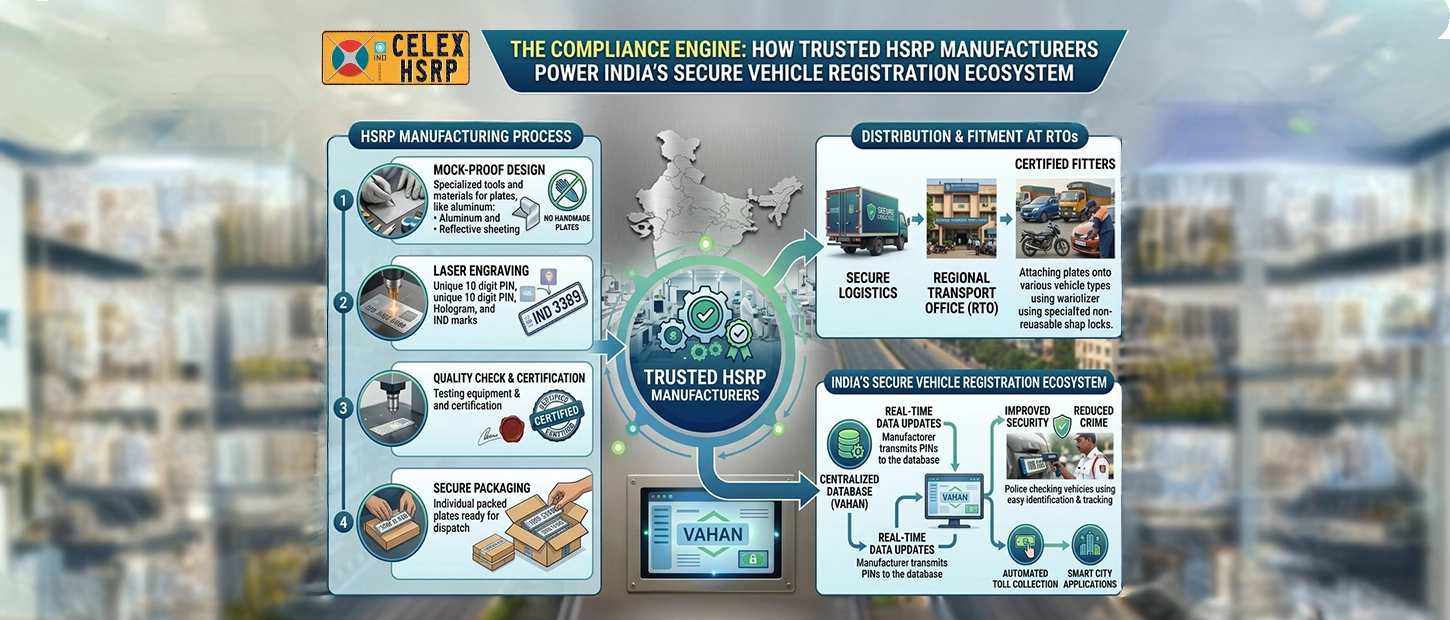
The Compliance Engine: How Trusted HSRP Manufacturers Power India’s Secure Vehicle Registration Ecosystem

Introduction


India has over 300 million registered vehicles on its roads. That’s a staggering number. And every single one of those vehicles needs a registration plate that actually means something, not just a decorative piece of metal slapped on the bumper. 


Here’s the real problem. Millions of vehicles across the country still carry counterfeit, cloned, or non-standardised plates. Criminals exploit these loopholes to evade toll systems, escape traffic enforcement cameras, and even commit serious crimes. The result? Law enforcement loses the ability to track vehicles reliably. Citizens bear the consequences. 


This is exactly why high security registration plates exist. They aren’t just a regulatory checkbox. They represent a complete overhaul of how India identifies, tracks, and governs its vehicle population. 


But here’s what most people miss. The plates themselves are only as good as the manufacturers producing them. Without certified, capable, and compliant HSRP manufacturers, even the best regulations remain just words on paper. 


Keep reading. This guide walks you through the entire compliance infrastructure, the engineering behind secure plates, and why trusted manufacturers are the real engine powering India’s secure vehicle registration ecosystem. 


The Compliance Infrastructure Behind India’s Vehicle Identification System 


India’s vehicle identification system didn’t always look the way it does today. For decades, registration plates were manufactured by roadside vendors with no standardisation, no security features, and no traceability. The system was ripe for exploitation. 


The government recognised this vulnerability and acted. High security registration plates were introduced under the Central Motor Vehicles Rules (CMVR) as a direct response to the growing threat of vehicle identity fraud. The idea was simple but powerful: create a uniform, tamper-resistant identification standard that applies to every registered vehicle in the country. 


Unlike traditional plates, HSRPs bring together multiple layers of automotive registration plate standards into a single product. They use retroreflective license plate technology, embedded holograms, and laser-etched vehicle identification codes that permanently link each plate to a specific vehicle record. 


This isn’t just about visibility on roads at night, though reflectivity certainly helps law enforcement read plates in low-light conditions. The deeper purpose is traceability. Every plate manufactured enters a trackable supply chain, gets assigned to a specific vehicle, and becomes part of a national compliance record. 


Manufacturers operating at scale play a decisive role here. Companies like Celex Technologies Pvt. Ltd. serve as the operational backbone of this ecosystem, producing compliant plates in the millions and ensuring governments and OEMs can execute this mandate efficiently across the country. 


Regulatory Foundations: The CMVR Framework Driving HSRP Compliance 


Let’s talk about the legal architecture that makes all of this possible, because without a strong regulatory foundation, the entire system collapses. 


Rules 50 and 51 of the Central Motor Vehicles Rules form the legislative spine of CMVR Rule 50 compliance for registration plates in India. These rules don’t leave much room for interpretation. They specify exact requirements for plate construction, formatting, character dimensions, colour coding, and security element integration. 


Here’s what the rules mandate in practical terms. Every plate must use embossed aluminium as the base material. Aluminium is preferred for its durability, weight, and compatibility with embossing machinery. The surface must feature retroreflective license plate technology, which utilises special sheeting materials to bounce light back toward its source, making plates clearly visible to cameras and enforcement personnel, even at night or in adverse weather conditions. 


Beyond visibility, automotive regulatory compliance manufacturing requires the integration of chromium-based holograms, laser identification numbers, and colour-coded backgrounds that correspond to the vehicle category. Private vehicles carry white plates. Commercial vehicles use yellow backgrounds. Electric vehicles have green plates. This colour-coding system creates an immediate visual classification system for enforcement officers. 


The rules also govern the installation process itself. Plates must be mounted using anti-tamper snap-lock plate mounting systems that prevent removal without destroying the plate or lock. This single feature eliminates the ability to swap plates between vehicles, which was previously a common tactic among criminals. 


Manufacturers like Celex Technologies Pvt. Ltd. translate these detailed policy requirements into scalable production lines, ensuring every plate rolling off their assembly lines meets the exact specifications outlined in CMVR. 


Security Engineering: The Technical Architecture of High Security Registration Plates 


Now let’s get into the engineering. This is the point at which it becomes truly fascinating. 


A high security registration plate isn’t a simple stamped metal sheet. It’s a multi-layered security document in the form of a vehicle identification tag. Each component serves a specific anti-fraud purpose, and removing or replicating any single layer without the proper machinery and materials is practically impossible. 


Start with the base. Embossed aluminium license plates form the structural foundation. The aluminium sheet is precisely cut to standardised dimensions and then passed through embossing machinery that raises the characters to a specific height. This embossing isn’t decorative. It creates a physical profile that’s difficult to replicate with standard tools. 


On top of the aluminium sits the retroreflective license plate technology layer. This sheeting uses microscopic glass beads embedded in a polymer film to redirect light. The result is exceptional visibility across distances and lighting conditions, which directly supports camera-based enforcement systems. 


The chromium-based hologram is perhaps the most visually striking security feature. These hologram security plates use diffraction patterns that change colour and appearance depending on the viewing angle. Standard printing or photocopying cannot replicate these patterns. Any attempt to copy the hologram results in a flat, non-diffracting image that’s immediately identifiable as fake. 


Then come the laser-etched vehicle identification codes. A high-powered laser permanently engraves a unique identification number into the plate surface. This number links directly to the vehicle’s registration record in national databases. The laser etching is permanent and cannot be altered without leaving visible damage. 


Companies like Celex Technologies Pvt. Ltd. integrate all these features using precision manufacturing processes that meet stringent national security and durability standards, ensuring that every plate performs exactly as required throughout its operational life. 


Traceability Systems: Linking Physical Plates to Digital Vehicle Databases 


A secure plate that isn’t connected to a reliable database is half a solution. The full power of high security registration plates emerges when physical plates link seamlessly to digital vehicle records. 


This is where VAHAN database integration becomes critical. VAHAN is India’s national vehicle registration database, maintained by the Ministry of Road Transport and Highways. Every registered vehicle in the country has an entry in VAHAN, and every HSRP issued must correspond to a verified vehicle record within that system. 


The connection happens through the laser-etched vehicle identification codes engraved on each plate. These codes serve as unique digital keys. Traffic enforcement officers, toll plaza cameras, and law enforcement agencies can scan or enter these codes to instantly retrieve complete vehicle information, including ownership details, registration status, insurance validity, and emission compliance. 


The traceability benefits extend beyond enforcement. Transport departments may use this data for policy planning, fleet monitoring, and compliance auditing. Insurance companies verify vehicle details more efficiently. Citizens benefit from a more reliable registration ecosystem overall. 


Intelligent transport enforcement systems depend heavily on this data connectivity to function effectively. Without accurate, real-time plate-to-vehicle mapping, automated enforcement cameras and toll systems lose their reliability entirely. 


Technology-driven manufacturers like Celex Technologies Pvt. Ltd. contribute by building software platforms and production tracking systems that maintain accurate records from the moment a plate is manufactured through to its installation on a specific vehicle. 


Anti-Tamper Mechanisms: Preventing Vehicle Identity Fraud 


Vehicle identity fraud is not a minor inconvenience. It’s a serious crime that enables toll evasion, facilitates hit-and-run escapes, and supports organised criminal activity. High security registration plates are engineered specifically to shut down these possibilities. 


The most impactful anti-tamper feature is the anti-tamper snap-lock plate mounting system. Traditional plates attach with standard screws. Anyone with a screwdriver can remove them in seconds. HSRPs use specially designed snap-lock bolts that require a unique tool to remove. Attempting to remove the plate without this tool permanently damages the locking mechanism or the plate, making the attempted tampering immediately visible. 


The hologram adds another layer of protection. Hologram security plates use hot-stamping processes to apply the hologram directly onto the plate surface. This isn’t a sticker that can be peeled off and repositioned. The hot-stamping process bonds the holographic film to the aluminium at a molecular level. Attempting to remove it destroys the hologram and leaves visible marks on the plate surface. 


Laser-etched vehicle identification codes contribute another layer of permanence. These codes are physically removed from the plate surface. No paint or adhesive covers them. No ink can fade or wash away. The only way to alter a laser-etched code is to physically grind the plate surface, which leaves obvious damage. 


Together, these features mean a stolen or misused plate is instantly identifiable as tampered. Criminals cannot swap plates between vehicles, cannot clone plates accurately, and cannot remove and reinstall plates without destroying their functionality. 


Manufacturers such as Celex Technologies Pvt. Ltd. integrate these anti-tamper elements into every plate they produce, ensuring that India’s vehicle identification system maintains its integrity from production floor to road. 


Manufacturing at Scale: Industrial Capabilities Behind Nationwide HSRP Deployment 


India registers roughly 20 million new vehicles every year. That’s 20 million front plates and 20 million rear plates, minimum. Add replacement plates for existing vehicles transitioning to HSRP compliance, and the production numbers become genuinely enormous. 


Meeting this demand requires industrial-scale manufacturing infrastructure. Not every company claiming to produce registration plates can operate at this level. Automotive regulatory compliance manufacturing at a national scale requires heavy capital investment in specialised machinery, raw materials, quality systems, and logistics. 


The production process begins when the aluminium roll arrives at the manufacturing facility, serving as the foundational raw material from which all plates originate.  


At this stage, rather than working with pre-cut sheets, the continuous roll format enables a high-volume, consistent production flow. The reflective sheeting is then pasted directly onto the aluminium surface through an automated machine-driven process, ensuring uniform bonding across the entire material without gaps or misalignment.  


Hologram hot stamping follows, where precisely calibrated equipment bonds the chromium-based hologram onto the reflective surface at a molecular level, making any tampering visibly evident.  


The LID number laser etching comes next, where laser engraving systems permanently mark each plate with its unique laser identification code, linking it to the corresponding vehicle record in the national database.  


The material is then cut to standardised dimensions as specified under regulatory requirements and sorted according to state-wise demand and destination.  


Finally, the sorted and packed plates are dispatched to embossing stations located across different states, where alphanumeric characters are raised to the precise height and hot-stamped as mandated by regulatory standards. This decentralised embossing step ensures that region-specific registration details are accurately applied closest to the point of vehicle delivery.  


At these embossing stations, AI-powered inspection systems serve as the final quality checkpoint, verifying that every character and detail embossed onto the plate precisely matches the vehicle data fed into the system, ensuring accuracy and compliance before the plate proceeds further. 


Celex Technologies Pvt. Ltd. maintains a large manufacturing infrastructure capable of producing millions of plates monthly. Plus, Celex has an extensive network for embossing. To be precise, the network comprises more than 100+ embossing stations across the country, and the count is constantly on the rise. As a result, this serves hundreds of automotive OEMs and transport authorities across India. This kind of scale isn’t achieved overnight. It requires years of infrastructure development, process refinement, and regulatory relationship building. 


Quality Assurance and Certification: Ensuring Global Manufacturing Standards 


Producing a plate that looks compliant and producing a plate that actually performs to regulatory standards are two very different things. Quality assurance systems bridge that gap. 


Type Approval Certificate (TAC) plates are the gold standard in the Indian HSRP regulatory framework. To receive a TAC, manufacturers must submit their plate designs and production samples to accredited testing agencies. These agencies subject the plates to rigorous performance tests covering reflectivity under multiple lighting conditions, adhesion strength of the hologram and reflective sheeting, resistance to temperature extremes, resistance to chemicals and weathering, and dimensional accuracy of embossed characters. 


Only plates passing all these tests receive Type Approval certification. And this approval isn’t permanent. Manufacturers must maintain consistent production quality to retain their certification status. Any change to materials, processes, or suppliers can trigger a re-certification requirement. 


Beyond TAC, leading manufacturers pursue internationally recognised quality management certifications. ISO 9001 certification covers quality management systems. ISO 14001 covers environmental management. IATF 16949 is the automotive-specific quality standard that OEM partnerships often require. 


These automotive registration plate standards apply globally, meaning manufacturers holding these certifications can demonstrate their processes meet international benchmarks, not just domestic ones. 


Smart vehicle identification technology also demands software quality certifications alongside physical product certifications, as the digital traceability systems must meet data accuracy and security standards. 


Good HSRP manufacturers possess a Type Approval Certificate (TAC). But only the best ones have TACs along with at least 10 “Conformity of Production” (CoP), a manufacturer-related safety certification to live up to their reputation.  And as a trusted HSPR manufacturer, Celex Technologies Pvt. Ltd. maintains the threshold of being the “best HSRP manufacturer“, apart from rigorous compliance processes. This ensures that their products satisfy both domestic regulatory requirements and the international manufacturing standards that major automotive OEMs expect from their supply chain partners. 


OEM Partnerships: Integrating HSRP Manufacturing with the Automotive Industry 


The most efficient point to install a compliant registration plate is before the vehicle leaves the dealership for the first time. This is the principle driving OEM license plate supplier partnerships between approved HSRP vendors and automobile companies. 


Here is how the integration works in practice. A customer purchases a new vehicle at an authorised dealership. The dealership submits the vehicle’s registration details to the VAHAN digital platform during the purchase process. The Regional Transport Office (RTO) generates the registration number, which is then communicated by the dealership to the approved HSRP vendor. The vendor produces the plate embedded with the vehicle-specific registration details, security features, and laser-etched identification codes. The finished plate is then delivered to the dealership and pre-fitted onto the vehicle before the customer takes delivery. 


This integrated workflow eliminates a major compliance gap that existed previously. Without OEM partnerships, buyers received their vehicles and were expected to independently obtain HSRP compliance. Many simply didn’t, either through neglect or because the process was cumbersome. 


VAHAN database integration plays a central role in making this workflow seamless. The HSRP vendor’s systems sync directly with VAHAN, enabling accurate vehicle-to-plate data capture and ensuring every plate produced is correctly mapped to its corresponding vehicle record from production through to fitment. Post-installation, the fitment status is updated in the VAHAN database, enabling authorities to instantly verify vehicle details and improving traceability for stolen or missing vehicles. 


The result is a streamlined supply chain that benefits all stakeholders. Customers receive a fully compliant, road-legal vehicle without any additional effort. Dealerships operate within a structured, mandate-driven process. And transport authorities benefit from improved traceability and enforcement through centralised VAHAN records. 


Celex Technologies Pvt. Ltd. maintains extensive OEM partnerships that demonstrate exactly how approved HSRP vendors bridge the gap between automotive production and regulatory compliance, streamlining the delivery process for both manufacturers and end customers. 


Digital Compliance Platforms: Software and Data Systems Supporting HSRP Operations 


The physical plate is only half the story. Behind every HSRP sits a digital ecosystem that tracks its journey from raw material to road, and continues monitoring it throughout the vehicle’s operational life. 


Modern HSRP manufacturers deploy centralised software platforms that manage every aspect of production and distribution. These platforms handle order management from OEM partners and dealerships, including production scheduling and batch tracking, quality inspection records and certification, documentation, dispatch logistics and delivery confirmation, further extending to the integration with government databases, including VAHAN. 


VAHAN database integration within these platforms enables real-time verification at multiple stages. Production systems query the database to confirm vehicle registration details before printing plates. Delivery systems update records when plates ship and again when installation confirmation is received. This creates a continuous, auditable data trail for every plate produced. 


Intelligent transport enforcement systems rely on the data accuracy maintained by these platforms. Traffic cameras, toll systems, and law enforcement databases pull information from VAHAN in real time. If the plate data in VAHAN is inaccurate because of poor manufacturer data practices, the entire enforcement ecosystem suffers. 


Digital compliance platforms also generate reporting dashboards that transport authorities use to monitor compliance rates, track pending registrations, and identify geographic areas with low HSRP adoption. This data-driven oversight is a major advancement over the manual record-keeping systems that preceded it. 


Smart vehicle identification technology continues evolving, with manufacturers exploring integration of QR codes, RFID chips, and advanced optical character recognition into their compliance platforms. 


Celex Technologies Pvt. Ltd. has developed robust digital solutions that improve operational efficiency and ensure accurate compliance monitoring throughout the HSRP ecosystem, giving governments and OEM partners real-time visibility into the production and deployment process. 


Trusted Manufacturers as the Engine of India’s Secure Mobility Infrastructure 


Take a moment to stand back and consider the wider picture. India’s vehicle registration challenge is massive. The country has one of the world’s largest and fastest-growing vehicle populations. Managing the identification, compliance, and traceability of hundreds of millions of vehicles across diverse geography and administrative jurisdictions is genuinely complex. 


High security registration plates address this challenge by creating a standardised, secure, and digitally connected identification system. But the technology and regulations alone don’t make it work. The manufacturers do. 


Trusted HSRP manufacturers bring together engineering capability, regulatory compliance expertise, digital infrastructure, and industrial scale in a single operational package. They translate government mandates into physical products. They build the software systems that connect those products to national databases. They partner with OEMs to ensure compliance from the moment of sale. And they maintain the quality systems that keep the entire ecosystem reliable. 


The role of a compliant manufacturer isn’t simply to stamp aluminium and ship boxes. It’s to actively participate in and sustain India’s vehicle registration compliance infrastructure. Every plate produced by a certified, capable manufacturer strengthens the system. Every non-compliant plate undermines it. 


Automotive regulatory compliance manufacturing at this level demands deep institutional knowledge, substantial capital investment, and an ongoing commitment to regulatory engagement. Companies that excel in this space don’t just follow rules. They help shape the implementation frameworks that make the rules work in practice. 


Celex Technologies Pvt. Ltd. exemplifies this role, operating as the operational backbone that enables governments, law enforcement agencies, and automotive manufacturers to maintain a reliable and tamper-proof number plate infrastructure across the country. 


Conclusion 


India’s journey toward a secure, tamper-proof vehicle identification system is one of the more ambitious regulatory infrastructure projects the country has undertaken. It touches every vehicle on every road in every state. And it works because multiple systems operate together: strong legislation through CMVR Rule 50 compliance, sophisticated security engineering through retroreflective license plate technology and hologram security plates, reliable traceability through VAHAN database integration, and industrial scale through certified HSRP manufacturers. 


The individual features of a high security registration plate, such as the laser-etched vehicle identification codes, the anti-tamper snap-lock plate mounting, and the embossed aluminium license plates, are impressive on their own. Together, they create a vehicle identity document that’s nearly impossible to fake and easy to verify. 


But none of this infrastructure functions without manufacturers who invest in the certifications, machinery, partnerships, and digital systems required to deliver compliant plates at a national scale. Trusted manufacturers are the compliance engine that keeps the entire ecosystem running. 


As India’s vehicle population continues growing and enforcement systems become more sophisticated, the role of certified manufacturers will only become more critical. The road ahead demands nothing less than complete compliance, and the right manufacturing partner makes that possible. 


Partner with a Manufacturer That Takes Compliance Seriously 


Ready to Ensure Your Vehicles Leave Compliant from Day One? 


If you’re an automotive OEM, dealership network, or transport authority looking for a certified HSRP manufacturer who delivers at scale without compromising on quality, it’s time to work with a partner who has the certifications, infrastructure, and digital systems to back it up. Celex Technologies Pvt. Ltd. brings proven manufacturing capability, extensive OEM partnerships, and deep regulatory expertise to every engagement.  


Don’t let compliance gaps slow your operations or expose your vehicles to regulatory risk. Connect with Celex Technologies Pvt. Ltd. today and integrate a trusted, compliant, high-security registration plate supply chain into your vehicle delivery process. 


Frequently Asked Questions (FAQs) 


1. What makes high-security registration plates different from standard number plates? 


High security registration plates include multiple security layers that standard plates lack entirely. These include retroreflective license plate technology for enhanced visibility, chromium-based hologram security plates for authenticity verification, laser-etched vehicle identification codes for permanent traceability, and anti-tamper snap-lock plate mounting that prevents removal without specialised tools. Standard plates carry none of these features, making them easy to clone, swap, or replicate. 


2. Which rules govern the manufacture and installation of HSRPs in India? 


Rules 50 and Rule 51 of the Central Motor Vehicles Rules (CMVR) govern all aspects of registration plate design, manufacturing, and installation in India. These rules specify the exact materials, dimensions, security features, and installation methods that manufacturers and vehicle owners must follow. CMVR Rule 50 compliance is mandatory for all new vehicles and retrofitting programs for older vehicles. 


3. How does an HSRP connect to the national vehicle database? 


Each high security registration plate carries a laser-etched vehicle identification code that links directly to the vehicle’s record in the VAHAN database. This integration enables real-time verification by law enforcement, toll systems, and transport authorities. VAHAN database integration allows officers to instantly access ownership details, registration status, insurance information, and emission compliance data by scanning or entering the plate’s identification code. 


4. What certifications should a trusted HSRP manufacturer hold? 


A credible HSRP manufacturer must hold a Type Approval Certificate (TAC) from an accredited testing agency, confirming that their plates meet the performance specifications set by national regulations. Beyond TAC, leading manufacturers maintain ISO 9001 for quality management, ISO 14001 for environmental compliance, and IATF 16949 for automotive-specific manufacturing standards. These certifications collectively ensure that automotive registration plate standards are met consistently throughout production. 


5. How do OEM partnerships improve HSRP compliance rates for new vehicles? 


OEM partnerships integrate high-security registration plate production directly into the vehicle delivery process. Rather than leaving compliance to individual buyers after purchase, dealerships coordinate with certified manufacturers to have plates produced and installed before the vehicle leaves the showroom. This OEM license plate supplier model eliminates the compliance gap that arose when buyers managed plate registration independently, resulting in significantly higher compliance rates from the point of first sale. 

Copyright 2026 © Celex Technologies Pvt. Ltd.