A stolen car races past an ANPR camera at 2 AM, and the system should catch it instantly. Instead, the camera misreads a smudged, non-reflective plate, and the vehicle vanishes into the night. This is not a rare glitch. It happens every day across Indian highways because thousands of number plates still fail basic optical readability standards.
If you are a fleet owner, an OEM, or someone simply trying to register a new car, this gap between old-school plates and new-age surveillance technology should concern you. Poor plate quality does not just risk a traffic challan. It breaks the entire chain of automated law enforcement, tolling, and smart city monitoring.
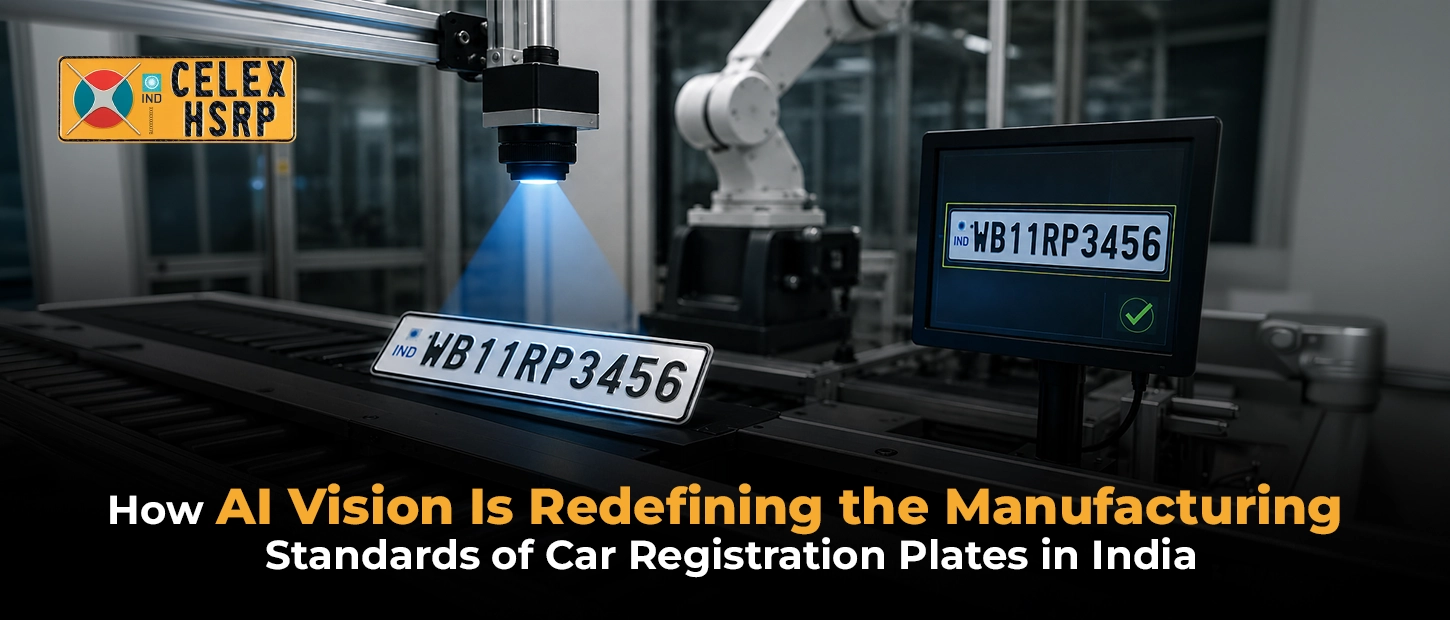
This article discusses how AI vision and ANPR are changing the engineering guidelines for car registration plates. It explains why selecting a government-approved HSRP manufacturer, such as CELEX Technologies Pvt. Ltd., is now infrastructure rather than a choice.
The Silent Shift from Legal Formality to Digital Infrastructure
For decades, a number plate was treated as paperwork bolted to a bumper, and nobody thought about it as a piece of precision engineering. That mindset is now outdated. India’s roads are filling up with ANPR cameras, toll scanners, parking sensors, and traffic enforcement drones, and every single one of these systems depends on one thing: a plate that a machine can read instantly and correctly. A camera does not “glance” at a plate the way a human traffic constable does. It captures thousands of frames per second, applies edge detection, isolates character boundaries, and cross-references the result against a national vehicle database. This raises a fair question worth answering directly: how is AI vision changing the role of a registration plate? It converts the plate from a static identifier into a live data input feeding a nationwide digital system.
If the plate has inconsistent font spacing, dull reflective performance, or warped aluminium, the recognition accuracy drops sharply, sometimes below 70 per cent in low light or rain. This shift matters because India’s vehicle base is enormous. According to the Ministry of Road Transport and Highways data, the country now has more than 413 million registered vehicles as of 2025-26. Every one of these vehicles is a potential node in a growing digital enforcement network. A single manufacturing inconsistency multiplied across millions of plates becomes a national-scale readability crisis, not a minor defect.
Why Optical Readability Has Become the New Benchmark for Plate Manufacturing
Machine-readability depends on four physical factors working together: character stroke width, spacing uniformity, surface glare control, and colour contrast. AI vision models are trained to expect specific geometry, and when manufacturers deviate even slightly, the model’s confidence score drops. People often ask, “What makes a car registration plate machine-readable?” And the honest answer is that it comes down to consistent physical execution of these four factors, not just legal compliance on paper.
Character Uniformity and Font Geometry
Every embossed character on an HSRP follows a strict font standard set by the Ministry of Road Transport and Highways (MoRTH). This is not decorative. Character uniformity ensures that an optical character recognition engine can segment each letter and number without confusion. A slightly tilted “8” or a cramped “B” next to a “3” can trigger a misread, especially at highway speeds where the camera has milliseconds to capture a clean frame.
Reflective Sheeting and Night Visibility
Retro-reflective sheeting is graded, and only certified Grade A sheeting is supposed to be used on HSRPs, ensuring visibility from roughly 200 meters even at night. This reflective sheeting bounces headlight beams and camera flash straight back to the lens, giving AI systems a sharp, high-contrast image to work with. Cheaper, uncertified sheeting scatters light unevenly, creating glare spots that confuse detection algorithms.
Laser Coding and Tamper-Proof Identification in the Age of Automation
Laser coding is where physical security and digital recognition finally meet. Every HSRP carries a unique ten-digit laser-etched code, permanently marked into the plate material itself. This is not paint or a sticker. It is a microscopic engraving that cannot be peeled off or duplicated cheaply, and it forms the backbone of a tamper-proof identification system that AI enforcement tools rely on.
Why Tamper Resistance Matters for AI Systems
An AI enforcement system is only as trustworthy as the data it reads. If a plate can be swapped, cloned, or reused across vehicles, the entire automated challan and toll system collapses into confusion. The snap-lock rivets used on HSRPs are designed to be non-reusable, meaning any attempt to remove the plate destroys it. Combined with the chromium hologram bearing the Ashok Chakra, this creates a physical layer of authenticity that supports the digital layer of recognition.
The Chakra Hologram as a Verification Layer
Some newer enforcement systems are beginning to cross-check the hologram pattern alongside the alphanumeric code, adding a second verification layer. This is early-stage technology in most states, but it points toward a future where plates are not just read; they are authenticated in real time, the same way a bank verifies a currency note under UV light.
Image Capture Challenges and the Real-World Limitations of ANPR
Automatic Number Plate Recognition sounds futuristic, but it struggles with mundane problems like dust, mud splashes, rain streaks, and motion blur. AI models compensate for some of this through deep learning trained on millions of plate images, yet the underlying plate quality still sets the ceiling for accuracy. The physical plate remains the weakest or strongest link in the entire chain, depending entirely on how it was manufactured.
Weather, Speed, and Angle Distortion
A camera mounted on a highway gantry captures vehicles moving at 80 to 100 kmph. At that speed, even a fraction-of-a-second exposure delay causes motion blur. Plates with poor edge definition or non-standard mounting angles worsen this problem. Standardised plate dimensions and consistent mounting height, both mandated under HSRP rules, reduce this variability significantly.
Why Consistency Across Millions of Plates Matters
AI models are trained on expected patterns, and this brings up a question every OEM should be asking: why does manufacturing consistency matter for enforcement accuracy? If ten per cent of plates in circulation deviate from the standard template, the model has to work harder to generalise, and error rates climb. This is precisely why authorised vendors follow strict tensile strength, thickness, and coating specifications rather than improvising designs.
Government Approval as a Quality Gatekeeping Mechanism
State transport departments only permit certified vendors to supply plates, and this restriction exists precisely because uncertified plates introduce the kind of inconsistencies that confuse AI systems. The government-approved HSRP manufacturer distinction is not a marketing label; it is a functional quality checkpoint built into India’s vehicle registration system.
Type Approval Certificate (TAC) and Certificate of Production (COP)
Manufacturers must clear a rigorous Type Approval Certificate and Certificate of Production process before they can legally produce HSRPs. This involves testing material thickness, reflective grade, embossing depth, and adhesive durability under simulated weather conditions. A plate cannot enter circulation without clearing these checkpoints. As such, CELEX Technologies Pvt. Ltd. leads the way as a government-approved HSRP manufacturer in India.
Why Local Shops Cannot Legally Issue HSRPs
Roadside shops cannot legally issue a genuine HSRP, and this restriction exists to protect the integrity of the entire recognition ecosystem. This is often summed up in one common query buyers search for: can I get an HSRP from a local shop? The answer is no, because every approved plate is registered in a centralised database linked to the vehicle’s chassis and engine number, something a local vendor simply cannot replicate.
CELEX Technologies Pvt. Ltd. and the Scale of Precision Manufacturing
Numbers tell a story that narration alone cannot. Celex Technologies Pvt. Ltd. has supplied over 6.10 crore HSRPs across India, maintaining a physical presence in 23 states through 348 touch points. That kind of geographic and volume scale only works if manufacturing precision stays consistent from the first plate to the sixty-millionth one produced.
The Numbers Behind the Precision
The company serves 500-plus OEM customers and works with over 12,000 dealer partners, backed by an annual production capacity exceeding 5 crore plates. With a team strength of 500-plus professionals and a turnover crossing 110 crore in FY 2024-25, Celex brings 23+ years of industry experience into every plate it produces. This is not a company experimenting with quality control; it is one built on repeatable, auditable precision manufacturing.
What This Means for Vehicle Owners and OEMs
Choosing a manufacturer with this level of scale is not about brand preference; it is about reliability. A plate from a high-volume, government-approved producer has been through consistent tooling, consistent material sourcing, and consistent quality checks, all of which directly translate into higher machine-readability once that plate hits the road.
Conclusion
Car registration plates have quietly transformed from bureaucratic stickers into critical sensor-facing infrastructure. Every embossed character, every reflective coating layer, every laser-etched code now feeds directly into India’s expanding network of AI-powered cameras and enforcement systems.
Poor manufacturing does not just look sloppy; it actively breaks recognition accuracy, weakens security, and undermines the credibility of automated traffic systems. As ANPR and smart mobility infrastructure expand across Indian cities and highways, the demand for precision-engineered, standardised plates will only intensify.
Working with a genuinely government-approved HSRP manufacturer is the single most practical step any vehicle owner, dealer, or OEM can take to stay compliant and future-ready. CELEX Technologies Pvt. Ltd., with its proven scale and decades of manufacturing discipline, stands as a clear example of what this precision looks like in practice.
Contact CELEX Technologies Pvt. Ltd. to upgrade to a truly machine-readable HSRP.
Do not let an outdated or substandard plate slow down your compliance or expose your fleet to enforcement errors. Celex Technologies Pvt. Ltd. brings 23+ years of manufacturing expertise, a footprint across 23 states, and over 6.10 crore plates already supplied nationwide. Whether you are an OEM, a dealer, or managing a vehicle fleet, partnering with a certified, high-capacity HSRP manufacturer means fewer disputes, faster fitment, and plates built for the AI-driven roads of tomorrow. Visit www.celex.co.in today and get your vehicles equipped with precision-engineered, government-approved HSRPs.
Frequently Asked Questions (FAQs)
1. Is HSRP mandatory for all cars in India in 2026?
Yes. HSRP has been mandatory since April 2019 for new vehicles, and most states have now enforced retrofitting deadlines for older vehicles too.
2. Can I buy an HSRP from a local number plate shop?
No. HSRPs must come from authorised, government-approved vendors listed on official state transport or booking portals.
3. Why does plate quality affect AI-based traffic cameras?
Poor reflectivity, uneven fonts, or warped material reduce optical clarity, causing ANPR systems to misread or fail to detect the plate entirely.
4. What security features does an HSRP include?
It includes a laser-etched ten-digit code, a retroreflective sheet, a chromium Ashok Chakra hologram, non-reusable snap-lock rivets, and hot-stamped “IND” lettering.
5. How is CELEX Technologies Pvt. Ltd. different from other manufacturers?
Celex combines 23+ years of experience with a 5 crore+ annual production capacity and presence across 23 states, ensuring consistent, certified quality at scale.