Introduction
Most people glance at a car registration plate and see nothing more than a string of letters and numbers. Fair enough. That is exactly what it looks like on the surface. But underneath that familiar metal rectangle sits something far more powerful than a simple identifier. Every plate connects to a layered network of databases, compliance records, ownership histories, and real-time verification systems that keep transportation ecosystems functioning accurately.
Here is the uncomfortable truth. Transportation systems that rely on outdated or insecure identification frameworks struggle with fraud, data inconsistencies, enforcement failures, and governance gaps. The risks are real and measurable. The good news is that modern data science is solving these problems systematically.
Advanced HSRP number plates now serve as sophisticated data anchors within vehicle identity networks, supporting traceability, authentication, and intelligent mobility management. Keep reading to understand how this hidden data architecture works and why it matters more than most people ever realise.
The Data Science Revolution Behind Modern Car Registration Plates
Not long ago, a registration plate was a purely administrative tool. Governments issued them. Vehicle owners displayed them. Traffic police checked them manually. That was the entire process. Data science has completely rewritten that story.
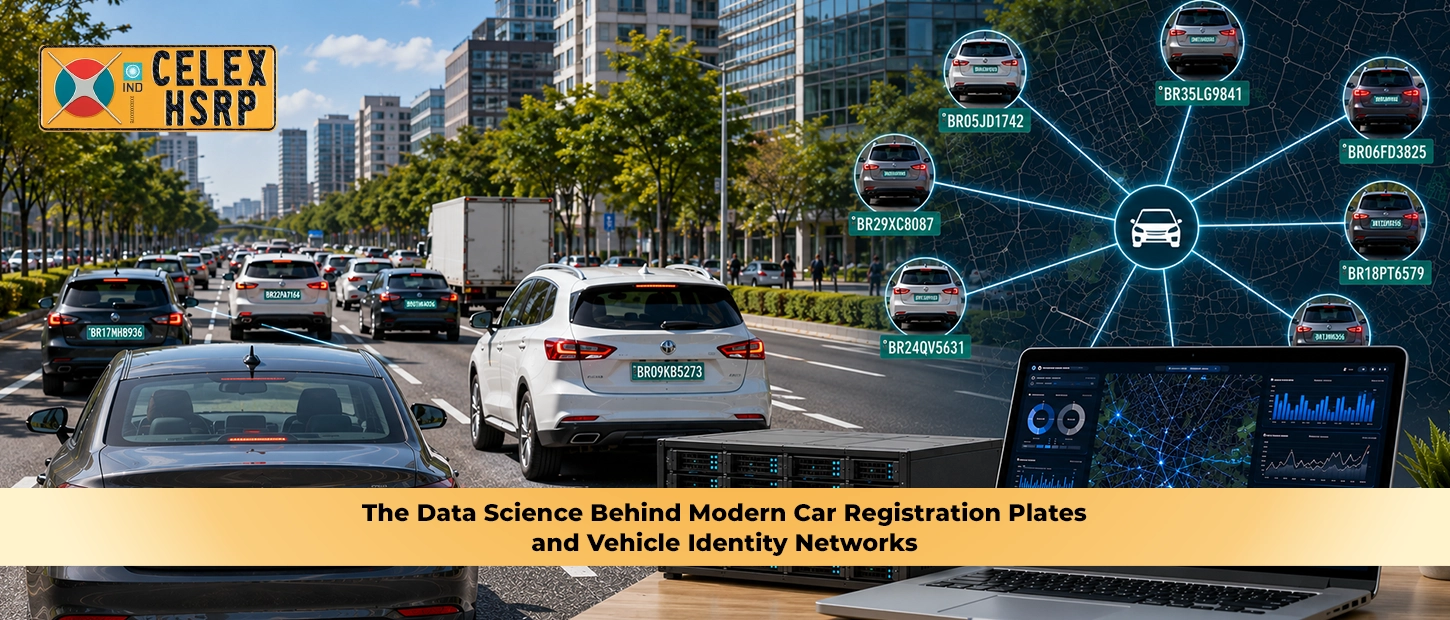
Today, every car registration plate represents a structured data point within a broader digital infrastructure. It connects to centralised databases managed by transport authorities, insurance platforms, enforcement agencies, and compliance monitoring systems. The plate itself is the physical key that unlocks a comprehensive digital profile associated with every registered vehicle.
Data science has transformed vehicle identification by introducing standardisation, automated recognition, pattern analysis, and predictive modelling into transportation management. These capabilities allow authorities to process enormous volumes of vehicle data accurately and efficiently.
How has data science changed the role of car registration plates?
It has shifted them from passive display items into active data nodes. Every plate interaction generates structured information that feeds into larger analytical frameworks supporting governance, safety, and operational planning across transportation networks.
Manufacturers who produce precision-engineered High Security Registration Plates contribute directly to this transformation by ensuring that every plate meets the exact technical specifications that modern data systems require for reliable performance.
Understanding Vehicle Identity Networks and Their Growing Importance
India has over 413 million registered vehicles as of 2025, according to the Ministry of Road Transport and Highways. Accurately managing the identities of that many vehicles is an extraordinary operational challenge. Vehicle identity networks are the systems built to meet that challenge.
A vehicle identity network connects physical vehicles to digital records through a combination of registration databases, compliance platforms, insurance systems, enforcement infrastructure, and verification mechanisms. Every node in this network depends on one consistent reference point to function correctly. That reference point is the car registration plate.
Why are vehicle identity networks so important for transportation management?
Because transportation systems cannot function safely or efficiently without reliable vehicle identification. Fraud detection, ownership verification, insurance validation, traffic enforcement, and regulatory compliance all require accurate identity data. A weak identification foundation compromises every system built on top of it.
Modern HSRP systems strengthen these networks by delivering unique, tamper-resistant, machine-readable identifiers that remain consistent throughout a vehicle’s operational lifecycle. Manufacturers focused on precision production and regulatory compliance to directly support the integrity of these nationwide identity networks.
The scale of this infrastructure is significant. Centralised transport databases process millions of queries daily across enforcement, insurance, registration, and compliance functions, all triggered by a single identifier displayed on a registration plate.
How Car Registration Plates Function as Data Anchors in Mobility Ecosystems
Think of a car registration plate as a primary key in a relational database. Every record associated with a vehicle links back to that single identifier. Ownership details, insurance coverage, service history, compliance status, tax records, and enforcement interactions all connect through the plate number.
This makes registration plates genuine data anchors within connected mobility environments. They are not standalone objects. They are access points to entire ecosystems of verified vehicle information.
What data does a car registration plate connect to in a modern vehicle identity ecosystem?
The list is extensive. Ownership and transfer records. Insurance policy status. Pollution under control certificates. Road tax payments. Traffic violation histories. Fitness certification data. Import and manufacturing records for applicable vehicles. Each category represents a distinct database layer, and the registration plate ties them all together.
This architecture creates powerful operational benefits. Enforcement officers retrieve complete vehicle profiles instantly. Insurance platforms verify coverage in real time. Traffic management systems identify non-compliant vehicles automatically. None of this works without a reliable, standardised, and consistent plate identifier at the foundation.
Secure manufacturing practices that produce durable, accurately coded plates directly protect the integrity of this data anchor function across years of operational use.
The Science of Data Collection Through Vehicle Identification Systems
Data does not collect itself. Behind every traffic camera, toll booth, parking system, and enforcement checkpoint sits a structured data acquisition framework that depends entirely on reading registration plates accurately.
Automatic Number Plate Recognition technology captures plate information optically and matches it against centralised databases within milliseconds. This process powers electronic toll collection, traffic violation detection, stolen vehicle identification, and smart parking management simultaneously.
How does registration plate data contribute to transportation intelligence?
Every successful plate read generates a structured data record containing the plate identifier, timestamp, location, and interaction type. Aggregated across millions of daily interactions, this data builds a rich picture of vehicle movement patterns, compliance behaviours, and traffic flows that transportation authorities use for planning and governance.
The quality of this data depends directly on plate quality. Reflective sheeting that performs consistently under varying light conditions improves recognition accuracy significantly. Standardised character spacing and font specifications reduce optical recognition errors. Durable materials maintain readability across years of weather exposure.
India’s HSRP mandate specifically addresses these quality requirements by establishing technical standards that every approved manufacturer must meet. The accuracy of national transport data collection systems is thus directly impacted by manufacturers who invest in precision engineering and high-quality materials.
Registration Plate Traceability and the Architecture of Vehicle Records
Traceability is one of the most valuable capabilities that modern vehicle identity networks provide. A fully traceable vehicle record connects every significant event in a vehicle’s lifecycle to a single consistent identifier, creating an auditable history that supports transparency and accountability.
The lifecycle begins at manufacturing or import registration. It continues through initial ownership, insurance activation, compliance inspections, service records, ownership transfers, traffic interactions, and eventually decommissioning. Every stage generates data. Every data point links back to the registration plate.
Why does traceability matter in vehicle identity management?
It protects buyers, insurers, authorities, and the public simultaneously. A traceable vehicle history prevents odometer fraud, conceals accident records, exposes stolen vehicle circulation, and supports accurate insurance risk assessment. Without traceability, the entire used vehicle market and insurance ecosystem operate on incomplete and potentially manipulated information.
Modern HSRP number plates support this traceability function through precision-engineered security features and tamper-evident physical designs that connect reliably to centralised digital databases. The physical plate and the digital record reinforce each other throughout the vehicle’s operational life.
Celex Technologies Pvt Ltd supports this traceability objective through advanced manufacturing processes, precision-engineered security features, and compliance-focused production standards that maintain consistent identity continuity throughout a vehicle’s operational lifecycle.
How Data Science Enhances Fraud Prevention and Vehicle Authentication
Vehicle identity fraud is a genuine and costly problem. Cloned plates, forged registrations, and manipulated vehicle records enable insurance fraud, facilitate stolen vehicle circulation, and compromise enforcement effectiveness. Data science provides increasingly powerful tools for detecting and preventing these activities.
Pattern recognition algorithms analyse registration plate data across enforcement and compliance databases to identify anomalies. Unusual movement patterns, mismatched ownership records, duplicate identifiers, and inconsistent compliance histories all trigger investigation flags. These models improve continuously as they process more data over time.
How does data science help prevent car registration plate fraud?
It creates a multi-layered verification environment where every claimed vehicle identity must align consistently across multiple independent data sources. A cloned plate creates discrepancies. A forged registration generates inconsistencies. Predictive models flag these patterns before manual investigators would detect them.
Physical security features on modern High Security Registration Plates add a complementary protection layer. Chromium-based holograms, snap-lock fasteners, hot-stamped foiling, and tamper-resistant design elements create a physical identifier that is extremely difficult to replicate accurately. Combining robust physical security with sophisticated data analysis creates a fraud prevention framework significantly stronger than either approach alone.
Celex Technologies Pvt Ltd contributes to this framework through its commitment to manufacturing precision, quality control, and compliance-focused production standards that strengthen authentication confidence across vehicle identity networks.
The Role of Machine Readability in Modern Car Registration Plate Systems
Transportation systems today operate at a scale where manual identification is simply not viable. Thousands of vehicles pass through a single urban corridor every hour. Enforcement systems, tolling infrastructure, and traffic management platforms all require automated identification to function effectively.
Machine readability has therefore become a fundamental technical requirement for modern car registration plates. Optical recognition systems need consistent character dimensions, adequate contrast, reliable reflectivity, and standardised layouts to achieve accurate reads across diverse operational conditions.
Why does plate manufacturing quality directly affect machine recognition performance?
Because optical recognition algorithms are trained on specific design parameters. Plates that deviate from standardised specifications through poor material quality, inconsistent manufacturing, or physical damage generate recognition errors. Those errors corrupt downstream data and reduce system efficiency across every application that depends on accurate identification.
Approved HSRP number plate manufacturers must meet technical specifications covering reflectivity levels, character geometry, material durability, and coding accuracy. These requirements exist precisely because machine readability is a system-level requirement, not just a product feature.
Celex Technologies Pvt Ltd’s precision manufacturing approach ensures that its plates meet these standards consistently, supporting seamless integration with machine-driven transportation technologies across diverse operational environments.
Connecting Car Registration Plates with Intelligent Transportation Infrastructure
Smart cities depend on data. Traffic optimisation systems, congestion pricing platforms, pollution monitoring networks, automated enforcement infrastructure, and mobility analytics platforms all consume vehicle identification data continuously.
Car registration plates sit at the entry point of this entire data flow. Every camera read, every toll transaction, every parking interaction begins with identifying the vehicle through its plate. The accuracy and consistency of that identification directly affect the quality of every downstream analysis.
How do registration plates support smart city transportation planning?
Registration plate data aggregated across time and geography reveals traffic patterns, identifies congestion hotspots, measures compliance rates, and supports infrastructure planning decisions. Cities use this intelligence to optimise signal timings, plan road expansions, design enforcement strategies, and evaluate mobility policy outcomes.
India’s smart city initiatives and the broader National Intelligent Transportation Systems framework explicitly depend on standardised vehicle identification as a foundational requirement.
Celex Technologies Pvt Ltd’s focus on producing consistent, machine-compatible, and durable HSRP systems supports this intelligent infrastructure by delivering the reliable identification layer these nationwide mobility modernisation projects require.
Data Integrity and Security Within Vehicle Identity Networks
A vehicle identity network is only as trustworthy as the data it contains. Inaccurate records, manipulated databases, and compromised identity systems create operational failures across every dependent application. Data integrity is therefore a foundational requirement, not an optional enhancement.
Maintaining data integrity within vehicle identity networks requires protection at multiple levels. Database security prevents unauthorised access and manipulation. Identity verification processes ensure that records accurately reflect physical reality. Tamper-resistant registration plates prevent unauthorised modification at the physical layer. Regular synchronisation across distributed databases maintains consistency across the entire system.
What are the biggest data integrity risks in vehicle identity systems?
Unauthorised database modifications represent a serious risk. Physical plate tampering creates mismatches between records and reality. Delayed synchronisation across database systems generates temporary inconsistencies that enforcement and compliance platforms can exploit or misinterpret. Each risk requires targeted protective measures at both the technical and physical levels.
In order to overcome these obstacles, Celex Technologies Pvt Ltd is dedicated to quality control, regulatory compliance, and advanced manufacturing standards that guarantee each plate provides consistent physical security features, resists tampering throughout its operational lifespan, and safeguards the integrity of linked vehicle identity records.
The Growing Influence of Predictive Analytics on Vehicle Identification Systems
Predictive analytics is changing how transportation authorities use registration plate data. Historically, vehicle identification supported reactive processes. A violation occurred. A plate was read. A record was retrieved. Modern analytics frameworks are shifting this toward proactive management.
Registration plate data combined with historical compliance records, movement patterns, and behavioural analytics allows authorities to forecast where and how violations are likely to occur. Enforcement resources can be deployed more effectively. Compliance campaigns can target specific vehicle categories or geographic areas. Policy decisions can incorporate data-driven evidence about transportation behaviour.
How can predictive analytics improve transportation governance through registration plate data?
By transforming historical records into forward-looking intelligence. A vehicle with a pattern of compliance failures becomes a targeted intervention priority. Geographic zones with high rates of unregistered vehicle movement receive focused enforcement attention. Insurance risk models incorporate actual driving pattern data to price policies more accurately.
These capabilities depend entirely on accurate, consistent, and comprehensive vehicle identification data. Celex Technologies Pvt Ltd’s manufacturing precision and compliance-focused production practices ensure that the underlying identification data feeding these predictive models remains accurate, consistent, and trustworthy across large-scale transportation environments.
How Celex Technologies Pvt Ltd Is Advancing the Future of Vehicle Identity Networks
Celex Technologies Pvt Ltd occupies a significant position within India’s vehicle identity infrastructure as the top HSRP number plate manufacturer focused on precision, compliance, and scalability. The company’s manufacturing capabilities cover the full production spectrum from material selection and security feature integration through regulatory certification and quality assurance.
Its plates meet the technical specifications required by modern automated recognition systems, supporting consistent machine readability across diverse operational environments. The security features incorporated into its products strengthen fraud resistance at the physical layer, complementing the data-level protections built into centralised vehicle databases.
Why does manufacturing expertise matter so much for vehicle identity network reliability?
Because the physical plate is the starting point for every digital interaction. Software systems, analytics platforms, and enforcement networks are all downstream of that initial physical identification event. A plate that fails to read accurately, gets tampered with easily, or degrades prematurely undermines every system built on top of it.
Celex Technologies Pvt Ltd’s focus on manufacturing excellence, regulatory compliance, and nationwide scalability positions it as a key contributor to India’s evolving digital vehicle identity infrastructure. As transportation ecosystems grow more connected and data-driven, the importance of reliable physical identity infrastructure only increases, and manufacturers who consistently meet that standard become strategically essential to the entire ecosystem.
Conclusion
Car registration plates have completed a remarkable transformation. They began as simple administrative markers. They have become sophisticated data anchors connecting physical vehicles to comprehensive digital identity ecosystems that support governance, safety, compliance, analytics, and intelligent mobility management simultaneously.
The data science underpinning modern vehicle identity networks is sophisticated, layered, and continuously evolving. Centralised databases, automated recognition systems, fraud detection algorithms, predictive analytics, and traceability frameworks all depend on one consistent foundation: a reliable, standardised, and secure registration plate identifier.
Every manufacturer, authority, and technology provider contributing to this ecosystem plays a role in determining how effectively transportation systems serve the public. Manufacturers who invest in precision engineering, security feature integrity, and regulatory compliance are building the physical identity layer that all other systems depend on.
As India’s transportation ecosystem grows increasingly connected, intelligent, and data-driven, the role of secure HSRP systems will only become more strategically important. The future of transportation intelligence begins with a reliable vehicle identity. And that identity begins with the registration plate.
Frequently Asked Questions
1. What is the role of data science in modern car registration plate systems?
Data science enables automated recognition, fraud detection, pattern analysis, and predictive modelling using registration plate data, transforming vehicle identification from a manual administrative process into an intelligent, data-driven transportation management capability.
2. How do car registration plates connect to centralised vehicle databases?
Every registration plate carries a unique identifier that links directly to centralised records containing ownership details, insurance status, compliance history, and enforcement interactions, enabling instant data retrieval across multiple transportation management platforms.
3. Why are High Security Registration Plates important for vehicle identity networks?
HSRPs provide tamper-resistant, machine-readable identifiers with precision-engineered security features that maintain consistent physical integrity throughout a vehicle’s lifecycle, protecting the accuracy of connected digital records.
4. How does machine readability affect transportation data quality?
Consistent machine-readable plates improve automated recognition accuracy, reducing data errors across tolling, enforcement, traffic management, and compliance platforms that depend on reliable vehicle identification for effective operation.
5. How does predictive analytics use car registration plate data?
Predictive models analyse historical plate data alongside compliance records and movement patterns to forecast violations, optimise enforcement resource deployment, improve insurance risk assessment, and support transportation policy planning decisions.