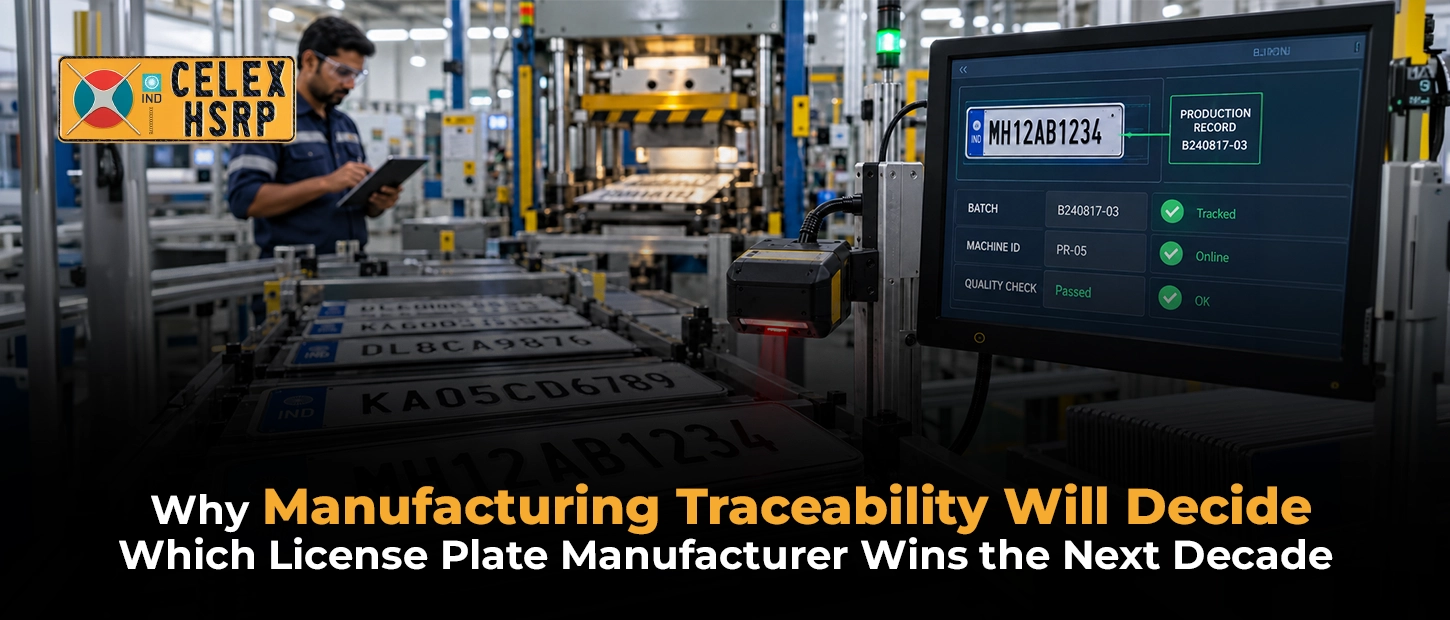
Ask any procurement head at an RTO or OEM what keeps them up at night, and traceability will come up fast. When a plate fails, cracks, or gets flagged during an audit, someone has to answer where it came from, which batch it belonged to, and which machine produced it. A license plate manufacturer without clean production records cannot answer that question quickly, and that delay will cost contracts, trust, and sometimes legal standing.
India’s HSRP framework already demands strict traceability, from the laser-etched permanent identification number down to the vendor authorisation chain. The manufacturers who treat traceability as a checkbox will struggle. The ones who build it into their DNA will win the next decade of contracts.
This article breaks down what real manufacturing traceability looks like in a plate production facility, why it matters more than ever, and what sets a genuinely reliable top HSRP number plate manufacturer apart from the rest of the pack. Continue reading to learn just what to look for.
What Manufacturing Traceability Actually Means for a License Plate Manufacturer
Traceability inside a manufacturing plant is not the same as vehicle lifecycle tracking. Vehicle lifecycle tracking follows a plate after it leaves the factory, through registration, fitment, and eventual replacement. Manufacturing traceability is narrower and, in many ways, more demanding. It means every single plate can be traced back to its exact production batch, the raw material lot used, the machine that pressed it, the operator on shift, and the quality checkpoint it passed through.
This matters enormously for a product like the HSRP, which is legally classified as non-replicable, made from 1.0 mm aluminium with a permanent, laser-branded ten-digit identification number, and designed to be tamper-proof through a snap lock mechanism that breaks if forcibly removed. A plate with this security sensitivity cannot afford gaps in its production story.
Why does traceability matter more for HSRP than ordinary number plates? Because HSRP is directly linked to a centralised vehicle database, and any inconsistency between the physical plate and its recorded origin raises immediate red flags for authorities. A license plate manufacturer that can produce a complete, auditable trail for any plate, on demand, is offering something far more valuable than just a physical product. They are offering accountability, and in a security product, accountability is the entire point.
Batch Identification and Why It Is the Backbone of Traceable Production
Batch identification is where traceability begins on the factory floor. Every production run, whether it produces five hundred plates or fifty thousand, needs a unique batch code tied to specific raw material lots, machine settings, and the exact time window of production.
This might sound like an administrative detail, but it carries real operational weight. If a defect is later discovered in field use, a manufacturer with strong batch identification can isolate exactly which run produced the faulty plates within minutes. A manufacturer without this system has to guess, and guessing in a security product industry is simply not acceptable.
Indian HSRP manufacturing already sits inside a tightly regulated supply chain. Authorised vendors are approved directly by a government-recognised testing agency, and the government does not allow OEMs, vehicle owners or dealers to source plates from the open market. This regulatory structure exists precisely because unregulated sourcing would make batch-level accountability impossible.
What happens when batch identification fails? Recall efforts become slower, costlier, and far less precise, often forcing a manufacturer to flag entire shipments instead of a single affected batch. That kind of blunt response damages relationships with OEM customers and dealer partners who expect a much sharper, more surgical response to any quality issue.
Production Records and Quality Checkpoints That Build an Auditable Trail
Production records are the connective tissue between raw material and finished plate. Every stage of manufacturing, from aluminium sheet cutting to hologram lamination to laser etching, should generate a record that is timestamped, machine-linked, and stored in a retrievable format.
Quality checkpoints sit inside this same trail. A plate that passes through embossing, laser branding, and final inspection should carry a digital footprint at each stage, confirming it met specifications before moving forward. This creates layered accountability rather than a single pass-or-fail moment at the very end of the line.
Standardisation plays a role here, too. HSRPs must maintain uniform font, size, colour, and border specifications as per the Central Motor Vehicle Rules, which means quality checkpoints are not just about catching visible defects. They are about confirming regulatory compliance at every single stage of production, something a top HSRP number plate manufacturer cannot afford to treat casually.
How do production records actually protect a manufacturer during an audit? They provide immediate, verifiable proof that every plate met specification at every stage, which shortens audit timelines and reduces the risk of penalties tied to unclear or missing documentation, a genuine business risk in a heavily regulated product category like this one.
Order Histories and Controlled Movement from Manufacturing to Dispatch
Traceability does not stop once a plate passes final inspection. Order histories connect finished plates to specific dealer partners, OEM customers, or state vendor contracts, and controlled movement tracking follows each batch from the production floor through packaging and dispatch.
This stage matters because HSRP plates are only meant to reach vehicle owners through authorised vendor channels. The government’s insistence that plates cannot be sourced from the open market means the movement of finished plates has to be just as controlled as their production. A gap here creates an opening for counterfeit plates to enter circulation, undermining the entire security purpose of the HSRP system.
Why does controlled dispatch matter as much as controlled production? Because a plate with a perfectly clean production record loses its value if the movement from factory to fitment centre cannot be verified with equal confidence. Order histories tied to specific batch codes allow a manufacturer to confirm exactly which dealer partner or vendor received which shipment, and when.
This level of dispatch control also protects manufacturers commercially. With networks spanning hundreds of touch points and thousands of dealer partners across multiple states, a manufacturer supplying at national scale needs order history systems robust enough to prevent stock discrepancies, delayed shipments, and disputes over delivery accuracy.
Why Traceability Creates Accountability in a Security-Sensitive Product Category
HSRP is not a generic consumer product. It sits inside a security framework designed to stop vehicle theft, plate duplication, and fraudulent reuse. A plate’s core physical features- the chromium-based hologram, the laser-etched permanent identification number, and the non-reusable snap lock- only work as intended if the manufacturing process behind them is equally rigorous.
Manufacturing traceability creates accountability at every point where something could go wrong. If a hologram batch shows weaker adhesion, traceability identifies exactly which lamination run and which raw material lot are responsible. If a laser-etched code becomes unreadable, traceability points directly to the specific engraving machine and shift involved.
What role does traceability play in preventing counterfeit HSRP plates? A manufacturer with complete production records makes it significantly harder for counterfeit plates to blend into the legitimate supply chain, because every authentic plate can be verified against a specific, documented production history. This directly supports the centralised database linkage that HSRP plates are built around, strengthening the entire anti-theft and anti-duplication purpose the plate was designed to serve.
Manufacturers who build this level of rigour into daily operations are not just meeting compliance requirements. They are building the kind of institutional trust that state transport departments and OEM customers actively look for when awarding long-term supply contracts.
What Separates a Trustworthy License Plate Manufacturer from the Rest
Scale alone does not make a manufacturer trustworthy. A license plate manufacturer earns trust through consistency, documentation, and the ability to answer hard questions quickly when something goes wrong. Authorisation from a state Transport Department is only the starting point, not proof of ongoing operational excellence.
Vendor Authorisation and Regulatory Standing
The authority to manufacture and supply HSRPs involves multiple layers of approval and certification, and this process exists specifically to filter out manufacturers who cannot meet the security and quality bar required for this product category. Maintaining that authorisation requires continuous compliance, not a one-time approval.
Scale, Consistency, and Long-Term Reliability
A manufacturer supplying crores of plates annually across multiple states needs traceability systems that scale without breaking down under volume. Consistency across 23 or more states, hundreds of touch points, and thousands of dealer partners is only possible when batch identification, production records, and dispatch tracking are built to handle genuine national scale, not just pilot-level operations.
The Future of Traceability in India’s License Plate Manufacturing Industry
Enforcement around HSRP has tightened significantly through 2026, with states integrating vendor systems directly with centralised vehicle databases and blocking key RTO services for vehicles not properly linked to an official HSRP record. This regulatory direction signals where the entire industry is heading. Traceability is no longer a background operational detail. It is becoming a frontline compliance requirement that regulators actively check.
Will traceability requirements get stricter for license plate manufacturers in the coming years? Very likely, given how closely HSRP data is already tied to centralised systems and how directly enforcement now affects services like duplicate RC issuance. Manufacturers who invest in robust batch tracking, digital production records, and controlled dispatch systems will now be far better positioned as compliance expectations continue to rise. Those still relying on manual, fragmented record-keeping risk falling behind both regulatory expectations and the trust of OEM customers who need reliable, auditable supply partners for the decade ahead.
In a Nutshell
Manufacturing traceability has quietly become the single biggest differentiator among license plate manufacturers in India. Batch identification, production records, quality checkpoints, order histories, and controlled dispatch together create an auditable chain that protects manufacturers, regulators, and vehicle owners alike.
In a security-sensitive product category like HSRP, where centralised databases and strict vendor authorisation already shape the entire supply chain, traceability is not an optional infrastructure. It is the foundation of trust. Manufacturers who invest in transparent, well-documented production systems today are the ones positioned to win long-term contracts, maintain regulatory standing, and earn lasting confidence from OEM customers and dealer partners.
As enforcement tightens and centralised tracking expands across more states, traceability will only grow more central to how manufacturers are evaluated and chosen in the years ahead.
Partner With Celex Technologies Pvt Ltd for Traceable & Precision-Driven HSRP Manufacturing
Celex Technologies Pvt Ltd brings over 23 years of industry experience to India’s HSRP ecosystem, having supplied more than 6.10 crore high security registration plates across 23 states through a network of 348 touch points and 12,000-plus dealer partners. With 500-plus OEM customers, an annual capacity exceeding 5 crore plates, and a turnover surpassing 110 crore in 2024 to 2025, Celex Technologies Pvt Ltd combines national scale with disciplined, auditable production practices. If you need a trusted and reputed license plate manufacturer that treats traceability as a foundation, not an afterthought, Celex Technologies Pvt Ltd is ready to support your requirements. Visit celex.co.in to explore partnership opportunities today.
Frequently Asked Questions (FAQs)
1. Why is manufacturing traceability important for a license plate manufacturer?
It allows manufacturers to trace any plate back to its exact batch, machine, and quality checkpoint, enabling faster issue resolution and stronger regulatory compliance.
2. How is HSRP traceability different from ordinary number plate production?
HSRP is linked to a centralised vehicle database and requires strict vendor authorisation, making production-level traceability a legal and security necessity, not optional.
3. What is batch identification in license plate manufacturing?
Batch identification assigns a unique code to each production run, tying it to specific raw materials, machine settings, and time windows for accountability.
4. Can vehicle owners buy HSRP plates from unauthorised sellers?
No, HSRP plates must be procured only through vendors authorised by the OEM/state Transport Department to maintain traceability and prevent counterfeiting.
5. Will traceability requirements for manufacturers get stricter in the future?
Yes, enforcement is tightening as states integrate vendor systems with centralised databases, making robust production traceability increasingly essential for manufacturers.