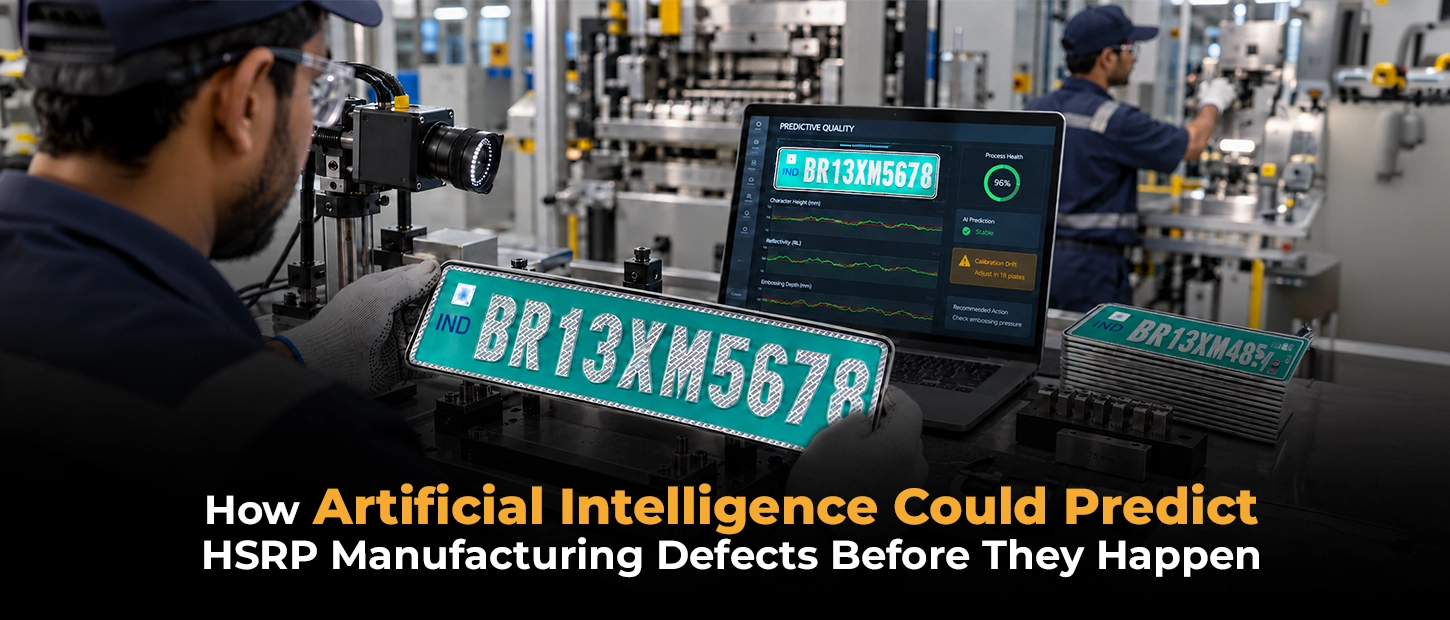
Every vehicle owner in India knows the drill. You buy a car, wait for your high security registration plates, and hope the plate that arrives actually fits, scans, and lasts. But what happens when a batch slips through with a misaligned hologram, a weak laser stamp, or a hairline crack in the aluminium sheet?
That single defect can delay registrations, trigger rework, and dent a manufacturer’s reputation overnight. Manual inspection catches some flaws, but it misses subtle patterns hiding in machine data long before a plate ever fails.
This article explores how artificial intelligence could flip the script for HSRP manufacturing in India, spotting defect risks before production even finishes. If you care about quality, compliance, or want to know where India’s plate manufacturing industry is headed, stick around. You are about to see why predictive intelligence might be the biggest shift this sector has seen in years.
What Are High Security Registration Plates and Why Quality Matters So Much in India
High security registration plates, commonly shortened to HSRP, are tamper-proof number plates mandated by the Ministry of Road Transport and Highways for every vehicle in India. Vehicles sold before 1 April 2019 must retrofit an HSRP, and non-compliance attracts fines ranging from roughly Rs 5,000 to Rs 10,000 depending on the state. Each plate carries a chromium-based Ashoka Chakra hologram, a unique laser-etched permanent identification number, and a non-reusable snap lock that breaks the moment someone tries to remove it.
Why does this matter for India’s road safety numbers? The Ministry of Road Transport and Highways has recorded nearly 170,000 annual road fatalities, a figure that has directly pushed regulators to mandate stricter vehicle identification and even AI-enabled advanced driver assistance features for commercial vehicles starting in 2026. HSRP sits right at the centre of this push because a traceable, tamper-proof plate is the backbone of enforcement, theft prevention, and accident investigation. A single defective plate is not just a manufacturing slip. It is a small crack in a much bigger national safety system.
The Current State of Quality Control in HSRP Production Across India
Most HSRP manufacturing units in India rely on a mix of automated optical inspection and human checks. Machines scan for visible defects like scratches, misprints, or hologram misalignment, and skilled operators do a final visual pass before plates are packed and sent to dealer partners.
This system works, but it has a well-documented weakness. It only catches defects after they exist, and manual inspection alone is genuinely unreliable at scale. Globally, traditional visual inspection has been shown to miss 20 to 30 per cent of defects, largely because of inspector fatigue. India is not immune to this gap.
Is AI already used in HSRP manufacturing in India? To a growing extent, yes. TeamLease data shows manufacturing sector AI usage in India jumped sharply from around 8 per cent to 22 per cent within a single year, part of an overall AI adoption rate across Indian industries of 48 per cent in FY2024. In the automotive space specifically, adoption is even faster. A 2026 Analytics Insight study found the automotive industry leading AI adoption globally at 26 per cent, and India’s own automotive AI market is expected to grow rapidly through 2032. NASSCOM’s Smart Factory Index reported that Indian enterprises adopting AI-powered automation saw up to a 45 per cent improvement in Overall Equipment Effectiveness, along with 30 per cent shorter cycle times and 25 per cent fewer unexpected stoppages. But most of this remains reactive detection. The next leap is prediction.
Understanding Predictive Quality Management in Manufacturing
Predictive quality management flips traditional inspection on its head. Instead of asking “is this plate defective,” it asks “will this plate become defective, and why?” It relies on continuous data collection from machines, sensors, and process logs, then applies statistical models and machine learning to spot patterns that precede failure.
Picture a laser engraving machine stamping the permanent identification number onto each plate. Over hours of continuous operation, laser intensity can drift due to heat buildup or lens wear. A human operator might not notice until dozens of plates come out with a faint or unreadable code. A predictive model tracks laser intensity in real time and flags the exact moment values start trending toward failure.
How is predictive maintenance already helping Indian manufacturers? Industry reporting shows that Indian automotive firms using IoT sensors, AI-driven predictive algorithms, and vision systems have cut machine breakdowns by around 20 per cent, improved efficiency by 15 per cent, and reduced defects by roughly 25 per cent. Separately, the World Economic Forum has found that AI-powered factories globally, a benchmark increasingly relevant to Indian plants adopting similar systems, recorded 12.5 per cent lower material costs, 66 per cent fewer defects, and up to 20 per cent faster cycle times. Applied to HSRP production, this kind of predictive discipline means fewer defective plates, less wasted raw material, and faster turnaround for the thousands of dealer partners waiting on stock across Indian states.
How Machine Learning Models Detect Defect Patterns Before They Occur
Machine learning models thrive on data, and HSRP manufacturing generates plenty of it. Every press cycle, laser pulse, and hologram lamination run produces measurable parameters like temperature, pressure, speed, and material thickness. When these parameters are logged consistently, an algorithm learns what “normal” looks like and flags anything that deviates from it.
How does machine learning identify manufacturing defects early? It works through pattern recognition. The model is trained on historical data covering both good plates and defective ones, along with the exact machine conditions present when each was produced. Over time, it learns subtle correlations that humans would struggle to spot manually, such as a specific combination of humidity and press speed that slightly raises the chance of a hologram bubble. India’s Ministry of Electronics and Information Technology has projected that digital technologies will account for 40 per cent of total manufacturing expenditure, up from just 20 per cent a few years earlier, a shift that puts data-driven quality systems firmly on the national manufacturing roadmap.
Anomaly Detection in Real Time
Anomaly detection algorithms constantly compare live sensor data against a learned baseline. The moment a reading falls outside the expected range, whether it is a dip in laser power or unusual vibration in the embossing press, the system raises a flag within seconds, giving operators time to pause the line before dozens of plates are wasted. A FICCI–EY survey found that AI-based visual inspection reduced rework rates by nearly 30 per cent at Indian OEM plants that adopted the technology, a number that hints at what full predictive systems could achieve for HSRP lines specifically.
Root Cause Correlation
Beyond flagging anomalies, advanced models attempt to trace the likely root cause. If plates from a specific shift consistently show weaker snap lock strength, the system can correlate that pattern with machine calibration logs from the same period, pointing engineers directly to the problem instead of leaving them to guess through trial and error.
The Role of Sensor Data and IoT in Predictive Quality Systems
None of this predictive capability works without good data, and good data starts with sensors. Indian manufacturing facilities are increasingly adopting Internet of Things-enabled equipment that continuously records operational metrics. Temperature probes on lamination presses, pressure gauges on embossing machines, and optical sensors on laser engravers all feed data into a central monitoring platform.
This connected infrastructure, often called a smart factory setup, is a genuine growth story in India. The domestic smart manufacturing market has been projected to grow at over 30 per cent CAGR through 2026, and India’s broader AI in manufacturing market is expected to reach nearly USD 4.89 billion by 2030 at a 41.5 per cent CAGR. Industrials and automotive together are expected to drive around 60 per cent of India’s net new AI value through FY2026.
What sensors are used in predictive HSRP quality control, and what holds Indian plants back? Common sensors include thermal sensors for lamination heat, pressure transducers for embossing force, laser power meters for engraving consistency, and optical cameras for real-time surface inspection. Even so, industry analysis of Indian factory floors points out that poor data integrity in legacy systems, not a lack of ambition, remains the single biggest barrier to scaling AI across Indian plants. Predictive maintenance and machine vision inspection remain the two most deployed AI use cases on Indian factory floors today, which is encouraging for an industry as safety-critical as HSRP manufacturing.
Reducing Raw Material Waste and Production Costs Through AI
Wasted raw material is one of the most overlooked costs in manufacturing, and HSRP production is no exception. Aluminium sheets, chromium hologram foils, and reflective sheeting all carry real costs. When a batch fails inspection after full production, every bit of material used in that batch is essentially wasted.
Predictive quality systems change this equation. By catching process deviations mid-production rather than post-production, manufacturers can halt a run before an entire batch is compromised. Indian manufacturers adopting industrial AI have reported up to a 50 per cent reduction in defects, according to a 2026 analysis of AI return on investment across Indian automotive, electronics, and FMCG sectors, with some Indian manufacturers achieving industrial AI returns as high as 457 per cent. Reduced scrap directly means fewer material purchases, and fewer material purchases mean healthier margins even as compliance volumes rise.
There is also a ripple effect across dealer networks. Fewer defective batches mean more predictable delivery timelines. With thousands of dealer partners depending on consistent stock across 23 or more states, even a modest improvement in first pass yield translates into smoother operations across the distribution chain. For manufacturers operating at scale, supplying crores of plates annually, this efficiency gain compounds quickly into real cost savings.
Challenges in Implementing AI-Driven Predictive Quality Systems in India
Adopting predictive quality management is not as simple as installing new software, and Indian manufacturers face some specific hurdles here. It requires clean, consistent historical data, which many units have not traditionally collected in a structured format. Building a reliable model demands months of labelled defect data paired with corresponding machine parameters.
What challenges do Indian manufacturers face when adopting AI for defect prediction? Data quality remains the biggest hurdle, echoed repeatedly in Indian industry analysis pointing to legacy machines, patchy sensor data, and a shortage of AI-literate engineers as the real bottlenecks, more so than lack of intent. There is also the challenge of integrating new AI systems with older machinery that was never designed to output digital data streams in the first place.
Workforce Training and Change Management
Operators and quality engineers need training to interpret AI-generated alerts correctly. A predictive system is only as useful as the human response to its warnings. Without proper training, alerts get ignored, and the entire investment loses value. This is precisely why 44 per cent of automotive and manufacturing leaders surveyed in India call AI “highly important,” while another 49 per cent call it “absolutely critical,” a combined signal that skills investment now matters as much as the technology itself.
Initial Investment and Return on Investment Timelines
Sensor networks, computing infrastructure, and skilled data science talent all require upfront investment. Manufacturers need realistic expectations about the payback period, typically several production cycles before the model matures enough to deliver consistently reliable predictions, even though some Indian manufacturers have reported industrial AI returns exceeding 450 per cent once systems mature.
The Future of AI in High Security Registration Plate Manufacturing in India
Looking ahead, predictive quality systems are likely to become standard practice across Indian HSRP manufacturing rather than a competitive edge, especially as vehicle registration volumes keep climbing and states tighten enforcement. Passenger vehicle exports from India reached roughly 0.77 million units recently, and two-wheeler sales touched 19.6 million units, a scale that only reinforces why predictive, not reactive, quality control matters for every safety-critical component riding on these vehicles, HSRP included.
Will AI replace human inspectors in HSRP manufacturing? Not entirely. AI will handle the heavy lifting of pattern detection and early warning, but human judgment remains essential for final verification, troubleshooting complex issues, and nuanced quality decisions that data alone cannot fully capture. Major Indian OEMs including Tata Motors, Mahindra & Mahindra, and Maruti Suzuki are already embedding AI not just for efficiency but as a genuine competitiveness enabler, and industry commentary suggests digital twins and predictive maintenance will be mainstream across Indian manufacturing by 2030. Expect closer integration between predictive quality models and automated corrective actions, where machines automatically adjust parameters like laser intensity or press pressure the moment early warning signs appear. This kind of self-correcting manufacturing line represents the natural evolution of today’s anomaly detection systems.
Conclusion
Predictive quality management represents the next meaningful leap for HSRP manufacturing in India. Moving beyond simple automated inspection, artificial intelligence now offers the ability to forecast defects using sensor data, historical production patterns, and machine learning models trained on real-world outcomes.
Indian data already backs this shift, from a 48 per cent overall AI adoption rate across industries to automotive-specific gains like a 25 per cent reduction in defects and nearly 30 per cent lower rework rates at OEM plants using AI-based inspection. This shift reduces raw material waste, improves first-pass yield, and strengthens reliability for dealer partners and OEM customers alike. While challenges around data quality, workforce training, and upfront investment remain real, the direction is clear.
Manufacturers who embrace predictive intelligence today are positioning themselves for stronger quality control, lower operational costs, and greater trust across India’s rapidly expanding vehicle registration ecosystem.
Time to Choose a Manufacturer Who Relies on Data, Precision, and Trust (H2)
As the best HSRP manufacturer, Celex Technologies Pvt Ltd brings over 23 years of industry experience to India’s HSRP ecosystem, having supplied more than 6.10 crore high security registration plates across 23 states through a network of 348 touch points and 12,000-plus dealer partners. With 500-plus OEM customers, an annual capacity exceeding 5 crore plates, and a turnover surpassing 110 crore in 2024 to 2025, Celex Technologies Pvt Ltd combines national scale with manufacturing precision. If you want a partner that understands both compliance and quality at scale in India’s evolving HSRP landscape, Celex Technologies Pvt Ltd is ready to support your registration plate needs. Visit celex.co.in to explore partnership opportunities today.
Frequently Asked Questions (FAQs)
1. What is the main benefit of predictive AI over traditional inspection in HSRP manufacturing?
Predictive AI catches defect risks during production instead of after, reducing wasted material, saving costs, and improving first-pass yield across large manufacturing batches in India.
2. How fast is AI adoption growing in India’s manufacturing sector?
TeamLease data shows manufacturing AI usage rose from around 8 per cent to 22 per cent within a year, part of a broader 48 per cent industry-wide adoption rate in FY2024.
3. Can small HSRP manufacturers in India afford AI-based predictive quality systems?
Yes, though smaller manufacturers may start with basic sensor monitoring and scale toward full predictive models as data collection and budgets grow over time.
4. Does predictive AI eliminate the need for quality inspectors in Indian plants?
No, human inspectors remain essential for final verification, troubleshooting, and judgment calls that automated systems cannot fully replicate.
5. How long does it take to implement predictive quality management in an Indian factory?
Implementation typically takes several months to over a year, depending on existing data infrastructure, sensor availability, and workforce training requirements.