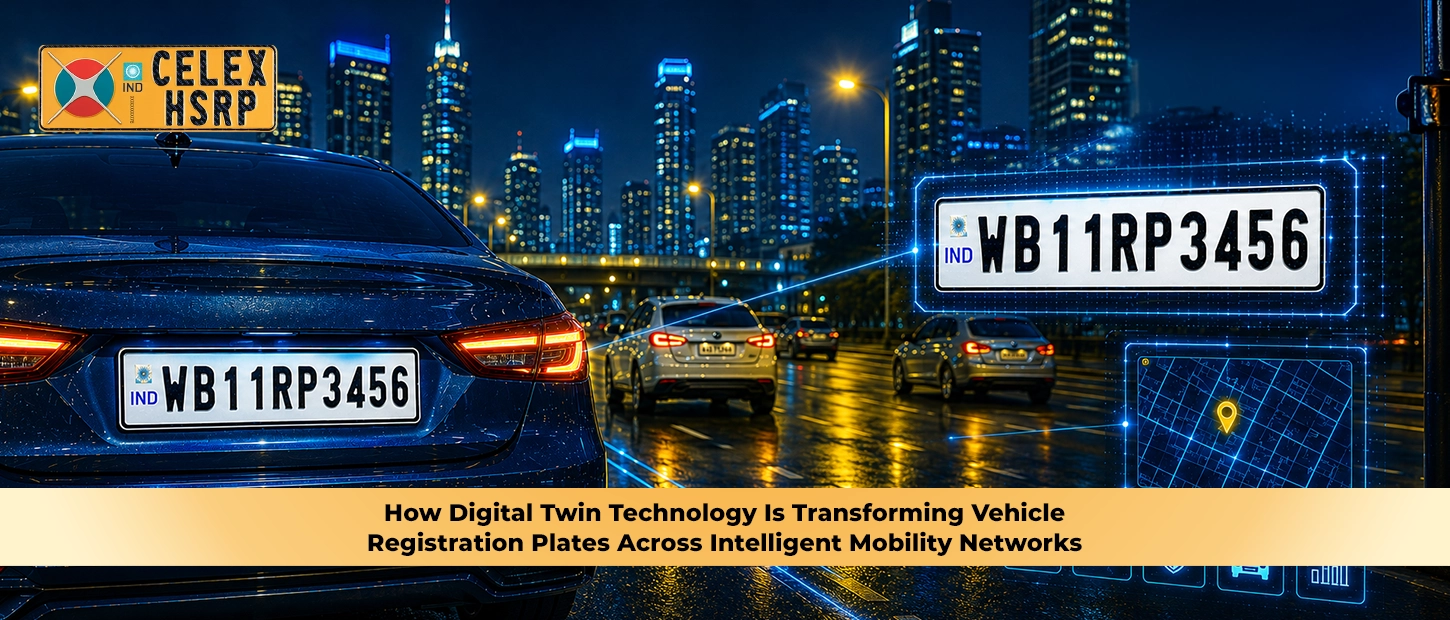
Traffic cameras have stopped being passive observers. Today, they read, analyse, process, and act on vehicle data in real time, all within milliseconds. And here is the uncomfortable truth most vehicle owners do not realise: the quality of your vehicle registration plate directly determines whether the AI system can do its job properly.
India’s roads carry over 413 million registered vehicles as of 2025-26, according to the Ministry of Road Transport and Highways. Every single one of those vehicles interacts with an expanding network of AI-powered traffic enforcement cameras daily. The margin for error? Practically zero.
A poorly manufactured plate does not just look bad. It actively breaks automated enforcement systems, creates false negatives in toll networks, and weakens law enforcement databases. The stakes have never been higher for plate engineering.
This article explores exactly how artificial intelligence is reshaping the science behind vehicle registration plates, why manufacturing precision has become a national infrastructure concern, and what the best HSRP manufacturer standards look like in 2026. Read on, because the details will genuinely surprise you.
Why AI Traffic Enforcement Has Raised the Bar for Plate Engineering
The relationship between artificial intelligence and vehicle registration plates has fundamentally changed how plates are engineered, manufactured, and evaluated. AI enforcement systems no longer treat a registration plate as a simple visual label. They treat it as a structured data source that must perform with machine-grade consistency across thousands of enforcement interactions every single day. Understanding how this shift occurred helps explain why manufacturing standards have become so critical in 2026.
How AI Traffic Enforcement Systems Process Registration Plate Data
AI traffic enforcement systems use automatic number plate recognition (ANPR) technology, which combines high-resolution imaging, computer vision algorithms, and deep learning optical character recognition (OCR) to extract vehicle identity data in real time. The camera captures the frame. An AI algorithm isolates the plate region. The OCR engine reads each character. The system then cross-references that data against national vehicle databases within fractions of a second.
Traffic management has emerged as the leading application segment, capturing approximately 43% of the global ANPR market share in 2026, driven by intensifying urban congestion and government mandates for intelligent transportation systems. That figure tells a clear story: AI enforcement is now mainstream infrastructure, not experimental technology.
The ANPR System market was valued at USD 3.17 billion in 2023 and is expected to reach USD 6.96 billion by 2032, growing at a CAGR of 9.15% over the forecast period. This explosive growth means more cameras, more enforcement touchpoints, and significantly higher demands on every plate that enters the system. So, the question worth asking is this: does your vehicle’s registration plate actually meet the technical demands of the AI systems now operating across India’s roads? The answer depends entirely on how that plate was manufactured.
The critical insight here is this: AI systems do not tolerate plate imperfections. They demand consistency, precision, and standardisation at every level of plate engineering. And that is precisely where the best HSRP manufacturers become central players in national mobility infrastructure.
The Plate Engineering Variables That AI Systems Depend On
Registration plate engineering has always involved material science, dimensional standards, and visual legibility requirements. However, the rise of AI enforcement systems has introduced an entirely new dimension: machine readability under real-world operational conditions. Several specific engineering variables now determine whether a plate functions as a reliable AI data source or becomes a liability within automated enforcement networks. Each of these variables demands precision that only advanced manufacturing systems can consistently deliver.
Reflectivity and Light Return Performance
Retroreflective sheeting technology is the single most important physical characteristic that determines whether an AI camera reads a plate successfully. Retroreflective sheeting reflects light directly back toward its source, which in enforcement scenarios means the camera captures a bright, high-contrast plate image even under poor lighting conditions. This is not a cosmetic feature. It is an engineering specification that directly controls AI recognition performance.
Studies from large-scale intelligent transportation system deployments show retroreflective plates can improve capture rates by over 30% in low-light conditions. That is not a marginal improvement. A 30% gain in nighttime capture rates means thousands of additional enforcement events processed accurately every single night across a city-wide camera network.
Standardised reflective sheeting with luminance values greater than 300 cd/lx/m² has been required by governments in 48 countries, increasing nighttime visibility by 36%. India’s HSRP specification aligns with these global standards, requiring Grade A retro-reflective sheeting that ensures visibility from a minimum of 200 meters. Plates that deviate from this specification fail AI camera reads at exactly the moments when enforcement matters most: at night, in rain, and at high vehicle speeds. This is why reflective license plate technology is a non-negotiable manufacturing benchmark, not an optional quality upgrade.
Character Geometry, Font Consistency, and OCR Accuracy
The geometric precision of characters embossed or laser-coded onto a vehicle registration plate directly determines how accurately an AI recognition engine reads the plate. This is one of the most technically demanding aspects of modern HSRP manufacturing, and one of the most commonly underestimated by non-specialists.
OCR-based recognition engines are trained on standardised character shapes, stroke widths, and spacing ratios. Plates that deviate from these parameters, even slightly, introduce recognition errors that compound rapidly at scale. Industry benchmarks show well-standardised plates push ANPR accuracy above 95% in controlled environments. Poor-quality plates can drop accuracy below 70%, triggering false negatives and missed enforcement events.
Consider what a 25% accuracy drop means across a city with 7,500 ANPR cameras. Thousands of enforcement events get missed daily. Stolen vehicles pass undetected. Toll evasion goes unrecorded. Traffic violation databases become unreliable. The public safety consequences of poor plate character geometry are significant and direct. It raises a serious question about the national standard of plate manufacturing: if non-compliant plates are entering AI enforcement networks, how much enforcement data are authorities actually missing?
Embossing consistency matters here too. Laser-etched alphanumeric codes now cover 94% of newly issued HSRPs, reducing duplication risks by 57% versus embossed formats. Precision laser coding ensures that character dimensions remain stable over the plate’s operational lifetime, unlike hand-embossed characters that wear unevenly and lose OCR clarity over time.
Plate Positioning, Dimensional Accuracy, and Camera Framing
AI camera systems operate with fixed framing parameters calibrated for standard plate dimensions. Plates that fall outside standard dimensional tolerances create framing mismatches that force recognition algorithms to compensate, reducing accuracy and processing speed simultaneously. This is a systemic problem when non-standardised plates enter large-scale enforcement networks.
Dimensional accuracy in HSRP manufacturing is therefore not just a compliance formality. It is a functional prerequisite for AI enforcement compatibility. Embossing accuracy exceeds 99.4% per batch of 100,000 units in top-tier HSRP manufacturing operations, a benchmark that ensures dimensional consistency at industrial scale. Achieving this level of accuracy consistently requires automated production infrastructure and AI-assisted inspection systems operating in real time throughout the manufacturing process.
Celex Technologies Pvt. Ltd. manufactures plates with uniform reflectivity and laser precision, maintaining dimensional accuracy across a production capacity of 4 million plates per month. Every plate leaving their facility meets the engineering specifications that modern AI-enabled traffic infrastructure requires, making them one of the most technically credible HSRP manufacturing operations in the country.
India’s ANPR Expansion and the Growing Infrastructure Demand
India’s investment in intelligent traffic enforcement infrastructure has accelerated dramatically through 2025 and into 2026. States are deploying ANPR networks at scale, smart cities are integrating AI surveillance into core transportation management systems, and the national government is rolling out multi-lane free-flow tolling infrastructure that will transform highway travel. All of this expansion creates a growing and urgent dependency on registration plates that perform reliably within AI recognition frameworks at every point in the network.
ANPR Deployment Across Indian Cities in 2026
The scale of India’s ANPR deployment in 2026 is genuinely impressive. Delhi has over 7,500 ANPR cameras installed across the city for traffic enforcement, stolen vehicle detection, and pollution monitoring. Bengaluru’s Intelligent Traffic Management System uses ANPR for automated challan generation. Hyderabad’s integrated ANPR network covers major intersections and highway corridors. Ahmedabad’s Smart City project includes ANPR at 200+ intersections.
India’s Smart Cities Mission aims to deploy over 10,000 ANPR units by 2026, with significant backing from state and municipal budgets. This expansion creates an enormous infrastructure dependency on plates that perform reliably within AI recognition frameworks. Every camera added to the network increases the volume of plate reads happening daily, and every plate read is only as accurate as the plate being read.
Now consider the quality question from the other direction. If a poorly manufactured plate enters a city with 7,500 ANPR cameras, it does not create one recognition failure. It creates a recognition failure every single time that vehicle passes a camera, across the entire lifetime of that plate. The cumulative impact on enforcement data quality is significant and completely preventable through proper manufacturing standards.
Multi-Lane Free-Flow Tolling and the Speed Requirement
The Ministry of Road Transport and Highways has announced a nationwide rollout of a multi-lane free-flow tolling system powered by AI, satellite integration, and ANPR cameras, allowing vehicles to pass through toll points without stopping. For vehicles travelling at up to 80 km/h, the AI tolling system automatically computes and deducts toll charges using FASTag data, satellite monitoring, and ANPR camera recognition.
This is a transformational development for HSRP manufacturing standards. Multi-lane free-flow tolling at 80 km/h requires plates that maintain full retroreflective performance, dimensional accuracy, and OCR-compatible character geometry at highway speeds. Plates that fail this test do not just create inconvenience. They break automated toll collection entirely, forcing manual intervention that defeats the purpose of the system completely.
As of 2026, over 40 smart cities have either deployed or tendered for ANPR-based traffic systems, with 99%+ accuracy demanded in real-world conditions across day/night, rain, and high-speed scenarios. A 99% accuracy standard is only achievable when the plates feeding the system meet equally rigorous manufacturing precision standards. This is the direct link between best HSRP manufacturer credentials and national enforcement infrastructure performance.
Anti-Counterfeit Engineering and Its Role in AI Enforcement Integrity
Physical plate security and digital enforcement integrity are not separate concerns. They are directly connected through a chain of identity that begins at the manufacturing facility and ends at the enforcement database. Counterfeit or cloned plates break this chain in ways that corrupt AI enforcement systems far beyond the immediate incident, creating cascading data integrity problems across tolling, law enforcement, and insurance networks. This is why anti-counterfeit engineering has become a core component of AI-compatible plate manufacturing, not merely a security add-on.
How Cloned Plates Corrupt AI Enforcement Systems
Cloned or duplicate registration plates create data corruption within AI enforcement databases. An ANPR camera reads a cloned plate and records an enforcement event against the legitimate vehicle owner, not the criminal. The legitimate owner receives challan notices for violations they did not commit. Enforcement databases fill with false associations. Insurance and legal systems downstream inherit corrupted identity data. The entire value of AI-powered enforcement depends on the integrity of the physical plate feeding data into it.
Tamper-proof locking mechanisms achieved 98% compliance in regulated tenders, compared to 81% in 2018. This improvement reflects the growing recognition that physical anti-counterfeit engineering is inseparable from digital enforcement integrity. The two must be engineered together, not treated as separate disciplines.
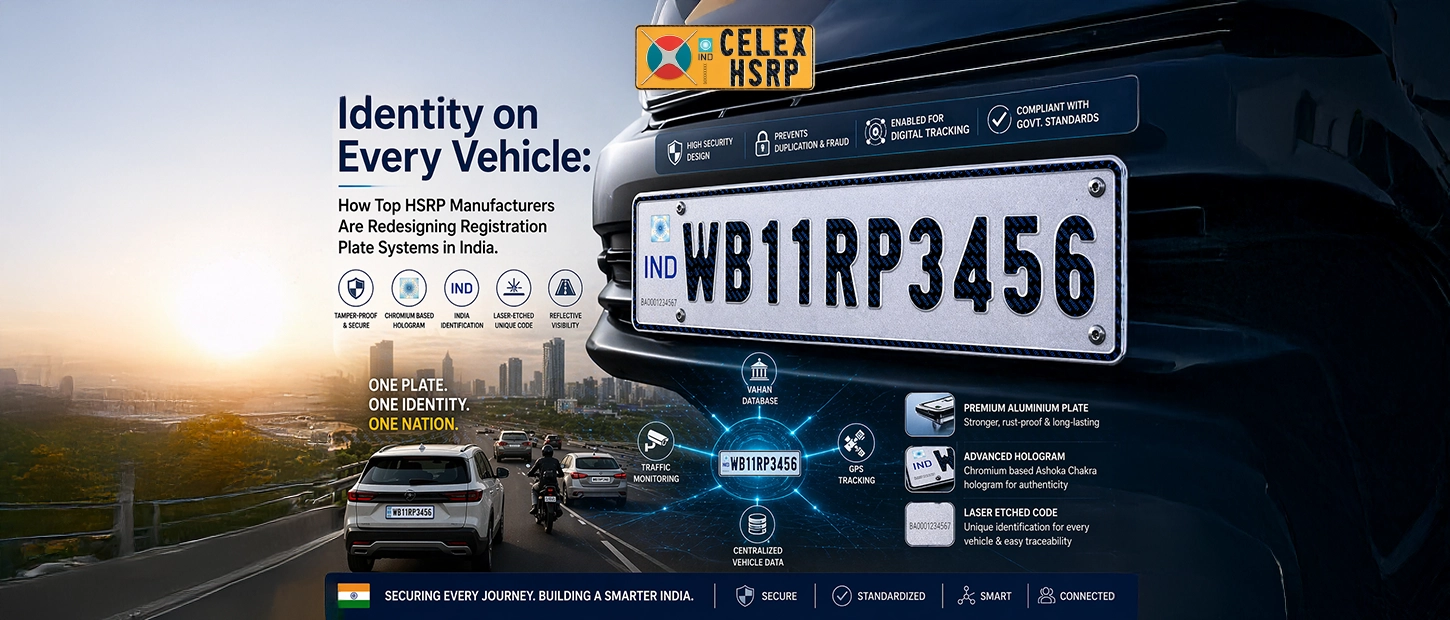
Chromium holograms embedded in HSRPs provide an immediate visual authentication layer. Laser-etched permanent identification numbers create a cryptographically unique physical fingerprint that cannot be replicated without industrial-grade equipment. Tamper-proof snap lock systems prevent silent plate substitution between vehicles, maintaining the physical integrity of the identity chain from manufacturing to road deployment. These features do not just protect individual vehicle owners. They protect the accuracy of every AI enforcement system that reads those plates.
Celex Technologies Pvt. Ltd. and Multi-Layered Security Manufacturing
Celex Technologies Pvt. Ltd. has manufactured over 6.10+ crore HSRPs incorporating these multi-layered security features. Their plates integrate chromium holograms, Grade A retroreflective sheeting, laser-coded unique identifiers, and snap-lock mechanisms into a single engineered assembly that supports both physical security and AI recognition system performance simultaneously.
The manufacturing discipline required to deliver these security features consistently at scale is substantial. Every chromium hologram must bond correctly. Every laser code must be precisely inscribed. Every snap lock must function as designed. At 40 lakh plates per month, maintaining this consistency requires AI-assisted production monitoring and automated quality inspection systems operating at every stage of the manufacturing process. This is exactly the kind of manufacturing excellence that the best HSRP manufacturers build their operational infrastructure around.
How the Best HSRP Manufacturers Support AI-Ready Plate Engineering
Not every HSRP manufacturer is equally equipped to support India’s expanding AI enforcement ecosystem. The gap between compliant manufacturers and truly AI-ready manufacturers is significant, spanning manufacturing precision, certification infrastructure, digital integration capability, and industrial-scale production consistency. Understanding what separates the best from the rest matters enormously for transport authorities, automotive OEMs, and anyone responsible for selecting a manufacturing partner within India’s evolving intelligent mobility infrastructure.
Manufacturing Precision at Industrial Scale
AI-compatible plate engineering demands production consistency that ordinary manufacturing environments cannot achieve. Reflectivity must remain uniform across every unit in a production batch. Character embossing must maintain dimensional accuracy across millions of plates manufactured monthly. Laser coding must produce identifiers with zero character deviation across the entire production run. These are not aspirational standards. They are operational requirements for plates entering AI enforcement networks.
Automated plate manufacturing lines have increased output efficiency by 41%, lowering defect rates to below 1.8% per 10,000 units. This level of defect control requires AI-assisted quality inspection systems operating continuously alongside production lines, scanning every plate for reflectivity deviation, dimensional inconsistency, and laser code accuracy before dispatch.
Celex Technologies Pvt. Ltd. operates with a manufacturing capacity of 4 million plates per month and embossing 50,000 plates per day across 267 cities. This industrial scale is matched by precision quality systems that maintain AI enforcement compatibility across every plate leaving their facility. Their 23+ years of manufacturing experience and a turnover exceeding ₹110 crore reflect the operational maturity and scale that AI-ready plate manufacturing genuinely demands.
Certification Infrastructure and Compliance Standards
Government-approved manufacturers hold certifications that validate not just their product quality but also their manufacturing processes, information security systems, and production consistency protocols. Type Approval Certificates (TAC) from accredited testing agencies confirm that a manufacturer’s entire production system meets national HSRP technical specifications. ISO 9001:2015 quality management certification validates production process consistency. ISO/IEC 27001, ISO/IEC 20000-1, and TISAX information security certification protect the digital identity data linked to every plate manufactured. These certifications are not decorative credentials. They are audited, maintained, and renewed through continuous compliance processes that shape every aspect of how a manufacturer operates.
As the best HSRP manufacturer, Celex Technologies Pvt. Ltd. holds a comprehensive certification portfolio, including at least 25 “Conformity of Production” (CoPs), Type Approval Certificates (TACs), ISO 9001:2015, ISO 14001:2015, ISO/IEC 27001, ISO/IEC 20000-1:2018, TISAX AL2, ISO/IEC 20000-1, and TISAX certification covering high availability and confidentiality standards. This multi-certification infrastructure positions them as one of India’s genuinely future-ready HSRP manufacturers, capable of supporting the national AI enforcement ecosystem with both technical precision and regulatory credibility at the same time.
The Future of Registration Plate Engineering in an AI-Dominated Mobility World
The engineering trajectory of vehicle registration plates points clearly toward greater intelligence, greater connectivity, and greater integration with AI-powered transportation networks. The plates of 2026 already represent a significant leap from the simple metal identifiers of a decade ago. The plates of the next decade will represent an even more dramatic transformation, evolving from passive physical identifiers into active digital components within connected transportation ecosystems. Manufacturers who invest in future-ready engineering capabilities today will define the standards that govern this next chapter.
RFID, Blockchain, and Edge AI Recognition
RFID integration within registration plates will enable passive vehicle identification without line-of-sight camera dependency, supporting underground parking management, border crossing automation, and fleet tracking within logistics corridors. RFID-enabled plate penetration reached 33% in 2024, compared to 19% in 2021, enhancing enforcement efficiency by 42%. This adoption rate signals that RFID-capable plate manufacturing is rapidly moving from emerging technology to operational expectation.
For more than ten years, deep learning for ANPR has been a tool in the enforcement sector’s toolbox, with neural networks continuously increasing read rates. New developments now embed vehicle analytics software directly into cameras, extracting plate, make, model, colour, classification, and speed at the edge with no back-office server required. This edge computing evolution means plates must perform even more consistently, as recognition now happens locally without the correction capabilities of centralised server processing. Every manufacturing imperfection becomes immediately visible within edge AI frameworks.
Blockchain-based verification systems may replace centralised database models with distributed ledger architectures, providing tamper-proof identity records accessible across state and national jurisdictions simultaneously. Smart vehicle identification systems incorporating AI-powered predictive analytics will depend on historically consistent plate data to build accurate vehicle movement models for urban planning and enforcement prioritisation. The plates being manufactured today are already feeding the datasets that these future systems will train on.
Celex Technologies Pvt. Ltd. and India’s Future-Ready HSRP Ecosystem
India’s roads are getting smarter by the day, and your vehicle’s registration plate needs to keep pace. Celex Technologies Pvt. Ltd. brings 23+ years of HSRP manufacturing excellence, a production capacity of 40 lakhs per month, over 6.10+ crore HSRPs supplied, and a network spanning 267 cities across India to every partnership they build.
Whether you are an automotive OEM, a transport authority, or a fleet operator, Celex’s government-approved, multi-certified HSRP manufacturing ecosystem delivers plates engineered for the age of AI enforcement. From retroreflective precision to laser-coded security and VAHAN-integrated traceability, every Celex plate is built to perform where it matters most: on India’s roads, in front of AI cameras, and within the digital governance systems shaping the future of Indian mobility.
Ready to experience AI-ready HSRP manufacturing? Partner with Celex Technologies Pvt. Ltd. today. Visit celex.co.in today and connect with India’s most trusted HSRP manufacturing partner.
Conclusion
The humble vehicle registration plate has quietly become one of the most technically demanding components in India’s national transportation infrastructure. AI-powered traffic enforcement systems have fundamentally changed what a plate needs to do, how it needs to perform, and what engineering standards it must meet to function within automated enforcement networks operating at a national scale.
Retroreflective sheeting, laser-etched identification codes, embossing precision, chromium holographic security layers, and dimensional accuracy are no longer optional quality features. They are functional prerequisites for every plate entering India’s expanding AI enforcement ecosystem. Poor plates do not just fail inspections. They break automated systems, corrupt enforcement databases, and weaken the public safety infrastructure that millions of people depend on daily.
The best HSRP manufacturers understand this responsibility completely. Celex Technologies Pvt. Ltd. has built its 23+ year manufacturing legacy on exactly this foundation: engineering precision, certification excellence, and a commitment to plates that perform reliably within whatever intelligent enforcement infrastructure India builds next. Choosing the right manufacturer is no longer just a procurement decision. It is a decision that directly affects the quality and reliability of India’s national transportation governance systems.
Frequently Asked Questions (FAQs)
1. How does plate reflectivity affect AI traffic enforcement camera accuracy?
Higher retroreflective performance improves camera capture clarity in low-light and high-speed conditions. Studies show retroreflective plates improve ANPR capture rates by over 30% compared to non-reflective alternatives.
2. Why do AI enforcement systems fail to read poor-quality vehicle registration plates?
Poor plates deviate from standardised character geometry, reflectivity, and dimensional specifications that AI OCR engines depend on. Recognition accuracy can drop from 95% to below 70% with non-compliant plates.
3. What makes Celex Technologies Pvt. Ltd. a trusted HSRP manufacturer for AI-compatible plates?
Celex holds multiple certifications, including Conformity of Production (CoPs), Type Approval Certificates (TACs), ISO 9001:2015, TISAX AL2, ISO/IEC 20000-1, and TISAX backed by 23+ years of experience, 6.10+ crore HSRPs supplied, and 40 lakh plates monthly production capacity.
4. How does India’s ANPR expansion in 2026 impact HSRP manufacturing standards?
India’s Smart Cities Mission targets over 10,000 ANPR units by 2026, requiring plates with consistent reflectivity, standardised fonts, and laser-coded identifiers to maintain system-wide enforcement accuracy.
5. What future technologies will further evolve vehicle registration plate engineering?
RFID integration, blockchain-based verification, edge AI recognition, and IoT connectivity will transform plates into active digital identity nodes within connected transportation ecosystems over the next decade.