Introduction
India has one of the most complex vehicle registration challenges in the world. With over 300 million registered vehicles and millions more added every year, keeping track of every vehicle on every road is no small task. And yet, a shocking number of vehicles still carry non-compliant, cloned, or counterfeit plates that make enforcement nearly impossible.
This is the core problem that Government-approved HSRP manufacturers exist to solve. But here’s what most people don’t fully appreciate: producing a compliant high security registration plate is only one part of the equation. Getting that plate from a factory floor onto the right vehicle, at the right time, with the right data attached to it, is an entirely different operational challenge.
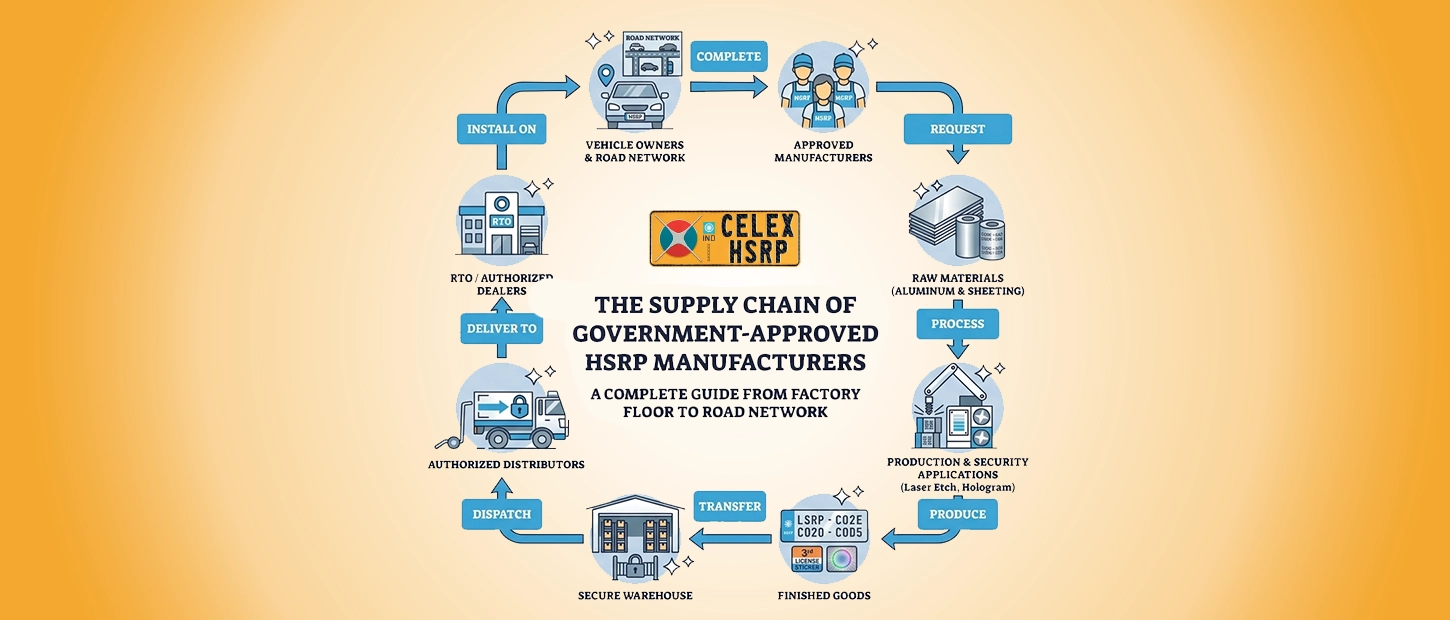
The supply chain behind HSRP manufacturing is more complex than most people realise. It involves raw material procurement, precision manufacturing, security feature integration, digital traceability, and nationwide logistics, all operating in tight coordination.
This guide breaks down that entire supply chain, step by step. By the end, you’ll understand exactly how trusted manufacturers keep India’s vehicle identification infrastructure secure, compliant, and functional at an enormous scale.
The Strategic Role of HSRP Supply Chains in Vehicle Security
Let’s start with the big picture, because context matters here. India mandated High Security Registration Plates to solve a problem that traditional plates simply couldn’t address. Ordinary plates were manufactured by unregulated vendors, varied wildly in quality and format, and offered zero resistance to cloning or tampering. Criminals could duplicate a plate in minutes using basic equipment. Stolen vehicles disappeared into the road network without a trace. Enforcement systems broke down because plate data was unreliable.
The HSRP manufacturing supply chain changed this completely. By centralising production with Government-approved HSRP manufacturers, the government created a controlled ecosystem where every plate is traceable, standardised, and embedded with security features that cannot be replicated without specialised industrial equipment.
The plates themselves incorporate chromium holograms, laser-etched vehicle identification codes, high-grade retroreflective license plate systems, and snap-lock plate mounting mechanisms that prevent removal without destroying the plate entirely. Each of these features requires specific machinery and controlled production conditions to implement correctly.
This is why the supply chain matters so much. A plate with a poorly applied hologram or an inaccurate laser code creates a security gap in the entire vehicle registration security technology framework. Every stage of the supply chain, from raw material sourcing to final installation, must operate with precision and consistency.
Manufacturers like Celex Technologies Pvt. Ltd. serve as the operational anchor of this ecosystem. They produce plates in massive volumes, maintain distribution networks spanning hundreds of cities, and integrate their production systems with national transport databases to ensure every plate is accurately linked to its vehicle. Without this kind of industrial-scale, end-to-end capability, the HSRP mandate would remain a policy goal rather than a functioning reality on India’s roads.
Raw Material Procurement: The Foundation of Secure License Plate Manufacturing
Every secure plate starts with the right raw materials. This sounds obvious, but the specifications here are far more demanding than you might expect.
Aluminium license plate manufacturing requires high-grade aluminium alloy sheets that meet specific thickness, tensile strength, and surface quality standards. The Ministry of Road Transport and Highways mandates that plates use aluminium substrates capable of withstanding corrosion, mechanical impact, and prolonged UV exposure without degrading structurally or visually. Substandard aluminium simply doesn’t qualify.
The reflective sheeting applied over this aluminium base is equally critical. This material forms the retroreflective license plate systems layer that makes plates visible at night and in low-visibility conditions. Regulatory specifications require the sheeting to carry the embedded “IND” inscription and meet minimum retroreflectivity coefficients measured in candela per lux per square meter. These aren’t arbitrary numbers. They directly affect whether automated cameras and human observers can reliably read plates under real-world conditions.
Beyond aluminium and reflective sheeting, manufacturers procure chromium foil for hologram hot-stamping, specialised adhesives for lamination, and unique locking hardware for the snap-lock plate mounting mechanism. Each of these materials must come from verified suppliers who can consistently deliver as per the specifications.
Government-approved license plate production requires manufacturers to document their raw material supply chains and submit to periodic audits. This traceability extends backwards from the finished plate to the source materials, ensuring that counterfeit or substandard inputs cannot enter the production process undetected.
Celex Technologies Pvt. Ltd. relies on carefully vetted suppliers and incoming quality inspection protocols to ensure that production begins with materials meeting every regulatory and performance requirement. A plate is only as good as what it’s made from, and this upstream discipline is what makes downstream quality possible.
Industrial Manufacturing Processes: From Aluminum Sheets to Security Plates
Raw materials arriving at the factory floor undergo a precisely sequenced manufacturing process. Each step builds on the previous one, and any deviation at any stage can compromise the finished plate’s compliance and security integrity.
The process begins when the aluminium roll arrives at the production facility. Rather than pre-cut sheets, the material is fed continuously from the roll, enabling a streamlined, high-volume production workflow with minimal material wastage and consistent surface quality throughout.
Reflective sheeting lamination follows immediately. The retroreflective film is applied directly onto the aluminium surface using automated machine-driven heat and pressure processes that bond the film uniformly, without bubbles, gaps, or misalignment. This step determines the plate’s long-term visibility performance and is completed at this early stage to ensure the surface is ready for subsequent security applications.
Hologram hot stamping comes next. Specialised foil stamping equipment operating at precisely calibrated temperatures and pressures bonds the chromium hologram onto the reflective surface at a molecular level, making it impossible to remove without visibly damaging the plate.
The laser-etched vehicle identification codes are then applied. High-powered laser engraving systems permanently mark each plate with a unique LID (Laser Identification) number generated by the production management system.
Cutting and sorting follow. The processed roll is now precision-cut to standardised plate dimensions as specified under CMVR Rule 50 vehicle plate standards, with tight tolerances maintained to ensure consistent border dimensions and character spacing. Plates are then sorted based on state-wise requirements and destinations.
Finally, the sorted plates are packed and dispatched to embossing stations across different states as per requirement. Since embossing, the raising of alphanumeric characters to the precise height mandated by regulatory standards, must reflect the specific registration details assigned by each state’s Regional Transport Office.
Automotive compliance manufacturing at this level requires significant capital investment in machinery, environmental controls, and process monitoring systems. Celex Technologies Pvt. Ltd. operates modern factories equipped with this full production capability, producing millions of plates annually while maintaining uniform compliance across every unit.
Security Feature Integration: Embedding Anti-Counterfeiting Technologies
Security features aren’t applied as an afterthought. They’re engineered into every stage of the production process, creating a layered anti-counterfeiting architecture that makes fraudulent replication practically impossible.
The chromium Ashoka Chakra hologram is the most visually distinctive security element. This tamper-proof number plate technology feature uses diffraction-based optical patterns that shift colour depending on the viewing angle. Standard printing equipment cannot reproduce these optical effects. Photocopying produces a flat, non-diffractive image that immediately gets identified as a fake to any trained enforcement officer.
The embedded “IND” inscription in the reflective sheeting adds another authentication layer. This inscription isn’t printed on the surface. It’s integrated into the sheeting material during its manufacturing process, making it impossible to add counterfeit reflective films after the fact. Inspectors checking plate authenticity can verify this inscription as part of standard plate examination protocols.
The snap-lock plate mounting system adds an extra layer of security at the installation level. These non-reusable locking bolts allow plates to be affixed to vehicles, but cannot be removed without destroying the lock itself or the plate. This permanently visible damage makes plate-swapping between vehicles immediately detectable during any inspection. Traditional screw-mounted plates offered no such protection.
Laser-etched vehicle identification codes deliver the digital security layer. Unlike surface markings that can be painted over or scratched out, laser etching physically removes material from the plate surface. Altering a laser-etched code requires grinding the plate, which leaves obvious physical damage and triggers immediate suspicion during inspection.
Automated number plate recognition compatibility is also an engineering consideration during security feature design. The character fonts, spacing, and reflectivity levels must conform to specifications that allow ANPR cameras to reliably read plates in motion, at a distance, and under varying lighting conditions.
Celex Technologies Pvt. Ltd. implements specialised equipment specifically calibrated to apply each of these security features consistently across every plate produced, ensuring that no unit exits the production line without complete security feature integration.
Digital Traceability: Linking HSRPs to National Vehicle Databases
Manufacturing a secure plate is only part of the job. Connecting that plate to accurate digital records is what makes the security features meaningful in practice.
Digital vehicle registration databases form the backbone of India’s vehicle identity management system. The VAHAN platform, maintained by the Ministry of Road Transport and Highways, stores registration details for every vehicle in the country. Each HSRP must be linked to a specific VAHAN record before it leaves the production facility.
This linkage happens through the laser-etched vehicle identification codes engraved on each plate. These codes are generated by the manufacturer’s production management system in coordination with the transport authority’s registration database. The code is simultaneously engraved on the plate and recorded against the vehicle’s VAHAN entry, creating a permanent, verifiable connection between the physical plate and the digital record.
Secure vehicle identity management systems deployed by manufacturers maintain detailed production logs that track every plate from the moment of manufacture through distribution and installation. These logs record the plate’s unique identification code, the corresponding vehicle registration number, the production date, the distribution destination, and the installation confirmation timestamp.
Law enforcement agencies access this data through VAHAN integration when they scan or query a plate in the field. A traffic officer who stops a vehicle can instantly verify whether the plate is authentic, whether it matches the registered vehicle, and whether the vehicle’s registration, insurance, and emission compliance are current. This entire verification process takes seconds.
HSRP logistics and distribution systems must maintain data accuracy throughout the distribution chain. If a plate is assigned to the wrong vehicle record or if installation data isn’t updated promptly, the traceability system fails at the critical verification point. This is why manufacturers integrate their distribution management systems directly with VAHAN rather than relying on manual data updates.
Celex Technologies Pvt. Ltd. has built a robust digital infrastructure that maintains accurate plate-to-vehicle mapping from production through installation, supporting law enforcement agencies and transport departments with reliable, real-time vehicle identity verification capabilities.
Distribution Networks: Moving Plates from Factories to Dealerships
A plate sitting in a factory warehouse provides zero value to the compliance ecosystem. Efficient distribution is what transforms manufactured plates into functional vehicle identities across the country.
HSRP logistics and distribution systems must handle enormous volumes while maintaining the accuracy required by digital vehicle registration databases. A plate dispatched to the wrong dealership or delivered after the vehicle has already been handed over to its owner creates compliance gaps and administrative headaches for everyone involved.
The distribution architecture typically operates in tiers. Central manufacturing facilities dispatch plates in batches to regional distribution hubs located strategically across the country. These hubs then manage last-mile delivery to individual OEM outlets, dealerships and retrofit installation centres in their service areas.
Each shipment carries documentation linking specific plates to specific vehicle orders. This documentation maintains the chain of traceability from production through delivery. Dealership staff verify incoming plates against their expected orders, confirming that the right plates have arrived for the right vehicles before signing off on delivery.
OEM license plate supplier network requirements add another layer of precision to distribution scheduling. OEM partners operate on tight vehicle delivery timelines.
India’s geography makes this a significant operational challenge. Serving dealerships in metropolitan areas like Mumbai and Delhi is straightforward. Reaching dealerships in remote districts of Rajasthan, the Northeast, or the Andaman Islands requires more complex logistics planning, including partnerships with regional carriers and buffer inventory management at local hubs.
Celex Technologies Pvt. Ltd. maintains a nationwide distribution network spanning hundreds of cities and towns, enabling reliable plate delivery to both urban dealerships and remote installation points with the timing precision that OEM partners require. Also, if we speak numbers, when it comes to embossing, Celex has a vast network. Specifically, the network consists of 100+ embossing stations nationwide, and the number is continuously increasing.
OEM and Dealer Integration: Installing Plates at the Point of Vehicle Delivery
The integration between Government-approved HSRP manufacturers and automotive OEMs forms a vital component of the OEM license plate supplier network in India’s vehicle compliance framework. It solves a fundamental compliance gap by moving plate installation from an afterthought to a mandatory part of the vehicle delivery process.
Here’s the practical problem that OEM integration solves. Previously, buyers received their vehicles and were expected to obtain HSRP compliance independently. Many didn’t bother, or found the process cumbersome, or simply didn’t know it was required. The result was a large population of new vehicles operating on non-compliant plates, undermining the entire mandate.
Approved High Security Registration Plate (HSRP) vendor networks operating under government mandate address this directly. Under the integrated model used in India, the dealership submits the vehicle’s registration details to the VAHAN digital platform during the purchase process. The Regional Transport Office (RTO) generates the registration number, which is communicated to the government-approved HSRP vendor through the vehicle dealership. The vendor produces the plates with the precise registration details, security features such as chromium-based holograms, retroreflective sheeting, and laser-etched identification codes unique to each vehicle. The plates are delivered to the dealership and pre-fitted before the customer receives the vehicle, as mandated for all new vehicles manufactured from April 1, 2019 onwards.
Such a workflow requires tight coordination between multiple parties. The transport authority, the high security registration plate manufacturer or vendor, the distribution logistics team, and the dealership delivery scheduling team must all share accurate, real-time information. Secure vehicle identity management systems serve as the connective tissue here, enabling automated data exchange that keeps all parties synchronised.
The compliance benefit is immediate and substantial. Every vehicle leaving the dealership under this model is fully compliant from its first moment on the road. Registration data is accurate in VAHAN. The plate is properly installed with functioning snap locks. The identification codes are correctly linked. Enforcement systems can verify the vehicle instantly.
Celex Technologies Pvt. Ltd. works with hundreds of OEM customers and dealership networks across India, demonstrating exactly how automotive compliance, manufacturing and automotive retail can integrate smoothly to produce systemwide compliance.
Compliance Monitoring and Quality Control Across the Supply Chain
Quality control in HSRP manufacturing isn’t a single checkpoint at the end of the production line. It’s a continuous process that operates at every stage, from incoming raw materials through finished plate distribution.
Government-approved license plate production requires manufacturers to document their quality management systems and submit periodic audits by regulatory bodies. These audits examine production processes, testing protocols, equipment calibration records, and output quality data. Manufacturers failing to maintain audit standards risk losing their approval status, which would halt production entirely.
On the embossing stations, AI inspection systems check number plates after embossing to ensure that the characters and details etched are accurately placed onto the plate as per the data fed.
CMVR Rule 50 vehicle plate standards specify precise performance benchmarks that finished plates must achieve. Reflectivity values must fall within defined ranges for white, yellow, and green (for EVs) plate variants. Character height, width, and spacing must meet exact dimensional tolerances. The hologram must cover its designated position without displacement. Snap lock components must meet mechanical strength requirements that ensure they cannot be removed without visible destruction.
Plates failing at any inspection checkpoint are rejected and removed from the production flow. Rejected plates are catalogued, their identification codes voided in the production management system, and the physical plates disposed of through controlled processes that prevent them from re-entering the supply chain.
Additionally, holding a Type Approval Certificate (TAC) is a sure sign of a reputable HSRP manufacturer. However, only the “best” manufacturers have TACs along with at least ten “Conformity of Production” (CoP) certifications.
As such, Celex Technologies Pvt. Ltd. upholds its reputation as the “best HSRP manufacturer” by possessing all the required certifications. Also, Celex Technologies Pvt. Ltd. uses modern factory infrastructure and comprehensive quality assurance protocols to maintain high production standards throughout the supply chain, ensuring consistent compliance with national vehicle identification regulations across every plate produced. This guarantees that their products meet the international manufacturing standards that major automobile OEMs demand from their supply chain partners, as well as domestic regulatory requirements.
Nationwide Installation and Retrofit Programs
New vehicle compliance is the easier part of the HSRP mandate. The harder part is bringing millions of existing vehicles into compliance through retrofitting programs.
India’s vehicle population includes hundreds of millions of older vehicles that were registered before the HSRP mandate took effect. These vehicles carry older, non-compliant plates that don’t meet current CMVR Rule 50 vehicle plate standards. State transport authorities have progressively implemented retrofit programs requiring these vehicle owners to replace their old plates with compliant HSRPs.
The logistical scale of retrofit programs is staggering. A single state implementing a retrofit drive can involve millions of vehicles requiring new plates within a defined compliance window. Manufacturers must plan production capacity and distribution schedules around these programs in advance, ensuring plates are available across all distribution points before the compliance deadline.
Retrofit programs typically operate through a network of authorised installation centres established specifically for the initiative. These centres may include transport department offices, authorised workshops, and dedicated HSRP fitting stations at high-traffic locations. Each centre requires a reliable supply of plates covering the full range of vehicle categories served by that location.
HSRP logistics and distribution systems for retrofit programs differ from the OEM distribution model. Old vehicle customers can order their HSRPs through two channels. The first one is the dealership network, and the second one is, quite obviously, the HSRP vendor’s online portal. These means ensure that retrofit access is available through both in-person and digital touchpoints.
The digital traceability requirement remains just as strict for retrofit plates as for new vehicle plates. Each retrofit plate must be linked to the correct vehicle record in VAHAN before or at the point of installation, maintaining the data integrity that makes the entire vehicle identification infrastructure reliable.
Celex Technologies Pvt. Ltd. supports nationwide retrofit programs through strong operational infrastructure, large-scale production capacity, and distribution networks capable of reaching installation centres across both urban and rural India within tight compliance timelines.
How Government-Approved Manufacturers Sustain India’s Secure Vehicle Identity Ecosystem
Take a step back and consider the whole picture. India’s HSRP manufacturing supply chain isn’t a simple linear process from factory to vehicle. It’s a complex, multi-stage ecosystem where manufacturing, logistics, digital systems, regulatory compliance, and automotive industry partnerships must all function together seamlessly.
Every stage of this ecosystem depends on the capability and reliability of Government-approved HSRP manufacturers. Raw material quality determines finished plate durability. Manufacturing precision determines security feature integrity. Digital system accuracy determines traceability & reliability. Distribution efficiency determines compliance rates on the ground.
Automated number plate recognition compatibility requirements tie the entire system back to road-level enforcement. ANPR cameras deployed at toll plazas, traffic intersections, and border checkpoints must be able to reliably read plates produced and installed by manufacturers. If plate quality or installation standards are inconsistent, ANPR systems generate errors, enforcement agencies lose confidence in the data, and the entire vehicle identity management framework is undermined.
The regulatory relationship between manufacturers and government authorities is also ongoing and dynamic. CMVR Rule 50 vehicle plate standards evolve as technology advances and new security threats emerge. Government-approved manufacturers must stay ahead of these changes, updating their processes, materials, and systems in advance of regulatory amendments to maintain uninterrupted compliance.
Secure vehicle identity management systems developed and maintained by manufacturers serve not just their own operational needs but the broader transport governance ecosystem. Transport departments, law enforcement agencies, insurance companies, and vehicle owners all benefit from the data accuracy and system reliability that capable manufacturers sustain.
Celex Technologies Pvt. Ltd. exemplifies this broader contribution, operating as a critical pillar of India’s vehicle registration infrastructure through large-scale manufacturing capacity, nationwide distribution reach, advanced digital traceability systems, and deep integration with both OEM automotive networks and government transport authorities.
Conclusion
India’s HSRP manufacturing supply chain is one of the most sophisticated regulatory compliance ecosystems operating in the country’s automotive sector today. It spans raw material procurement, precision industrial manufacturing, multi-layer security feature integration, digital database connectivity, nationwide logistics, and OEM partnership management, all coordinated to ensure that every plate reaching the road is authentic, traceable, and tamper-proof.
The Government-approved HSRP manufacturer isn’t just a factory producing metal plates. It’s an operational infrastructure provider that enables governments, law enforcement agencies, and automotive manufacturers to implement and maintain a reliable vehicle identification infrastructure at a national scale.
CMVR Rule 50 vehicle plate standards provide the regulatory framework. Retroreflective license plate systems, laser-etched vehicle identification codes, and snap-lock plate mounting mechanisms provide security engineering. Digital vehicle registration databases form the backbone of traceability. And certified manufacturers with the industrial scale, logistical reach, and digital capability to execute across all these dimensions make the entire system work in practice.
The stakes couldn’t be higher. A secure, accurate vehicle identification system protects citizens from fraud, supports law enforcement effectiveness, and enables data-driven transport governance. The manufacturers who power this system carry enormous responsibility, and the trusted ones deliver on it every single day.
Build Your HSRP Compliance Strategy with a Manufacturer You Can Trust
Partner with India’s Leading Government-Approved HSRP Manufacturer Today
Your vehicles need compliant plates. Your dealerships need a reliable supply chain. Your transport compliance strategy needs a manufacturing partner with the industrial capacity, distribution infrastructure, and digital systems to deliver at scale. Celex Technologies Pvt. Ltd. checks every box. As a certified Government-approved HSRP manufacturer, Celex combines large-scale production capability with nationwide distribution networks and deep OEM integration expertise to make HSRP compliance seamless for automotive manufacturers, dealerships, and transport authorities. Don’t leave vehicle identity compliance to chance. Connect with Celex Technologies Pvt. Ltd. today and build a supply chain partnership that delivers results from the factory floor to the road network.
Frequently Asked Questions (FAQs)
1. What qualifies a manufacturer as a Government-approved HSRP manufacturer in India?
A Government-approved HSRP manufacturer must obtain a Type Approval Certificate from an accredited testing agency, confirming that their plates meet all specifications under CMVR Rule 50 vehicle plate standards. The manufacturer must also demonstrate compliant production processes, quality management systems, and the ability to integrate with digital vehicle registration databases such as VAHAN. Regular audits by regulatory authorities verify ongoing compliance with these requirements throughout the manufacturer’s approval period.
2. How does the HSRP supply chain maintain traceability for each plate produced?
Each plate receives a unique laser-etched vehicle identification code during production. This code is simultaneously recorded in the manufacturer’s production management system and linked to the corresponding vehicle record in VAHAN. The HSRP manufacturing supply chain tracks the plate through distribution and installation, updating the traceability record at each stage. This creates a complete, auditable data trail that allows any plate to be verified back to its specific vehicle, production batch, and installation date.
3. How do HSRP manufacturers coordinate with automotive OEMs to ensure compliance at vehicle delivery?
OEM license plate supplier network partnerships involve real-time data exchange between the transport authority, the manufacturer’s production system, and the dealership’s delivery scheduling system. The transport authority shares vehicle registration details with the manufacturer, who produces the corresponding plates and dispatches them to the dealership before the scheduled delivery date. This integrated workflow ensures that vehicles leave dealerships already fitted with compliant, correctly linked HSRPs without requiring buyers to manage the compliance process independently.
4. What makes the snap-lock mounting system critical to HSRP security?
The snap-lock plate mounting mechanism uses non-reusable locking bolts that can be installed using standard tools but cannot be removed without destroying the lock itself. This makes plate-swapping between vehicles immediately detectable, since any attempted removal leaves permanent, visible damage to the mounting hardware. Traditional screw-mounted plates offered no such protection, allowing criminals to swap plates between vehicles in seconds. The snap-lock system closes this critical security gap permanently.
5. How do retrofit programs differ from new vehicle HSRP supply chains in terms of logistics?
New vehicle HSRP supply chains distribute plates that are vehicle-specific and pre-registered, delivered through OEM dealership networks before the customer receives the vehicle, with each plate linked to a specific vehicle record in the national database prior to delivery. Retrofit programs, by contrast, are structured around the existing vehicle owner and work through two ordering channels. First, the dealership network; second, the HSRP vendor’s online portal. Thus, making the process order-driven rather than inventory-driven, where the plate is produced against a specific order while maintaining the same vehicle-specific traceability standards as the new vehicle program.