Introduction
Vehicle fraud has evolved. Plate cloning has evolved. Traffic enforcement has evolved. Sadly, traditional number plates did not get the memo for years. Paint, screws, and stamped metal once worked fine because enforcement depended on human eyes and manual checks. That era is gone for good.
Today, India adds millions of vehicles to its roads every year. Automated challans, smart surveillance cameras, national databases, and digital policing now define how roads operate. In this environment, a duplicated or tampered plate is not a small issue. It breaks trust across the entire enforcement chain. A cloned plate lets offenders escape penalties. It misdirects investigations. It damages insurance claims. It creates identity chaos.
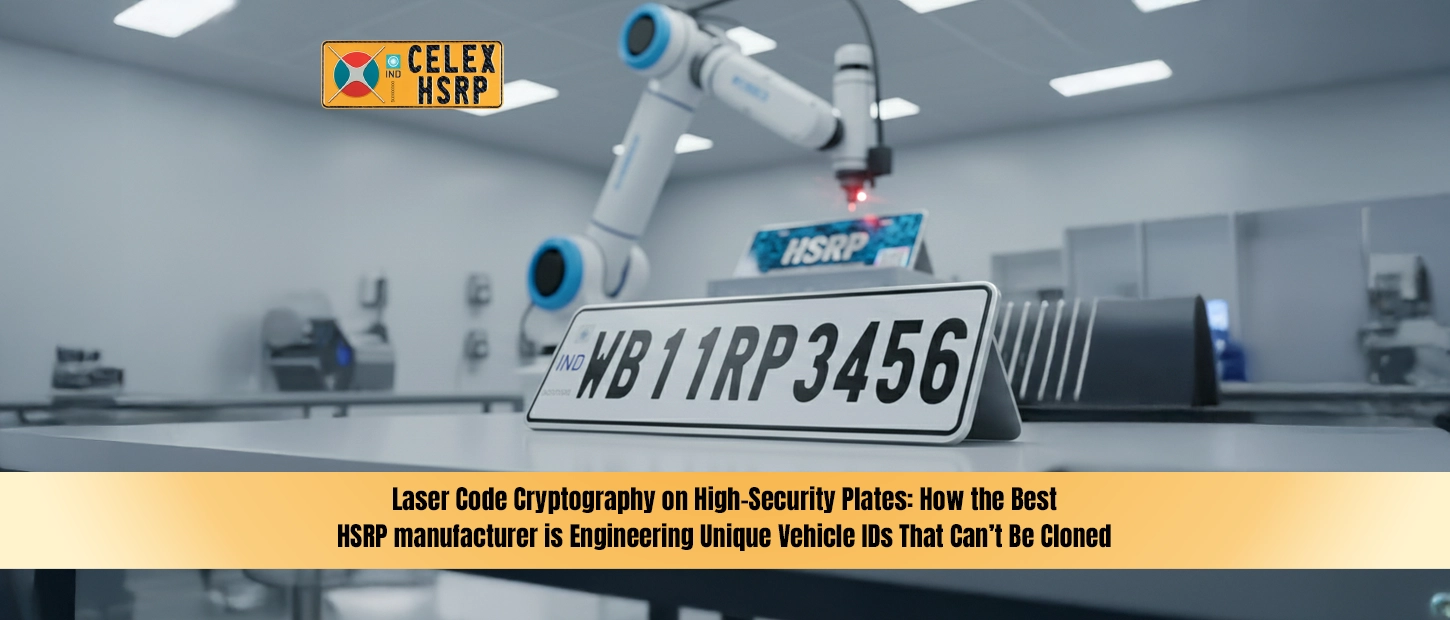
This problem demands more than stronger metal. It demands intelligence built into the plate itself. That is where High-Security Registration Plate systems powered by laser code cryptography change the game. Modern HSRPs carry a laser-etched permanent identification number that acts like a cryptographic fingerprint. This code does not just identify a vehicle visually. It authenticates it digitally. It links directly to official records. It refuses to be copied cleanly.
This article explains how the Best HSRP manufacturer engineers these unique vehicle identities at scale. It breaks down how laser engraving works, why cryptographic patterns beat simple serial numbers, and how secure linkage with national databases eliminates cloning loopholes. It also connects these systems to Celex’s HSRP quality assurance, showing how manufacturing discipline protects cryptographic integrity from raw material to final fitment.
Stick around. By the end, you will never look at a number plate the same way again.
Why Laser Cryptography Is a Game-Changer in Vehicle Security
Modern vehicle identity cannot rely on surface-level markings anymore. Criminals duplicate fonts. They copy colours. They recreate layouts. Basic plates fall apart under this pressure.
High-Security Registration Plate systems solve this by embedding identity into the material itself. Each plate carries a laser-etched permanent identification number that becomes inseparable from the plate structure. This number acts as a unique digital fingerprint. No two legitimate plates share the same code.
Unlike painted characters, laser codes do not sit on top of the plate. The process alters the retroreflective layer permanently. Any attempt to erase or modify the code destroys reflectivity and exposes tampering instantly.
This cryptographic approach blocks casual duplication and organised counterfeiting alike. Fraudsters cannot guess valid codes because each code is associated with a registered vehicle record. Guesswork fails. Replication fails.
Here, vehicle identification cryptography plays a silent but powerful role. The code structure follows controlled generation logic rather than random printing. Databases verify authenticity instantly.
As an OEM license plate manufacturer in India, Celex applies this security at a production scale. Every plate moves through controlled workflows that prevent duplication at the source. Cryptography begins before the plate ever reaches a vehicle.
Laser codes turn plates from visual labels into secure identity devices. That shift redefines vehicle security across the ecosystem.
The Science Behind Laser Etching: What Makes It Hard to Clone
Laser etching works at a microscopic level. The laser does not scratch the surface. It vaporises precise portions of the retroreflective plate encryption layer using controlled energy bursts.
This process creates micro-textures that scatter light differently from the surrounding material. Cameras detect this contrast instantly. Human hands cannot recreate it. Even advanced printing fails to match the depth, texture, and optical response.
Attempts to file or sand the code destroy the reflective film entirely. That damage becomes visible under inspection and unreadable under cameras. In short, cloning ruins usability.
Each laser pulse follows digitally programmed coordinates. That precision eliminates manual variance. The result stays consistent across millions of plates.
Celex pushes this further by exceeding baseline HSRP production standards. Tight calibration, frequent audits, and traceable batch controls ensure no duplication occurs during manufacturing.
This science-backed approach explains why laser codes act like digital signatures. They combine physical alteration with optical uniqueness. That combination defeats traditional counterfeiting methods effortlessly.
Linking Laser Codes to National Databases: The Backbone of Anti-Clone Security
A laser code means nothing without verification. The real power appears when that code links to official records.
Every legitimate HSRP laser code maps to a vehicle profile inside the National VAHAN database integration framework. This linkage creates instant validation. Enforcement systems scan the plate. Databases confirm identity. Any mismatch raises a red flag.
Fake plates collapse instantly under this model. Without a valid database entry, a plate has no identity. Traffic systems reject it. Enforcement officers flag it.
This system relies on accuracy. One wrong code breaks trust. That is why Celex invests heavily in controlled data handling and verification pipelines. Each plate undergoes digital reconciliation before dispatch.
As a RTO authorised plate supplier, Celex maintains clean data flows between manufacturing systems and registration platforms. This discipline ensures that every physical plate corresponds to a valid digital identity.
Database linkage transforms laser codes from markings into enforcement tools. Security scales automatically.
Cryptographic Patterns vs. Simple Serial Codes: Security Explained
Not all codes offer equal security. A simple serial number increases sequentially. Criminals exploit predictability easily.
Cryptographic plate codes follow controlled distribution logic. They include structure, verification checks, and uniqueness constraints. This design prevents pattern collision and brute-force duplication.
Each code validates itself against backend systems. Incorrect formats fail instantly. Missing checks expose fakes quickly.
The best HSRP manufacturer treats this as a production responsibility, not just a regulatory requirement. Celex enforces multi-layer validation to prevent accidental duplication during high-volume runs.
This approach elevates HSRP anti-cloning technology beyond compliance. It builds trust at the engineering level.
Combating Counterfeiting: Laser Codes in the War on Fake Plates
Fake number plates are not a small roadside problem anymore. They sit at the centre of serious crimes like vehicle theft, toll evasion, hit-and-run cases, fuel fraud, and organised plate cloning rackets. Criminals exploit weak plates because visual similarity fools humans, but machines do not forgive inconsistencies.
This is where HSRP anti-cloning technology becomes a frontline defence.
A genuine High-Security Registration Plate carries a laser-etched permanent identification number that exists both physically on the plate and digitally inside a registered vehicle database linkage system. The moment enforcement cameras scan a plate, the system checks whether that laser serial exists, matches the vehicle record, and aligns with registration metadata. Fake plates fail instantly because they cannot pass database validation.
Illegal manufacturers typically copy fonts and colours but skip cryptographic depth. They avoid laser engraving because replicating retroreflective plate encryption destroys material integrity and exposes tampering. Even if a fake code is etched, it lacks backend registration, which makes laser serial code verification fail in seconds.
As an anti-counterfeit HSRP manufacturer, Celex designs plates to close every known loophole. Controlled laser coding, strict HSRP production standards, and digital reconciliation prevent duplicate issuance. Every plate carries a traceable identity trail that law enforcement can trust.
This approach shifts enforcement from reactive checks to proactive detection. Fake plates stop being invisible. They become obvious anomalies inside smart vehicle identity systems.
OEM Integration: Why Manufacturers Prefer Cryptographically Verified Plates
Vehicle manufacturers cannot afford identity ambiguity. A plate that fails verification delays registration, delivery, and customer onboarding. That risk pushes OEMs to demand secure, compliant suppliers.
An OEM license plate manufacturer in India must deliver more than physical plates. It must support OEM license plate compliance, data accuracy, and seamless system integration. Cryptographically verified plates reduce disputes during registration and post-sale audits.
Laser-coded HSRPs integrate cleanly into OEM build-to-delivery pipelines. Vehicles leave the assembly line with identities that enforcement systems accept instantly. This reduces rework, avoids registration rejections, and protects brand credibility.
Celex supports OEM workflows through standardised plate formats, verified laser code issuance, and compliance-ready data handling. Its systems align physical manufacturing with digital verification layers, ensuring plates function correctly inside national registration and enforcement frameworks.
For OEMs, cryptographic plates are not a feature upgrade. They are risk control. Secure identity at birth simplifies every downstream process.
End-User Trust and Vehicle Lifecycle Management
Vehicle ownership does not end at registration. Plates stay relevant across resale, insurance, theft recovery, and compliance checks. A weak plate creates friction at every stage.
A cryptographically secure plate builds lifelong trust.
The laser-etched permanent identification number becomes a constant identity anchor. Insurers verify authenticity during claims. Buyers validate legitimacy during resale. Enforcement confirms records during routine checks. Every stakeholder sees the same verified identity.
This continuity matters because vehicle fraud often surfaces years after initial registration. Plates that rely on paint or stickers age poorly. Laser codes do not fade, peel, or detach.
Celex maintains lifecycle reliability through controlled production and Celex HSRP quality assurance systems. Each plate follows a regulated flow from blank substrate to vehicle delivery. This discipline ensures that identity integrity remains intact throughout the vehicle’s operational life.
Trust is not emotional here. It is systemic. Secure plates reduce disputes, speed up verification, and protect owners from identity-related risks.
The Future of Cryptographic Plates: RFID, Blockchain, and Beyond
Laser codes are the foundation, not the finish line. Future automotive security plates will likely combine laser engraving with RFID chips linked to backend records. This pairing enables faster roadside checks and automated tolling without sacrificing security. Blockchain-backed validation may store immutable plate histories, preventing data manipulation across ownership transfers.
AI-driven enforcement systems already analyse plate behaviour patterns. They flag anomalies like repeated location mismatches or suspicious movement trends. These systems rely on accurate physical identifiers to work effectively.
Laser-coded plates provide that accuracy. They anchor advanced technologies to a trusted physical identity.
Celex continues investing in forward-compatible manufacturing while maintaining present-day compliance. This balance ensures plates support both today’s enforcement needs and tomorrow’s smart vehicle identity systems without redesign or disruption.
The future does not replace laser cryptography. It builds on it.
Conclusion
Vehicle identity has become a security problem, a data problem, and an enforcement problem all at once. Weak plates collapse under this pressure. Cryptographically engineered HSRPs do not.
Laser code cryptography transforms number plates into permanent, verifiable identity devices. The laser-etched permanent identification number stops cloning, enables instant verification, and links vehicles reliably to official records. This integration strengthens enforcement, protects owners, and simplifies OEM workflows.
The best HSRP manufacturer does not treat compliance as a checklist. It treats identity as an engineered system. Through strict HSRP production standards, database accuracy, and tamper-proof number plate features, Celex ensures every plate carries cryptographic integrity from factory to vehicle.
In an era of automated enforcement and digital mobility, plates must do more than display numbers. They must prove identity. Laser-coded HSRPs do exactly that, quietly and reliably, every single day.
Frequently Asked Questions
1. Why are laser-etched codes safer than printed serial numbers?
Laser codes alter the plate permanently, making removal or duplication impossible without visible damage.
2. How does database linkage prevent plate cloning?
Each code must match a registered record. Fake plates fail verification instantly.
3. Do laser codes help in vehicle theft recovery?
Yes. Traceable codes allow faster identification across surveillance systems.
4. Why do OEMs prefer cryptographically verified plates?
They reduce registration errors, disputes, and compliance delays.
5. Can future technologies integrate with laser-coded HSRPs?
Yes. Laser codes form a strong base for RFID, AI, and blockchain systems.