Introduction
Picture this. A stolen vehicle cruises through a toll booth. The number plate is fake. The cameras capture it. But the data leads nowhere because the plate was never linked to any real record. Sound familiar? This is exactly the kind of loophole that cost India’s road safety and law enforcement system dearly for years.
Vehicle registration plates were once nothing more than painted boards with letters and numbers. No security. No traceability. No digital backbone. Anyone with basic tools could duplicate them, and many did. The consequences ranged from toll evasion to serious crime, and authorities had very little to fight back with.
Today, that story is changing fast. The rise of the high security registration plate system has turned a simple plate into a powerful identity instrument. This article walks you through the entire transformation, the technology, the regulations, the manufacturers driving it, and why it matters for every vehicle on Indian roads. Stay with us. This is genuinely important.
The Evolution of Vehicle Registration Plates in India: From Basic Identification to Secure Identity Systems
For decades, vehicle registration plates in India were produced without any national standard. Local workshops painted plates by hand. Fonts varied wildly. Materials ranged from cheap acrylic to thin sheet metal. Some plates faded within months. Others were duplicated within hours. The system was broken before it even had a chance to work properly.
The data speaks for itself. India had over 413 million registered vehicles as of 2025-26, according to the Ministry of Road Transport and Highways. Managing the identity of that many vehicles with unverified, non-standardised plates was practically impossible. Enforcement agencies across states struggled to cross-check vehicle records quickly, and criminals exploited every gap in the system.
The shift toward the high-security registration plate system was not a cosmetic upgrade. It was a structural correction. The government mandated standardised plates with embedded security features, centralised database linkage, and strict manufacturing compliance. This moved vehicle registration plates in India from a fragmented, locally managed affair to a centralised, nationally enforceable identity framework. Manufacturers capable of operating at this standard and scale became critical to making this shift real across millions of vehicles.
Regulatory Backbone: CMVR Rule 50 and the Mandate for Standardised Registration Plates
Rules without teeth rarely work. Fortunately, CMVR Rule 50 compliance plates come with very sharp teeth indeed.
CMVR Rule 50, under the Central Motor Vehicles Rules, 1989, lays down precise specifications for every aspect of a vehicle registration plate. It defines the material, the dimensions, the font style, the colour scheme, the reflective properties, and the mandatory security features that every plate must carry. This is not a guideline. It is a legal requirement, and non-compliance attracts penalties under the Motor Vehicles Act.
The Supreme Court of India reinforced this mandate, directing state governments to ensure HSRP implementation across both new and old vehicles. Several states have already made HSRP retrofitting compulsory for older vehicles, with fines ranging from ₹5,000 upward for non- compliance.
Top HSRP number plate manufacturers must calibrate every stage of their production process to these specifications. From the grade of aluminium used to the exact height of embossed characters, nothing is left to interpretation. Manufacturers like Celex Technologies Pvt. Ltd. build their entire production workflow around CMVR Rule 50 requirements, ensuring that every single plate leaving their facility qualifies as a legally valid, nationally standardised identity document. This level of regulatory alignment makes the difference between a plate that looks right and one that actually is right.
Engineering Security: The Technology Embedded in Modern HSRP Plates
Here is where the real engineering marvel begins. Modern high-security registration plates pack an impressive amount of technology into what looks like a simple piece of metal.
The production journey starts the moment an aluminium roll arrives at the manufacturing facility. Instead of using pre-cut sheets, the continuous roll format allows for a steady and high-volume production process that avoids the inconsistencies often found in batch manufacturing. Retroreflective license plate material is then bonded onto the aluminium surface through a fully automated machine-driven process. This ensures uniform adhesion across the entire plate surface with zero gaps and zero misalignment. The reflective properties this material provides are critical for nighttime visibility and for machine-based reading systems.
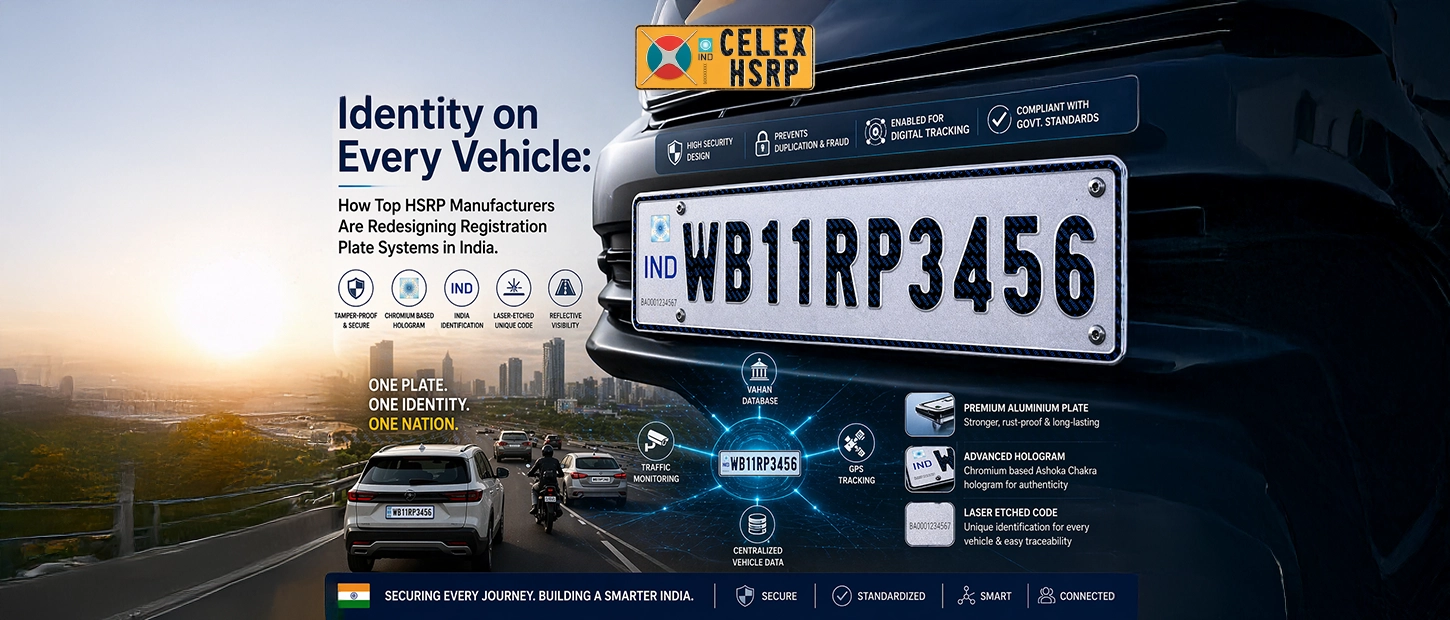
Hologram hot stamping follows next. Precisely calibrated equipment bonds a chromium-based hologram onto the reflective surface at a molecular level. This process makes tampering visually obvious because any attempt to remove or alter the hologram leaves permanent visible damage. This is an anti-counterfeit registration plate design working exactly as intended.
After that, laser-etched vehicle identification numbers are permanently marked onto each plate using high-precision laser engraving systems. These codes are unique to every plate and link directly to the corresponding vehicle record in the national database. The material is then cut to standardised dimensions as specified under CMVR Rule 50 and sorted according to state-wise destination and demand.
Plates then move to decentralised embossing stations across different states, where alphanumeric characters are raised to precise regulatory heights and hot-stamped with accuracy. At these stations, AI-powered inspection systems verify that every character on the embossed plate precisely matches the vehicle data in the system before the plate is cleared. This is HSRP manufacturing technology in India, delivering tamper-proof precision at an industrial scale. Tamper-proof number plate technology like this does not leave any room for error, and that is exactly the point.
Standardisation Across States: Creating a Unified National Vehicle Identity System
India’s vehicle registration landscape was once a chaotic mix. Every state did things differently. Inter-state vehicle tracking was a challenging task, often leading enforcement agencies to encounter obstacles when attempting to verify plates from other regions.
Embossed aluminium number plates under the HSRP framework address these issues directly. Standardised fonts, fixed dimensions, approved retroreflective license plate materials, and unique identification codes now ensure that a plate issued in Rajasthan is just as readable and verifiable in West Bengal. This uniformity is the backbone of any functional vehicle identity management system at a national level.
For large-scale manufacturers, producing millions of plates with absolute consistency across every unit is a significant operational challenge. It requires automated production lines, quality- controlled material sourcing, and a distribution network capable of reaching embossing stations in every corner of the country.
The decentralised embossing model, where plates are sorted centrally and embossed regionally, ensures that region-specific registration details are applied accurately and as close to the point of vehicle delivery as possible. The result is a secure vehicle registration ecosystem that functions consistently from Kashmir to Kanyakumari.
Digital Integration: Linking Physical Plates with VAHAN and Central Databases
A plate that cannot be verified digitally is only half a solution. The real power of modern vehicle registration plates lies in their connection to live data systems.
VAHAN database integration is what transforms a physical plate into a dynamic identity instrument. The VAHAN platform, maintained by the Ministry of Road Transport and Highways, holds records for hundreds of millions of vehicles across India. Every HSRP carries a unique laser identification code that is synchronised with the corresponding vehicle record in this database during the production process. Authorities can scan this code at any checkpoint and instantly retrieve ownership information, registration validity, insurance status, and compliance records.
This real-time verification capability is a game-changer for traffic enforcement, crime investigation, and fleet management. It eliminates the manual, time-consuming process of cross-referencing physical documents during checks. Manufacturers must ensure that every plate’s laser code is accurately synchronised with the VAHAN system before dispatching, because any mismatch breaks the entire chain of traceability. Precision in production directly enables precision in governance, and that responsibility sits squarely with the manufacturer.
OEM Integration: Redesigning Registration Plate Deployment at the Source
New vehicle delivery is a high-stakes moment in the registration process. A customer expects to drive their new vehicle home with everything in order. Any delay or gap in plate issuance creates frustration and compliance risk simultaneously.
OEM license plate suppliers in India solve this issue by integrating plate production and issuance directly into the vehicle delivery workflow. Plates are pre-assigned based on vehicle data, embossed with accurate registration details, and affixed to vehicles before the customer takes delivery. This approach eliminates the interim period where vehicles used to run on temporary or non-compliant plates.
Achieving this goal requires manufacturers to align production schedules with vehicle manufacturing timelines, manage state-specific regulatory formats simultaneously, and maintain a reliable distribution network across thousands of dealerships nationwide. Celex Technologies Pvt. Ltd. operates this kind of integrated supply chain, working directly with automobile OEMs and dealerships to ensure every new vehicle carries a CMVR Rule 50 compliance plate from day one of ownership. This is operational precision meeting regulatory compliance in real time.
Anti-Counterfeiting Ecosystem: Eliminating Fraud Through Secure Plate Design
Vehicle cloning is not a minor inconvenience. It is a serious crime that enables toll evasion, traffic violation evasion, and, in worst cases, links innocent vehicle owners to criminal activity. Traditional plates made cloning embarrassingly simple. A local workshop, some paint, and a stencil were all it took.
The anti-counterfeit registration plate design of HSRPs makes the process significantly harder. Multiple layers of security, including chromium holograms, laser-etched vehicle identification numbers, and tamper-evident snap locks, make replication with basic tools impossible. Even if someone manages to copy the visual appearance of a plate, the laser code will not match the VAHAN database integration records. Any digital verification will immediately flag the discrepancy.
Maintaining the integrity of this system requires manufacturers to uphold strict production standards. Every plate entering the market must be genuinely produced, accurately coded, properly linked to its vehicle record, and distributed through verified channels. A single counterfeit plate that slips through compromises the credibility of the entire system. This is why it is strict.
Manufacturing controls and auditable production processes are non-negotiable for any top HSRP number plate manufacturer operating responsibly within this ecosystem.
Scaling Manufacturing Excellence: Meeting India’s Massive Vehicle Demand
India registered approximately 413 million new vehicles by the year 2025, as per the data from the government’s PARIVAHAN website. Each of those vehicles needed a compliant, correctly issued high-security registration plate. Add to that the massive retrofitting demand from the existing vehicle population, and the production challenge becomes enormous.
Meeting this demand without compromising quality requires high-capacity automated production lines, reliable raw material supply chains, and a multi-location distribution infrastructure that can operate at a national scale. In India, HSRP manufacturing technology needs to be fast and accurate. Making millions of plates that are slightly wrong is worse than making fewer completely right plates.
The decentralised embossing model addresses part of this challenge by moving the final, region- specific step closer to the delivery point. Central production takes care of the standardised, high- security parts, such as reflective sheeting, holograms, and laser etching. Regional embossing stations then apply the specific registration details. This division of tasks lets manufacturers increase production without losing the accuracy that CMVR Rule 50 requires.
Enabling Smart Mobility: The Role of HSRPs in Intelligent Transport Systems
Automated number plate recognition (ANPR) technology is rapidly becoming a cornerstone of smart transport infrastructure India is building across its highway network, toll plazas, and urban traffic systems. These systems use cameras and image processing software to read vehicle plates automatically, enabling real-time traffic monitoring, automated toll collection, and instant flagging of vehicles with outstanding violations.
For ANPR to work well, license plates need to be made in a specific way, be easy to read, and be made from retroreflective license plate material that works well in different lighting situations, like bright headlights, rain, and at night. High security registration plates are engineered to meet exactly these requirements. Their standardised fonts, precise embossing depth, and reflective material specifications make them highly compatible with optical recognition systems.
Every improvement in plate manufacturing accuracy directly improves the performance of these smart systems. Manufacturers producing plates that feed into ANPR infrastructure are not just supplying a vehicle component. They are contributing to a smart transport infrastructure that India depends on for future-ready traffic governance. This positions leading manufacturers as genuine enablers of the country’s digital mobility agenda.
Redesigning Identity Beyond Plates: A System Built by Top HSRP Manufacturers
Vehicle registration plates in India have crossed a significant threshold. They are no longer passive labels attached to a vehicle’s surface. They are active, data-linked identity instruments embedded within a national governance framework.
The integration of precision manufacturing, regulatory compliance, digital database synchronisation, OEM supply chain collaboration, and smart infrastructure compatibility has fundamentally redefined what a number plate does and what it means. This level of system thinking goes far beyond stamping metal. It requires manufacturers who understand the full lifecycle of a plate, from raw aluminium roll to real-time ANPR data capture.
Celex Technologies Pvt. Ltd. represents this new generation of top HSRP number plate manufacturers. By combining high-volume production with precise engineering, AI-driven quality checks, and strong connections to both original equipment manufacturer supply chains and national digital databases, Celex helps create a secure vehicle registration ecosystem that can handle India’s size and complexity. Every plate they produce carries the credibility of that system, and every vehicle that carries their plate carries a verifiable identity that the entire national framework can rely on.
Conclusion
The transformation of vehicle registration plates in India is one of the most practically significant upgrades in the country’s road governance history. What began as a simple identification exercise has evolved into a sophisticated, multi-layered vehicle identity management system that connects physical plates with live digital databases, intelligent traffic infrastructure, and nationwide enforcement tools.
CMVR Rule 50 compliance plates set the legal standard. Tamper-proof number plate technology, laser-etched vehicle identification numbers, retroreflective license plate material, and VAHAN database integration deliver the technical substance. And manufacturers like Celex Technologies Pvt. Ltd. provide the production scale, engineering precision, and supply chain reach needed to make this system function across hundreds of millions of vehicles.
Reliable, standardised, and verifiable vehicle registration plates lay the groundwork for India’s smart transport infrastructure. Every plate that leaves a compliant manufacturing facility strengthens that foundation. Every top manufacturer that maintains rigorous standards makes Indian roads safer, smarter, and better governed for everyone who uses them.
Partner with India’s Leading HSRP Manufacturer for a Compliant, Secure Vehicle Identity System
If your business depends on reliable, regulation-grade vehicle registration plates, you cannot afford to compromise on your manufacturing partner. Celex Technologies Pvt. Ltd. is a top HSRP number plate manufacturer with a huge production capacity, precision engineering, and a nationwide distribution network to meet your needs at any scale.
Whether you are an automobile OEM, a state registration authority, or a dealership network seeking seamless compliance, Celex delivers plates that meet every CMVR Rule 50 specification and integrate fully with the VAHAN database. Visit celex.co.in today and take the first step toward building a smarter, safer vehicle identity system.
Frequently Asked Questions (FAQs)
1 . What is a High Security Registration Plate, and why is it mandatory in India?
A High Security Registration Plate is a standardised vehicle number plate that incorporates multiple embedded security features, including a chromium-based hologram, a laser-etched vehicle identification number, a tamper-proof snap lock, and retroreflective license plate material. The Government of India has made HSRPs mandatory for all vehicles under CMVR Rule 50 of the Central Motor Vehicles Rules. The mandate exists to eliminate plate duplication, strengthen vehicle traceability, and support national-level enforcement. Non-compliance attracts financial penalties and can result in legal complications for vehicle owners.
2. How does the laser-etched identification number on an HSRP work?
The laser-etched vehicle identification number is a unique alphanumeric code permanently engraved onto each plate using high-precision laser engraving systems during the manufacturing process. This code is directly synchronised with the vehicle’s record in the VAHAN database during production. Authorities at checkpoints, toll plazas, or enforcement stations can scan or verify this code to instantly access the vehicle’s ownership details, registration status, and insurance information. The laser etching is permanent and cannot be altered without causing visible damage to the plate’s surface.
3. How do top HSRP manufacturers ensure quality across millions of plates?
Top HSRP number plate manufacturers use fully automated production lines that handle reflective sheeting application, hologram hot stamping, laser etching, cutting, and sorting with consistency.
precision. AI-powered inspection systems at embossing stations verify that every character on a finished plate matches the vehicle data in the system before the plate is cleared for dispatch. This combination of automation and intelligent quality control ensures that large-scale production does not come at the cost of accuracy or CMVR Rule 50 compliance.
4. What role does VAHAN database integration play in the HSRP system?
VAHAN database integration is what transforms a physical high-security registration plate from a standalone identifier into a live data instrument. During production, each plate’s unique laser identification code is linked to the vehicle record in the VAHAN platform. This linkage allows real-time verification of a vehicle’s ownership, registration validity, and compliance status at any point. It also makes it significantly easier for authorities to detect cloned or fraudulent plates because any plate whose code does not match a valid VAHAN record is immediately flagged as suspicious.
5. How do HSRPs support automated number plate recognition systems?
Automated number plate recognition (ANPR) systems rely on plates being machine-readable under a wide range of conditions. High security registration plates are engineered to support this. Their standardised fonts, precisely embossed characters, and retroreflective license plate material ensure that cameras capture clear, consistent plate images even in low light or adverse weather. The data captured by ANPR cameras can be cross-referenced with VAHAN database records in real time, enabling automated toll collection, traffic monitoring, and instant flagging of vehicles with outstanding violations. HSRPs are therefore a foundational component of smart transport infrastructure, which India is actively deploying nationwide.