Introduction
Imagine a traffic camera capturing a speeding vehicle on a highway at 3 AM. The plate is scratched, faded, and non-standard. The system fails to read it. The vehicle disappears. No challan. No record. No accountability. This is not hypothetical. This was India’s reality for years, and it cost the country dearly in road safety, law enforcement efficiency, and traffic governance.
Car registration plates were never designed to do much beyond displaying a number. But smart roads need far more than that. They need plates that cameras can read instantly, databases can trace in seconds, and enforcement systems can act on without human intervention.
That is precisely what High Security Registration Plates deliver. HSRPs are the critical link between physical vehicles and India’s growing digital transport infrastructure. This article explains how standardised, machine-readable car registration plates are powering automated traffic systems, surveillance networks, and smart mobility across the country. Read on because this directly affects how India moves.
The Transition to Intelligent Vehicle Identifiers from Static Plates
Traditional car registration plates in India were, to put it bluntly, a mess. No uniform font. No fixed material standard. No digital connection. Hand-painted plates, acrylic boards, and locally manufactured metal sheets flooded the roads for decades. Automated systems could not read them reliably. Enforcement agencies could not verify them quickly. And criminals could duplicate them with minimal effort.
The introduction of high-security number plates in India changed this fundamentally. HSRPs brought uniform fonts, standardised dimensions, approved retro reflective number plates materials, and embedded security features that made every plate both physically readable and digitally traceable. This change was not a cosmetic improvement. It was a systemic overhaul of how India identifies its vehicles.
Each HSRP now carries a unique identifier that links it directly to the national vehicle identification system in India. This means every plate on the road is no longer just a visual tag. It is a data point in a larger, interconnected governance framework. Manufacturers producing these plates at scale play a foundational role in enabling this shift because the quality and consistency of the plate directly determine the reliability of every automated system that reads it.
Understanding the Core Architecture of High Security Registration Plates
To understand why HSRPs work well for automated systems, we must examine their materials and construction.
The foundation is an aluminium substrate. Aluminium provides the rigidity, durability, and weather resistance needed for plates that must perform across India’s extreme climate variations, from the scorching heat of Rajasthan to the monsoon-drenched roads of Kerala. On top of this substrate, retroreflective number plate sheeting is bonded through an automated, machine-driven process that ensures uniform adhesion without gaps or misalignment. This retroreflective layer is critical for nighttime visibility and, more importantly, for camera-based recognition systems that depend on consistent light reflection.
A chromium-based hologram is then hot-stamped onto the reflective surface using precisely calibrated equipment that bonds the hologram at a molecular level. Any tampering with this layer produces immediate, visible damage. After that, a laser-etched vehicle code is permanently engraved onto each plate. This code is unique to every single plate and links it to the corresponding vehicle record in the national database during production. Snap-lock mechanisms are installed to prevent plate removal or reuse without causing obvious physical damage.
CELEX Technologies Pvt. Ltd. manufactures plates through this complete process, maintaining compliance with AIS standards at every stage. AI-powered inspection systems verify that every embossed character precisely matches the vehicle data before the plate clears the embossing unit. This level of precision enables these plates to perform reliably in high-speed automated traffic systems.
How HSRPs Enable Automated Number Plate Recognition (ANPR) Systems
ANPR technology in India is expanding fast. From national highways to urban intersections, cameras equipped with optical character recognition software are capturing vehicle plate data at speeds and volumes no human team could match. But here is the catch: these systems are only as accurate as the plates they read.
ANPR technology depends on plates having uniform fonts, consistent character spacing, high-contrast alphanumeric embossing, and surfaces that reflect light predictably under varying conditions. A non-standard plate with an irregular font or a faded surface will generate a recognition error. Multiply that across millions of vehicles, and the data integrity of the entire system collapses.
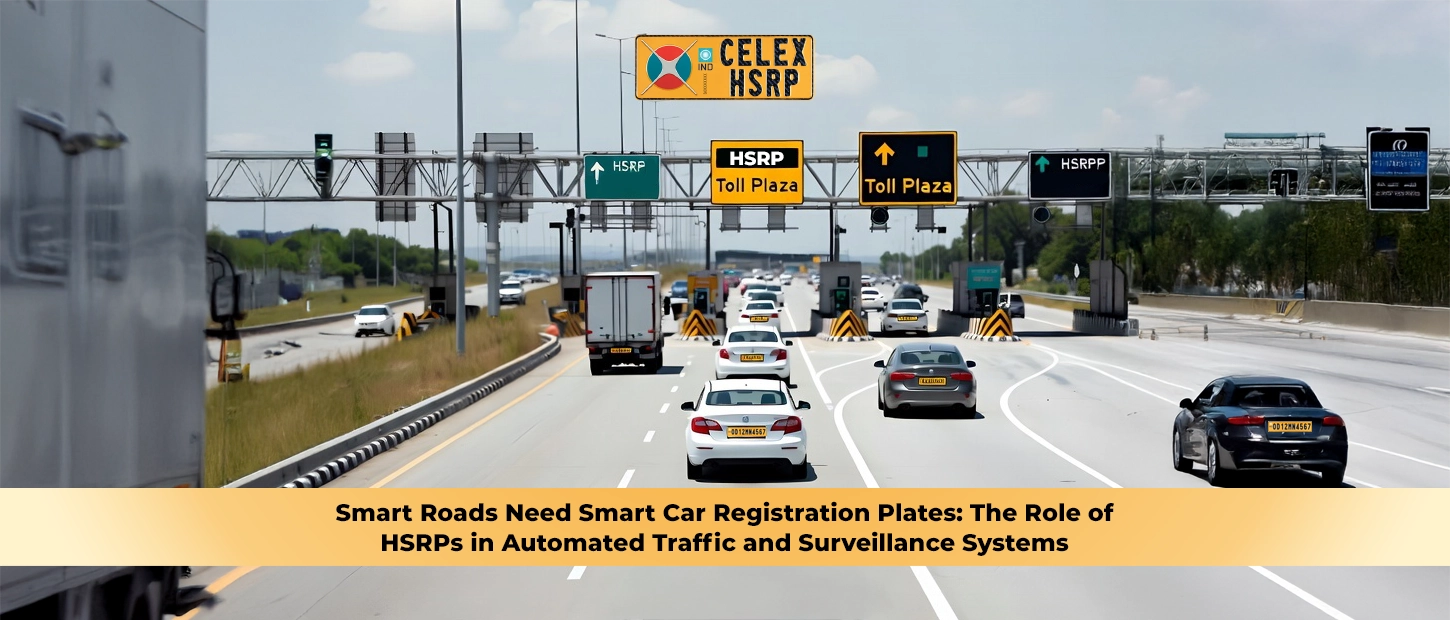
High-security number plates in India are engineered to eliminate exactly these failure points. The standardised font mandated under regulatory requirements ensures that every character is spaced, sized, and shaped identically across every plate in the country. The retroreflective number plates material ensures that cameras capture clear images even in low-light or high-speed scenarios. The result is dramatically improved recognition accuracy across toll plazas, red-light cameras, highway monitoring systems, and automated enforcement checkpoints.
CELEX manufactures plates optimised specifically for this kind of machine readability. Consistent embossing depth, uniform reflective surface quality, and precise character dimensions ensure that every plate leaving a CELEX facility performs reliably when a camera frame captures it at 120 kilometres per hour on a highway. That level of manufacturing consistency is what smart roads actually require.
Integration with VAHAN and National Transport Databases
A plate that looks right but connects to nothing is still half a solution. The real power of the modern secure vehicle registration system lies in the digital backbone that connects every physical plate to live national records.
VAHAN database integration is the mechanism that makes this connection work. The VAHAN platform holds registration records for hundreds of millions of vehicles across India. Every HSRP’s unique laser-etched vehicle code is synchronised with the corresponding VAHAN record during the issuance process. This means that any authority scanning a plate at any point in the country can instantly retrieve vehicle details in real time.
This integration transforms car registration plates from static identifiers into live data instruments within the vehicle identification system in India. For traffic enforcement agencies, it means instant verification without manual document checks. For the automated challan system, it means violations can be processed and dispatched without requiring a physical stop. For fleet operators and transport authorities, it means continuous, real-time visibility across vehicle movements.
Manufacturers must ensure that production data for each plate is accurately mapped to VAHAN records before dispatching, because any mismatch in the laser code breaks the traceability chain completely. CELEX includes checks in its production process to make sure that every plate it makes is correctly added to the national database and works well within India’s vehicle tracking infrastructure.
Strengthening Surveillance and Law Enforcement Capabilities
Law enforcement on Indian roads faces an enormous challenge. Millions of vehicles move across state borders daily. Tracking vehicles involved in crimes, identifying repeat traffic offenders, and detecting fraudulent plates all require a reliable, real-time identification system.
Tamper-proof number plates address the most basic form of vehicle identity fraud: plate swapping. Criminals used to remove plates from one vehicle and attach them to another with basic tools. The snap-lock mechanism on HSRPs prevents this. Removing the plate without visible damage is effectively impossible, making plate swapping detectable at a glance.
The combination of anti-counterfeit license plate design features, including chromium holograms, laser-etched vehicle codes, and VAHAN database integration, creates multiple independent layers of verification. A law enforcement officer can visually inspect the hologram and laser code and cross-check it against the national database simultaneously. If any layer fails to match, the plate is flagged immediately.
Vehicle surveillance technology across Indian highways increasingly depends on this multi-layer verification approach. CELEX contributes to this ecosystem by maintaining strict production controls that ensure only verified, accurately coded plates enter circulation. Every plate manufactured under these standards strengthens the enforcement system because it eliminates the variables that fraudulent or non-standard plates introduce into automated detection workflows.
The Role of HSRPs in Smart City and Intelligent Transport Systems
Smart traffic management in India is no longer a distant policy ambition. Cities like Hyderabad, Bengaluru, Pune, and Delhi are actively deploying intelligent transport systems in India to manage traffic flow, monitor congestion, enforce violations automatically, and feed data into urban planning systems in real time.
Every one of these systems depends on accurate, consistent vehicle identification data. Traffic signal optimisation algorithms need to know how many vehicles are at an intersection and how fast they are moving. Congestion management platforms need to track vehicle density across road networks. The automated challan system needs to link a violation captured on camera to a registered vehicle owner without ambiguity.
Car registration plates that meet HSRP standards provide the consistent, machine-readable data inputs that all of these systems require. Without standardised plates, the data quality feeding into smart city infrastructure degrades. Recognition errors accumulate. Enforcement accuracy drops. And the entire investment in intelligent transport technology underperforms its potential.
CELEX manufactures plates that meet the technical demands of these smart infrastructure environments. Consistent reflective surface quality, uniform character dimensions, and accurate laser coding ensure that every plate CELEX produces functions as a reliable data input for the intelligent transport systems in India that depend on it.
OEM Integration and the Future of Pre-Installed Smart Plates
One of the most significant developments in India’s secure vehicle registration system is the integration of HSRP issuance directly into the vehicle manufacturing and delivery process. Vehicles are now delivered with pre-installed, pre-assigned plates that carry the correct registration details from the moment the customer takes ownership.
This OEM number plate integration model eliminates one of the biggest gaps in the old system: the period between vehicle purchase and proper plate installation, during which vehicles used to operate on temporary or non-compliant plates. That gap created opportunities for errors, delays, and in some cases, deliberate misuse.
Achieving this integration requires plate manufacturers to align production schedules precisely with vehicle manufacturing timelines, manage state-specific regulatory format requirements simultaneously, and distribute correctly assigned plates to thousands of dealerships across the country without delays. This is a logistical challenge of significant complexity, and only manufacturers with the infrastructure to handle it can deliver consistently.
CELEX operates as a trusted OEM partner within this ecosystem. By coordinating directly with automobile manufacturers and dealerships, CELEX ensures that every new vehicle carries a compliance plate for road safety from day one of ownership. This seamless coordination between manufacturing, registration, and delivery eliminates the inconsistencies that used to characterise new vehicle plate issuance across India.
Engineering for Scale: Meeting India’s High-Volume Traffic Ecosystem
India has the third-largest automobile market globally. The country registered approximately 413 million new vehicles by the year 2025, according to data from the authenticated government PARIVAHAN website. Each of those vehicles required a standardised, secure, and digitally linked car registration plate. Add the ongoing retrofitting demand from the existing vehicle population, and the production scale required becomes genuinely staggering.
Vehicle tracking infrastructure at a national level only works if every vehicle in the system carries a compliant plate. A single weak link in the manufacturing or distribution chain creates gaps in the data network that enforcement and smart transport systems depend on. This means production scale and production quality must advance together, not at the expense of each other.
CELEX addresses these issues through high-capacity automated production lines, decentralised embossing stations located across multiple states, and a logistics network capable of reaching dealerships and registration points nationwide. The production model, where common high-security features like reflective sheeting, hologram stamping, and laser etching are done in one place while local embossing is done near where the products are delivered, helps CELEX increase output effectively without losing the uniformity needed from automated systems.
Anti-Counterfeiting Technologies and Their Impact on Traffic Automation
Anti-counterfeit license plates are not just a security feature. They are a functional requirement for automated traffic systems to operate with integrity.
ANPR technology in India and the automated challan system both depend on the assumption that the plate a camera reads is genuine and accurately linked to a registered vehicle. Fake or duplicated plates break this assumption. A cloned plate on a vehicle involved in a violation will generate a challan for the wrong owner. An undetected counterfeit plate will allow a vehicle to move through automated checkpoints without a valid record. These are not minor technical errors. They are systemic failures that undermine public trust in the entire smart transport framework.
The multi-layer security design of HSRPs directly addresses these issues. The chromium hologram is molecularly bonded and visually distinctive. The laser-etched vehicle code is permanent and database-linked. The snap-lock mechanism prevents plate transfer without visible damage. Together, these features make duplication extremely difficult and straightforward to detect. Any verification system immediately flags any plate that does not carry a laser code matching a valid VAHAN record.
By maintaining strict production controls, auditable manufacturing workflows, and precise data synchronisation with national databases, CELEX ensures that only verified and accurately produced plates enter circulation. This commitment to production integrity directly maintains the reliability of every automated system that reads a CELEX-manufactured plate on Indian roads.
The Future of Smart Plates in India’s Mobility Ecosystem
The current generation of HSRPs represents a significant leap forward. But the trajectory of smart traffic management in India points toward even more sophisticated integration in the years ahead.
Emerging discussions within India’s transport technology space include the potential incorporation of RFID chips into car registration plates, enabling real-time vehicle tracking without requiring line-of-sight camera capture. IoT integration could allow plates to communicate with roadside infrastructure directly, feeding data into traffic management systems continuously rather than only at camera capture points. As autonomous vehicle technology matures, the demand for plates that interact seamlessly with both human-operated and machine-operated transport infrastructure will only grow.
CELEX is positioned as a forward-looking manufacturer within this evolving landscape. The precision engineering capabilities, regulatory compliance expertise, and national distribution infrastructure that CELEX has built for the current HSRP system form the foundation for supporting the next generation of smart plate technology. As intelligent transport systems in India evolve, the manufacturers who combine technical sophistication with proven operational scale will play the most critical role in enabling that evolution.
Conclusion
Car registration plates have completed a remarkable transformation. From hand-painted boards that cameras could not read and criminals could easily duplicate, they have evolved into precision-engineered, digitally integrated identity instruments that power India’s automated traffic and surveillance infrastructure.
High security number plates in India deliver this capability through a combination of retro-reflective number plate materials, laser-etched vehicle codes, chromium holograms, tamper-proof snap locks, and deep VAHAN database integration. Together, these features make every plate a reliable, machine-readable, fraud-resistant data carrier that automated systems can trust.
ANPR technology in India depends on this consistency. The automated challan system depends on this accuracy. Smart traffic management in India depends on this standardisation. And none of it functions without manufacturers who can produce compliant plates at the scale India demands.
CELEX Technologies Pvt. Ltd. stands at the centre of this ecosystem. Through precision manufacturing, OEM integration, and nationwide distribution, CELEX ensures that every vehicle on Indian roads carries a plate that supports, rather than limits, the country’s smart mobility ambitions. The road ahead is intelligent. The plates need to match.
Build Smarter Roads with CELEX: India’s Trusted HSRP Manufacturing Partner
India’s smart transport future depends on plates that perform, not just plates that comply. CELEX Technologies Pvt. Ltd. manufactures high-security number plates in India that meet every regulatory standard while delivering the machine readability, digital traceability, and anti-counterfeiting reliability that intelligent traffic systems demand.
CELEX offers the production accuracy, OEM integration capability, and distribution to reach your operations requirements, regardless of whether you are a car OEM, a state transport authority, or a dealership network. Partner with CELEX today and contribute to a smarter, safer, and more efficient Indian road ecosystem. Visit celex.co.in to get started.
Frequently Asked Questions (FAQs)
1. In what ways do High Security Registration Plates enhance ANPR System accuracy?
High security number plates in India improve ANPR technology in India’s accuracy by providing uniform fonts, standardised character spacing, and retro reflective number plates surfaces that cameras can read consistently under varying light and speed conditions. Non-standard plates generate recognition errors that compromise data integrity. HSRPs eliminate these variables by ensuring every plate across the country follows identical specifications, allowing cameras to capture and process plate data reliably at high speeds across toll plazas, highways, and urban intersections.
2. What is the role of the laser-etched code on a High Security Registration Plate?
The laser-etched vehicle code is a unique alphanumeric identifier permanently engraved onto every HSRP during manufacturing. This code is synchronised with the vehicle’s record in the VAHAN database during production. Authorities and automated systems can check this code to instantly retrieve ownership details, registration status, and compliance records. Because the laser engraving is permanent and cannot be altered without visible damage, it makes every plate a tamper-evident, database-linked identity instrument.
3. How do HSRPs support the automated challan system in India?
The automated challan system relies on cameras capturing plate data at violation points and linking that data to registered vehicle owners without manual intervention. Car registration plates meeting HSRP standards provide the uniform, machine-readable surface that this process requires. The plate’s VAHAN database integration ensures that a camera-captured image translates directly into an accurate owner record, enabling challans to be generated and dispatched automatically and correctly.
4. Why is anti-counterfeiting important for automated traffic systems?
Anti-counterfeit license plates are essential because ANPR technology and the automated challan system both assume that every plate they read is genuine and accurately linked to a registered vehicle. Fake or cloned plates disrupt this assumption, generating incorrect enforcement actions and allowing vehicles to evade detection. The chromium holograms, laser-etched vehicle codes, and snap-lock mechanisms on HSRPs make duplication extremely difficult and detection straightforward, preserving the data integrity that automated systems depend on.
5. How does OEM integration improve the vehicle registration process in India?
OEM number plate integration ensures that vehicles are delivered with correctly assigned, pre-installed HSRP plates from the moment of customer delivery. This eliminates the gap that used to exist between vehicle purchase and proper plate installation, during which vehicles operated on temporary or non-compliant plates. Pre-installation ensures immediate road safety compliance, accurate VAHAN database registration from day one, and seamless entry of every new vehicle into the national vehicle tracking infrastructure without delays or data errors.